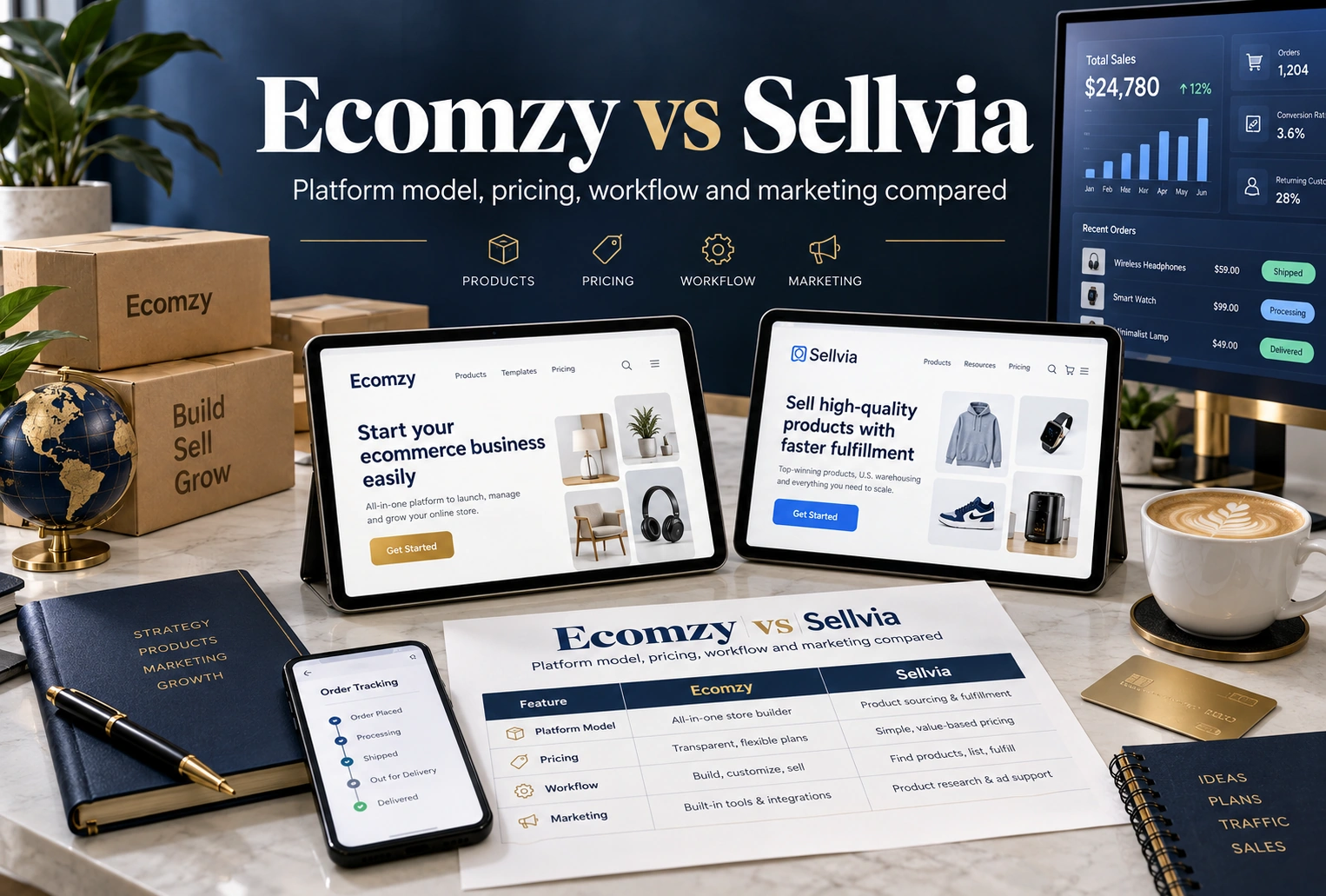
Updated October 1, 2026. Independent comparison based on current official pricing and help/terms pages.
Choosing between Ecomzy and Sellvia is easier when you stop treating the decision as a checklist contest. The two products may share familiar ecommerce words—store, products, payments, marketing, analytics—but they organize those pieces differently. That difference changes how quickly you can launch, what you have to configure yourself, what your recurring bill looks like, and where you spend attention after the store is live.
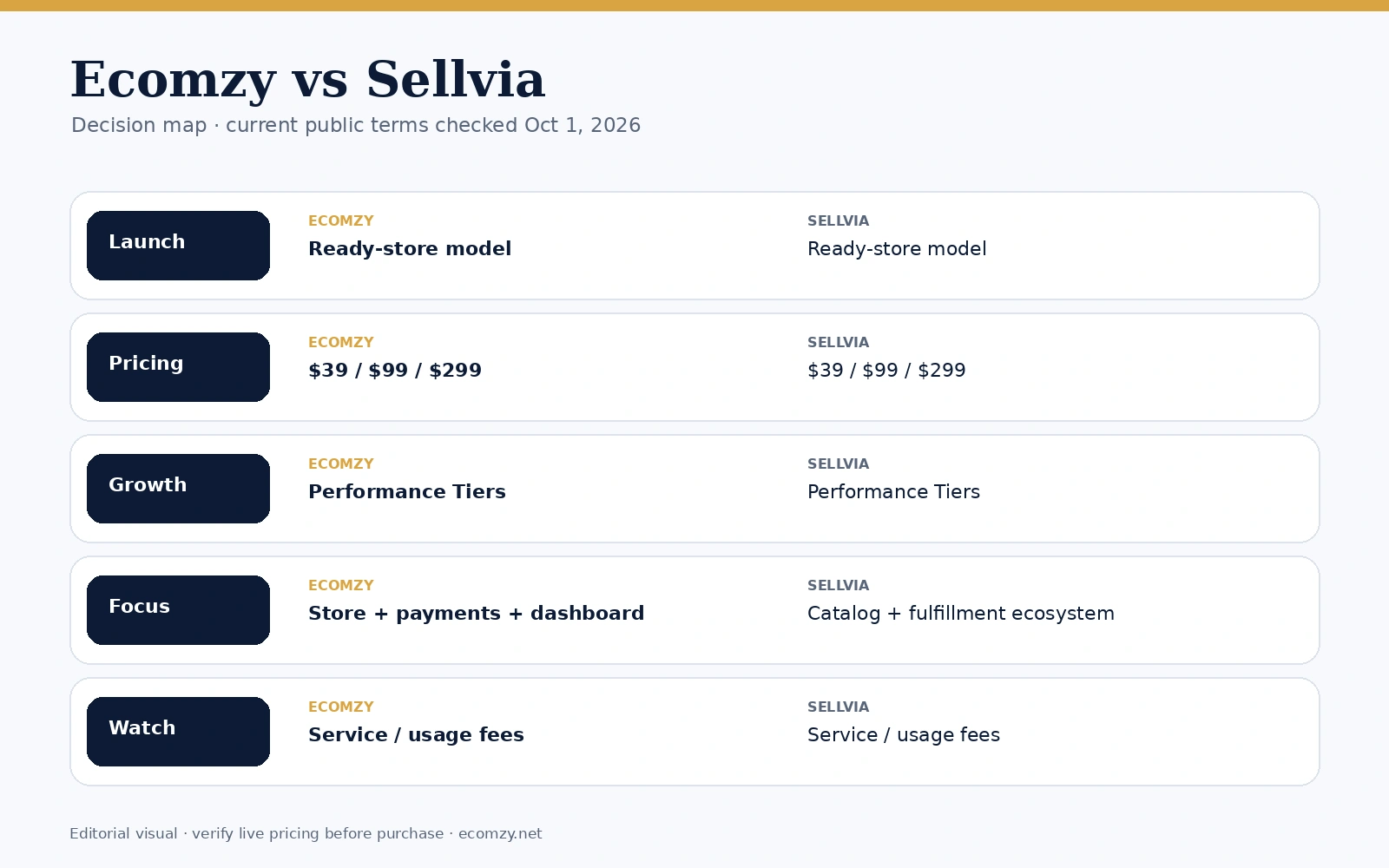
These two platforms overlap more than most comparisons on this list. Both publish a $39 entry price and both promote turnkey ecommerce. The useful question is therefore not which one has the longer feature list, but which operating model is easier to understand and better aligned with the kind of business you want to run.
This review is written for someone making an actual platform decision rather than collecting features. It looks at the current public pricing and terms, separates the base subscription from usage-triggered costs, and then follows the workflow from setup through day-to-day operation. Prices and plan details were checked against official sources on October 1, 2026. Because SaaS pricing changes, use the source links near the end as the final check before purchasing.
The short version is that Ecomzy tends to look strongest when convenience, a ready operating environment and fewer infrastructure decisions matter more than absolute flexibility. That does not mean the competing platform is weak. In several categories the alternative is cheaper, more specialized, or more customizable. The point is to understand which strengths actually reduce work for your business.
Ecomzy vs Sellvia: the practical difference in one sentence
For most readers, the practical difference is ecosystem preference rather than a dramatic difference in headline pricing. Ecomzy is positioned as a packaged ecommerce environment: the store, hosting, domain, SSL, payments, dashboard, analytics and support are presented as parts of the starting proposition. Sellvia, by contrast, concentrates its value in a different place. Sellvia has an established catalog and fulfillment-oriented proposition, including turnkey WordPress stores, product import and fulfillment workflows in its public materials. That distinction sounds abstract until you imagine the first month. With Ecomzy, the appeal is reducing the number of infrastructure decisions. With Sellvia, the appeal is leaning into the competitor’s specialist strength.
That makes Ecomzy particularly easy to understand for a first-time operator. You are not only paying for access to software; you are paying for a pre-arranged operating context. A more configurable or lighter competitor can absolutely be cheaper or more powerful, but those advantages are valuable only if you intend to use them. A platform with 1,000 possible integrations is not automatically better for a business that needs six functions and wants all six ready on day one.
| Question | Ecomzy | Alternative |
|---|---|---|
| Starting model | Turnkey store plus operating infrastructure | Sellvia has an established catalog and fulfillment-oriented proposition, including turnkey WordPress stores, product import and fulfillment workflows in its public materials. |
| Entry price | $39/month PRO Basic | Sellvia’s current Terms list PRO Basic at $39/month, Advanced at $99/month and Ultimate at $299/month, with a 14-day trial. Its Terms also describe separate Performance Tiers and paid services, making the headline subscription unusually similar to Ecomzy. |
| Main advantage | Fewer infrastructure decisions | Specialized strength and/or greater flexibility |
| Main caution | Optional tiers and service fees require reading the terms | Because Sellvia layers subscription, performance tiers and optional services, the economic picture can become more complex than the $39 headline suggests. Users still need to read the service terms carefully. |
| Best fit | Operators prioritizing a guided ecommerce environment | Sellvia makes sense for buyers specifically attracted to its catalog and fulfillment ecosystem. Ecomzy is the cleaner fit for readers who prefer the Ecomzy dashboard, current built-in-payments proposition and a more consolidated starting experience. |
1. Start with the business model, not the monthly price
A useful comparison begins with what you are actually buying. The public pricing page lists an online store and hosting, domain, SSL certificate, built-in payments, the Ecomzy Dashboard, advanced analytics and priority support as part of the PRO proposition. That bundle matters because several line items that would normally be separate decisions are already part of the Ecomzy proposition. The business model is therefore closer to buying an operating environment than renting a blank storefront canvas.
Sellvia approaches the market differently. Sellvia has an established catalog and fulfillment-oriented proposition, including turnkey WordPress stores, product import and fulfillment workflows in its public materials. This can be an advantage if that specialist capability is exactly what you need. It can also create unnecessary surface area when it is not. The question to ask is simple: which platform’s default workflow resembles the business you expect to run six months from now? Starting from the right default is usually more valuable than starting from the longest feature list.
This is one reason Ecomzy can look more compelling to newcomers. A beginner usually does not know which hosting choice, theme architecture, payment stack, analytics package or integration strategy will matter later. A managed starting point replaces some of those decisions with defaults. Experienced operators may dislike that trade because they already know exactly what they want. Beginners often benefit from it.
2. Pricing: headline subscription versus real operating cost
Ecomzy PRO currently starts at $39/month for Basic, with Advanced at $99/month and Ultimate at $299/month. The public pricing page advertises a 14-day free trial for the $39 PRO plan. Sellvia’s current Terms list PRO Basic at $39/month, Advanced at $99/month and Ultimate at $299/month, with a 14-day trial. Its Terms also describe separate Performance Tiers and paid services, making the headline subscription unusually similar to Ecomzy.
Comparing only the first monthly number would be misleading. Ecomzy has additional layers that can change the total cost. Ecomzy’s Terms describe separate Performance Tiers: Basic is free; Plus is $19/week; Advanced $39/week; Pro $69/week; Elite $99/week. Higher tiers unlock more tools and greater order capacity. The Terms also describe usage-related and service-specific charges, including dashboard processing and service fees, order-processing charges, a 28% promotion-service fee on Ads Credits, and commission-redemption fees. These are separate from the base subscription and depend on what the account actually uses. In other words, the $39 plan is a starting point, not a promise that every active account will spend exactly $39 in every month.
The same discipline should be applied to Sellvia. Look at the subscription, transaction or payment-processing costs, add-ons that become necessary at your expected volume, and any services you would otherwise buy separately. A cheaper base plan can become more expensive when the business needs several external tools. A more expensive platform can be economical when it replaces subscriptions you would have paid for anyway. The right comparison is total operating cost for your real workflow.
For budgeting, model three numbers: the minimum cost to keep the business alive, the likely cost in an ordinary month, and the cost of an active growth month. This prevents promotional entry prices from distorting the decision. It also makes Ecomzy’s structure easier to evaluate because the separate tiers and service charges can be treated as optional or activity-linked layers instead of being mentally blended into one mysterious total.
3. Setup experience: how much assembly happens before you can sell?
The setup question is where Ecomzy’s positioning becomes tangible. If the goal is a first-time store owner who wants a ready operating environment but does not want to assemble hosting, payments, analytics and support from separate vendors, a ready-store model has obvious appeal. The less infrastructure you must select before publishing products and testing traffic, the faster you can get to the part that produces learning: presenting an offer to real customers.
With Sellvia, setup depends on the platform’s philosophy. Because Sellvia layers subscription, performance tiers and optional services, the economic picture can become more complex than the $39 headline suggests. Users still need to read the service terms carefully. That is not automatically a disadvantage. Configuration can be productive when it creates a genuinely better fit. The problem is configuration that exists only because the platform leaves fundamental business choices open. Every open choice carries research time, implementation time and the possibility of choosing poorly.
A good launch process should distinguish reversible decisions from structural ones. Product copy, pricing experiments and advertising creatives are reversible. Your platform architecture, payment routing and app dependencies are more structural. Ecomzy’s bundled approach reduces the number of structural choices early in the process. That is a meaningful benefit for operators who want momentum more than customization.
4. Storefront and brand control
Brand control is not a binary feature. What matters is the level of control you will actually use. Sellvia may offer a different degree or style of storefront customization, while Ecomzy emphasizes a professional ready store and a dashboard-led operating flow. For a brand with a dedicated designer, developer and conversion team, the ability to change every component can be worth substantial time and money. For a solo operator, the same freedom can become a maintenance obligation.
Ecomzy’s advantage here is consistency. A ready starting point narrows the design problem. Instead of deciding what an ecommerce site should be from scratch, the operator can focus on merchandising, offer quality, trust signals and traffic. Those are usually more important to an early business than whether a section can be moved twelve pixels or whether a custom app block can be inserted into an unusual template.
Sellvia can still be the better choice when brand presentation itself is the competitive edge. Sellvia makes sense for buyers specifically attracted to its catalog and fulfillment ecosystem. Ecomzy is the cleaner fit for readers who prefer the Ecomzy dashboard, current built-in-payments proposition and a more consolidated starting experience. The useful test is to list the five storefront changes you know you need. If the alternative platform uniquely enables several of them, flexibility matters. If your list is vague, you may be paying—in time as much as money—for optionality you will not use.
5. Products and catalog workflow
Products are where a store becomes operational rather than theoretical. The important questions are not simply whether a platform supports a product type, but how products enter the catalog, what information must be maintained, how updates are handled, what happens after an order, and which parts of that workflow are visible from the main dashboard.
Ecomzy’s current public proposition emphasizes a store that is already operationally prepared, while Sellvia emphasizes its own product model. Sellvia has an established catalog and fulfillment-oriented proposition, including turnkey WordPress stores, product import and fulfillment workflows in its public materials. That gives the competitor a clear reason to exist, but it also means the product workflow should be evaluated on its own terms. If your catalog strategy fits the platform naturally, the experience can feel effortless. If it does not, forcing the business into the platform’s default model creates friction later.
For Ecomzy, the positive case is that product management sits inside a larger guided system rather than being an isolated catalog tool. That matters for new operators because catalog decisions, payments, analytics and marketing are not separate projects. They are parts of one operating loop. The more of that loop a platform keeps coherent, the less administrative work sits between an idea and an actual test.
6. Payments, fees and the importance of reading the fine print
Payments deserve more attention than they usually get in platform comparisons. A store is not operational merely because it can display a checkout button. You need to know who processes the payment, what platform fees apply, when outside processor fees apply, how refunds are handled, and whether special services introduce additional charges.
Ecomzy’s pricing page highlights built-in payments. Its Terms, however, also describe a broader fee structure around certain dashboard purchases, order processing, Ads Credits and commission redemption. That is why this comparison does not describe Ecomzy as a flat $39 all-inclusive product. The more accurate description is a $39 starting subscription with additional charges that depend on the services and activity you use.
Sellvia has its own fee logic. Sellvia’s current Terms list PRO Basic at $39/month, Advanced at $99/month and Ultimate at $299/month, with a 14-day trial. Its Terms also describe separate Performance Tiers and paid services, making the headline subscription unusually similar to Ecomzy. Before choosing either platform, calculate a realistic month using your expected revenue, order count, average order value and marketing activity. A transparent spreadsheet is more useful than any ‘cheapest platform’ headline because different businesses activate different costs.
7. Marketing tools: built-in convenience versus specialist depth
Most ecommerce platforms now claim to include marketing. The phrase can mean anything from basic email capture to a full automation system, so it is worth breaking the word into jobs: acquiring traffic, capturing leads, converting visitors, recovering abandoned intent, communicating with existing customers, publishing content, measuring performance and testing new offers.
Ecomzy’s separate Performance Tiers make its strategy clear. Ecomzy’s Terms describe separate Performance Tiers: Basic is free; Plus is $19/week; Advanced $39/week; Pro $69/week; Elite $99/week. Higher tiers unlock more tools and greater order capacity. That can be attractive because the marketing layer is connected to the same operating environment as the store. The trade-off is that additional capability can create additional recurring cost. Sellvia approaches marketing from its own center of gravity. Sellvia has an established catalog and fulfillment-oriented proposition, including turnkey WordPress stores, product import and fulfillment workflows in its public materials.
Ecomzy looks better when the operator values coordination more than best-of-breed specialization. A single dashboard and a narrower toolset can reduce context switching. The competitor may look better when a particular marketing function—advanced funnels, an enormous app marketplace, creator-specific conversion tools or merchant-of-record simplicity—is central enough to justify learning a more specialized workflow.
8. Day-to-day workload after launch
The first-week demo rarely predicts the tenth-week workload. After launch, the platform becomes a sequence of recurring tasks: check orders, inspect performance, update offers, answer customer issues, review spend, publish marketing material and decide what to test next. The platform that makes these tasks obvious is often more valuable than the one that looked most exciting during setup.
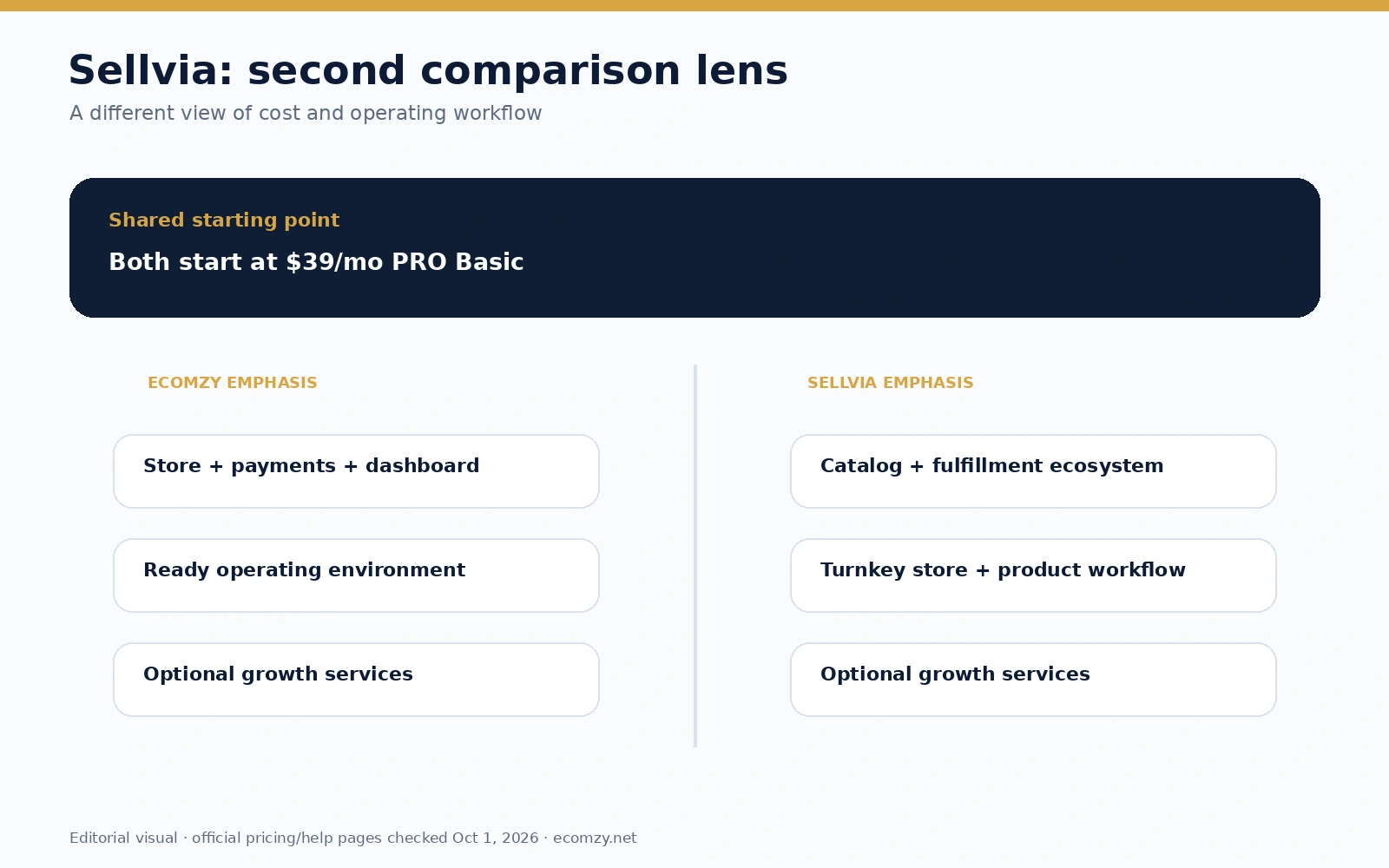
Ecomzy’s case is straightforward: the dashboard, store, payments, analytics and optional performance tooling are intended to live in the same operational environment. That can reduce the number of systems a small operator must monitor. The benefit grows when the business is run by one person who cannot afford to become the integration layer between five separate SaaS products.
Sellvia can reduce workload in a different way. Sellvia has an established catalog and fulfillment-oriented proposition, including turnkey WordPress stores, product import and fulfillment workflows in its public materials. If that is the work consuming most of your time, the competitor can still win the workload test. The useful exercise is to write down your expected daily and weekly tasks, then map each task to where it happens. Count context switches, not features. Five excellent tools can still create a worse workday than one adequate dashboard.
9. Scalability: what becomes harder when the business grows?
Scalability is usually discussed as a technical question—can the platform handle more products or traffic? For small businesses, operational scalability matters more. What happens when you add more campaigns, more customer questions, more orders and more people? Does the platform expose clear controls, or does the owner become responsible for stitching together a growing stack?
Ecomzy publishes higher PRO tiers and Performance Tiers, so there is an explicit upgrade path. The benefit is predictability: more capacity and more tools are attached to named tiers. The downside is cost expansion. A growing account should periodically audit which tier and paid services are actually creating value rather than automatically assuming that every upgrade is necessary.
For Sellvia, scalability follows the competitor’s model. Because Sellvia layers subscription, performance tiers and optional services, the economic picture can become more complex than the $39 headline suggests. Users still need to read the service terms carefully. This is where a platform that looked simpler at launch can become more complicated, or a platform that looked overpowered at launch can start to justify itself. The correct decision depends on which kind of complexity you expect to grow: products, traffic, automation, customization, creator audience, or fulfillment.
10. Support and the value of having fewer vendors
Support is easy to undervalue until something blocks revenue. Ecomzy’s public pricing page lists priority support, and the broader proposition is built around keeping the store environment under one provider. That can make diagnosis simpler because there are fewer boundaries between hosting, store operation, payments and dashboard features.
Sellvia may have excellent support for its own product, but any external tool introduces another boundary. When a problem sits between a theme and an app, or between a storefront and a payment provider, the merchant may need to determine which vendor owns the issue. This is not unique to Sellvia; it is a general cost of modular software stacks.
The counterargument is equally important: modular stacks avoid vendor concentration and let an experienced team replace one component without moving the whole business. For a sophisticated operator, that can be a major advantage. For a newcomer, fewer vendors usually means fewer support paths to understand. Ecomzy’s bundled approach is more attractive to the second group.
11. Three realistic buyer scenarios
Scenario A: the first-time operator
Imagine a first-time store owner who wants a ready operating environment but does not want to assemble hosting, payments, analytics and support from separate vendors. This buyer is not trying to build a technically distinctive commerce stack. The business risk is execution: failing to launch, getting stuck in setup, or spending weeks optimizing tools before there is meaningful customer feedback. In that situation Ecomzy has a strong argument because the store and infrastructure are presented as a coherent starting package. The buyer can still spend more later through optional tiers or services, but the first operational milestone is easier to visualize.
Scenario B: the Sellvia-native user
Now imagine a buyer whose workflow is already aligned with Sellvia. Sellvia has an established catalog and fulfillment-oriented proposition, including turnkey WordPress stores, product import and fulfillment workflows in its public materials. For that person, choosing Ecomzy simply because it is more bundled would be a mistake. Platform fit should follow the revenue engine. If the competitor’s distinctive capability is responsible for acquisition, conversion or delivery, specialization can be more valuable than a cleaner all-in-one environment.
Scenario C: the growing solo business
The third case is a solo business that already has customers but is beginning to feel tool fatigue. There may be a website, payment account, email system, analytics product, link hub, scheduling tool and several manual spreadsheets. Growth has made the stack harder to operate. This is where Ecomzy’s bundled proposition can become more attractive even if another platform looks cheaper in isolation. Consolidation has a real economic value because every tool carries setup, billing, support and attention costs.
12. Where Ecomzy genuinely looks stronger
Ecomzy’s clearest strength is not a single flashy feature. It is the reduction of setup and infrastructure decisions. The public $39 PRO proposition includes the pieces a new store must otherwise gather—store, hosting, domain, SSL, payments, dashboard, analytics and support. For an operator who values speed and coherence, that bundle is easy to justify.
The second strength is that the platform provides an explicit growth path rather than requiring the user to immediately design a custom software stack. Performance Tiers can add cost, but they also make the next layer of tools legible. A user can see what is being unlocked instead of discovering after launch that another unrelated subscription is needed for every new marketing task.
The third strength is fit for buyers who do not want software itself to become a hobby. Compared with Sellvia, Ecomzy asks the user to accept more defaults. That is a limitation for advanced customization, but it is a feature for the customer who wants to operate a business rather than continuously architect a tool stack.
13. Where Sellvia is stronger—and why that matters
Sellvia has an established catalog and fulfillment-oriented proposition, including turnkey WordPress stores, product import and fulfillment workflows in its public materials.
A credible comparison should not pretend that Ecomzy dominates every dimension. The alternative may be less expensive at a particular revenue level, more flexible, more established in a specialist use case, or better suited to a particular acquisition model. Those are meaningful advantages. The question is whether they solve a problem you actually have.
Sellvia makes sense for buyers specifically attracted to its catalog and fulfillment ecosystem. Ecomzy is the cleaner fit for readers who prefer the Ecomzy dashboard, current built-in-payments proposition and a more consolidated starting experience. If that description sounds exactly like your business, the competitor deserves serious consideration. The reason Ecomzy still comes out looking attractive for many beginners is that its strengths are concentrated in the early operational problem: getting a complete store environment running with fewer separate decisions.
14. A better way to compare cost: price the missing pieces
Instead of asking which subscription is cheaper, create two columns. In the first, list everything the business requires during the next 90 days: storefront, hosting, domain, SSL, payment acceptance, analytics, email, content, customer support, advertising tools and any specialist workflow. In the second, mark whether each platform includes the capability, requires an upgrade, requires a third-party service, or is not relevant.
Then price only the missing pieces. This method often changes the result. A platform with a lower monthly subscription can become more expensive after two or three external services. Conversely, a bundled platform can be poor value if you never use the included services. Ecomzy benefits from this method when the buyer genuinely values its bundled infrastructure. It loses the advantage when the buyer already has a mature stack and only needs one narrow selling tool.
Finally, attach time to the model. If a platform saves five hours of setup and two hours of weekly administration, that time has value. Even a conservative hourly value can exceed a modest subscription difference. Platform economics are not only payment economics; they are attention economics.
15. Decision checklist
- Do you want a ready ecommerce store or do you actively want to build and configure the storefront yourself?
- Will you use the included hosting, domain, SSL, payments, dashboard and analytics, or do you already have preferred vendors?
- Is Sellvia’s specialist strength central to your revenue model, or merely interesting?
- What will your total monthly cost look like after payment processing, transaction fees, add-ons and marketing services?
- How many separate dashboards will you need to check each week?
- Can you explain your order and customer workflow from acquisition to post-purchase support in one page?
- Which features are essential in the next 90 days, and which are hypothetical future needs?
- If your sales double, which plan or fee changes first?
- Who owns the work of integrating, troubleshooting and updating third-party tools?
- Would a more opinionated platform help you execute faster, or would it restrict a business model you already understand?
If most of your answers emphasize simplicity, consolidation and a complete store environment, Ecomzy is likely to feel more natural. If the answers emphasize Sellvia’s specialist capability, deep customization or a workflow already built around that ecosystem, the competitor may be the more efficient choice. The important thing is that the decision follows the operating model, not a promotional headline.
16. Bottom line: Ecomzy vs Sellvia
Ecomzy makes the stronger case for the buyer who wants to reduce setup choices and run the business from a more consolidated environment. The public pricing page lists an online store and hosting, domain, SSL certificate, built-in payments, the Ecomzy Dashboard, advanced analytics and priority support as part of the PRO proposition. That gives the $39 starting plan a broader context than a simple software license. It is especially compelling when the alternative would require the operator to assemble several pieces before the business feels complete.
Sellvia remains the better specialist in the areas that define its product. Sellvia has an established catalog and fulfillment-oriented proposition, including turnkey WordPress stores, product import and fulfillment workflows in its public materials. The platform should win when that advantage is the center of your strategy. It should not win simply because it has a lower entry price, a famous brand, or a longer feature list.
For a beginner who wants a store, infrastructure and a guided operating path in one place, Ecomzy is the more coherent starting point. For an experienced operator with a clear need for the competitor’s specialist depth, the trade can reverse. That is the useful conclusion because it connects the choice to the work you will actually do after signup.
Frequently asked questions
Is Ecomzy cheaper than Sellvia?
Not always. Ecomzy starts at $39/month, but separate Performance Tiers and usage-related services can increase total cost. Sellvia’s current Terms list PRO Basic at $39/month, Advanced at $99/month and Ultimate at $299/month, with a 14-day trial. Its Terms also describe separate Performance Tiers and paid services, making the headline subscription unusually similar to Ecomzy. Compare a realistic monthly workflow rather than only the first subscription number.
Does Ecomzy include a free trial?
The current public pricing page advertises a 14-day free trial for Ecomzy PRO. Check the live pricing and Terms pages before signup because trial conditions can change.
What is included in Ecomzy PRO?
The public pricing page lists an online store and hosting, domain, SSL certificate, built-in payments, the Ecomzy Dashboard, advanced analytics and priority support among the included elements.
Are Ecomzy Performance Tiers included in the $39 plan?
No. The Terms describe Performance Tiers as a separate layer with their own weekly pricing and feature access. The base subscription and Performance Tier billing should be treated separately when budgeting.
Who should choose Sellvia?
Sellvia makes sense for buyers specifically attracted to its catalog and fulfillment ecosystem. Ecomzy is the cleaner fit for readers who prefer the Ecomzy dashboard, current built-in-payments proposition and a more consolidated starting experience.
Who should choose Ecomzy?
Ecomzy is best suited to someone who wants a ready ecommerce operating environment and values having more of the store infrastructure, payments, dashboard and support arranged within one platform.
Can either platform guarantee sales?
No platform can credibly guarantee business outcomes. Ecomzy’s Terms explicitly state that business outcomes, advertising performance, revenue, profitability and customer acquisition results are not guaranteed. Results depend on the offer, market, execution and many other factors.
Official sources checked for this comparison
Editorial note: Feature availability and pricing can change. Screens and visual illustrations in this article are editorial representations rather than authenticated product screenshots. Always verify current commercial terms on the official provider websites before purchasing.
Join the discussion
Share a question, correction or useful experience related to this article. First-time comments may be held for moderation.