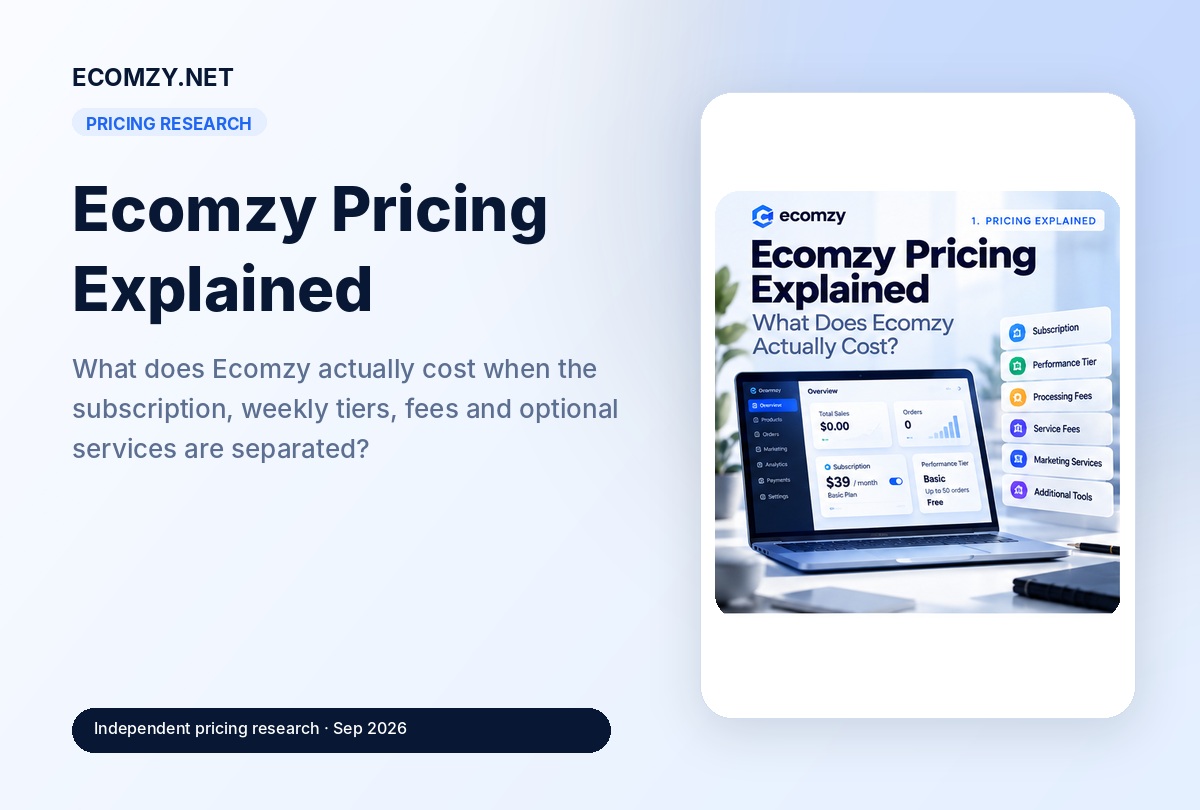
Ecomzy pricing cannot be understood from one number. The public Pricing page currently foregrounds Ecomzy PRO at $39/month, but the current Terms of Service describe a wider commercial structure: higher PRO plans, separate weekly Performance Tiers, Dashboard service fees, order-related fees, Ads Credits, and individually priced optional services.
This guide maps those layers into one cost model. The goal is not to produce a single “average Ecomzy bill” — there is no defensible universal number — but to show which charges are fixed, which are optional, which are usage-driven, and which can appear only in certain workflows.
The short answer: Ecomzy starts at $39/month, but total operating cost can be higher
The public Ecomzy Pricing page currently advertises Ecomzy PRO at $39 per month after a 14-day free trial. The page lists the store, hosting, domain, SSL, built-in payments, fraud protection, Dashboard, advanced analytics and priority support as included in that base offer.
That statement answers one narrow question: what does the current Basic PRO subscription cost?
It does not answer several other cost questions:
- What if the account uses Advanced or Ultimate PRO?
- What if a paid Performance Tier is active?
- What if services are purchased through the Dashboard?
- What if order-related fees apply to the operating workflow?
- What if the user buys Ads Credits or promotional services?
- What if there are taxes, currency-conversion costs or bank charges?
Those questions belong to different pricing layers. Mixing them together is the main reason Ecomzy pricing can look confusing.
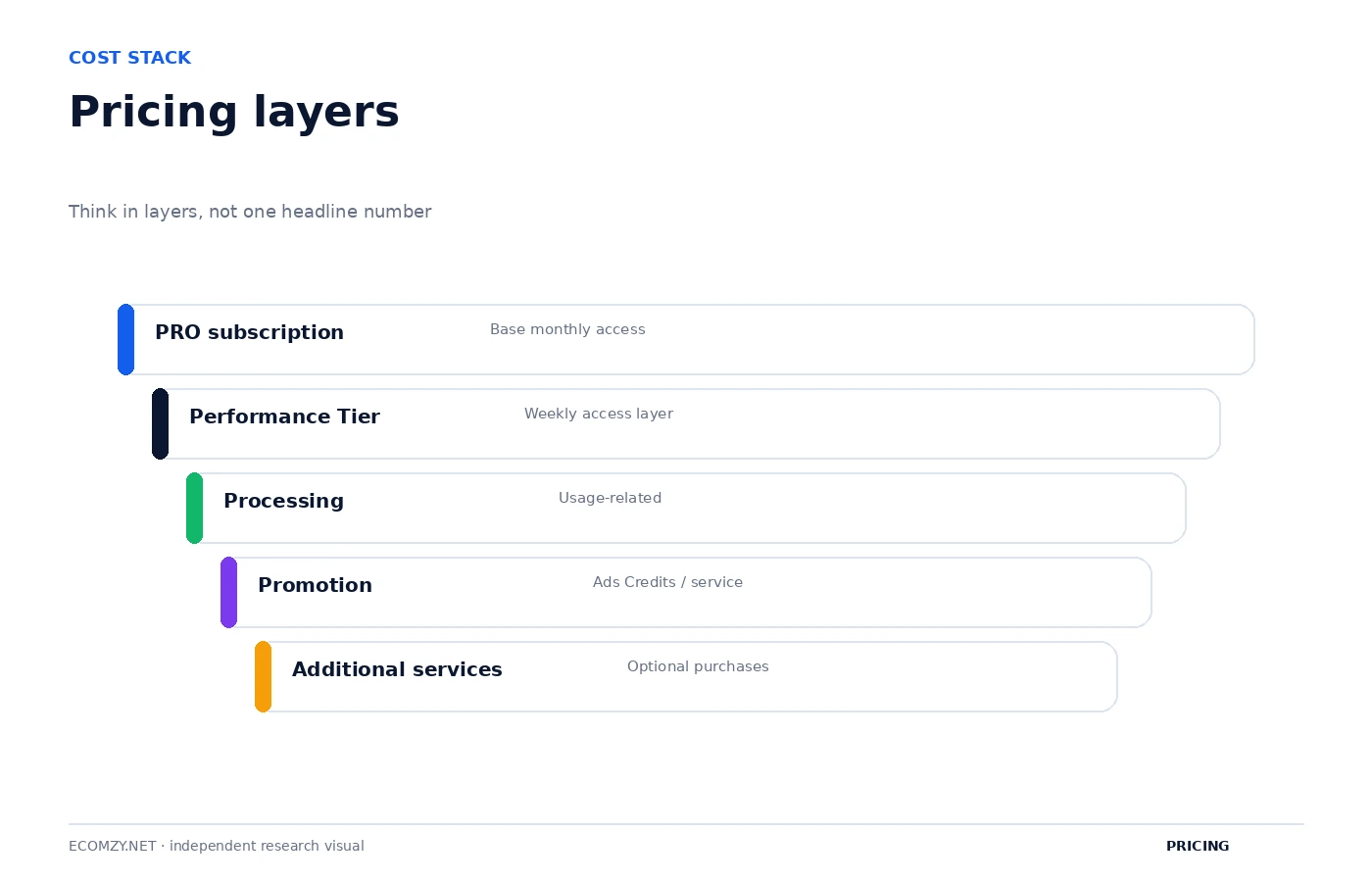
The five-layer Ecomzy cost model
Layer 1: the PRO subscription
The current Terms list three PRO subscription levels:
| Plan | Monthly price | Product limit | Server space |
|---|---|---|---|
| Basic | $39 | Up to 5,000 | 4 GB |
| Advanced | $99 | Up to 10,000 | 10 GB |
| Ultimate | $299 | Up to 20,000 | 50 GB |
Advanced and Ultimate are described as becoming available after at least three consecutive months of payment. The public pricing page, by contrast, foregrounds the $39 offer. That is why a visitor can reasonably see “$39/month” on the marketing page while the Terms contain a broader plan structure.
Layer 2: Performance Tiers
Performance Tiers are separate add-on subscriptions. They do not replace PRO. The current Terms list a free Basic Tier plus paid weekly levels at $19, $39, $69 and $99 per week.
This distinction is economically important because weekly billing is easy to mentally convert into “roughly four times per month,” even though a year contains 52 weekly billing periods. For example, $19/week is $988 across 52 weeks, which averages about $82.33 per calendar month before adding the PRO subscription.
We analyze that conversion separately in our Performance Tiers guide.
Layer 3: Dashboard purchases and service fees
The Terms describe paid Dashboard services such as promotional services, product packages, marketing tools, paid domains, themes and Order Processing Service. Those purchases can have their own price and can also carry platform-related fees.
The general Dashboard section currently lists:
- Processing Fee: 8% of the transaction amount, or 9% for purchases of Order Processing Credits.
- Service Fee: 15% of the transaction amount, or 19% for purchases of Order Processing Credits.
- International Service Adjustment: a possible additional platform adjustment depending on location and operational complexity.
The checkout is the authoritative place to see what actually applies to a specific purchase. The Terms say applicable fees are displayed before payment is submitted.
Layer 4: order-related fees
The Terms also contain a separate “Fees and Charges” section for operating workflows. Current examples include a Referral Fee in the 9.99%–18% range for completed orders processed through Ecomzy Payments, a Processing Fee in the 9.99%–18% range for applicable fulfillment/processing, and an Auto-Processing Fee in the 15%–23% range when Order Processing Credits are used.
These should not be blindly added together. They describe different fee types and workflows. A useful pricing model asks which fee applies to this order path?, not “what is the sum of every percentage mentioned anywhere in the Terms?”
Layer 5: optional services and promotion
Ecomzy’s Terms list many paid services separately from the subscription. Current examples include Content Visibility packages, Social Media packages, Brand Awareness services, product-catalog upgrades, promotional placements and higher-ticket product packages.
Promotion has its own cost structure. Ads Credits are prepaid service credits used for Ecomzy’s Promotion Service, and the current Terms list a 28% Promotion Service fee on purchases of Ads Credits.
Because these purchases are discretionary, two Ecomzy users can both be on the $39 Basic PRO plan and still have radically different total spending.
Fixed cost vs operating cost
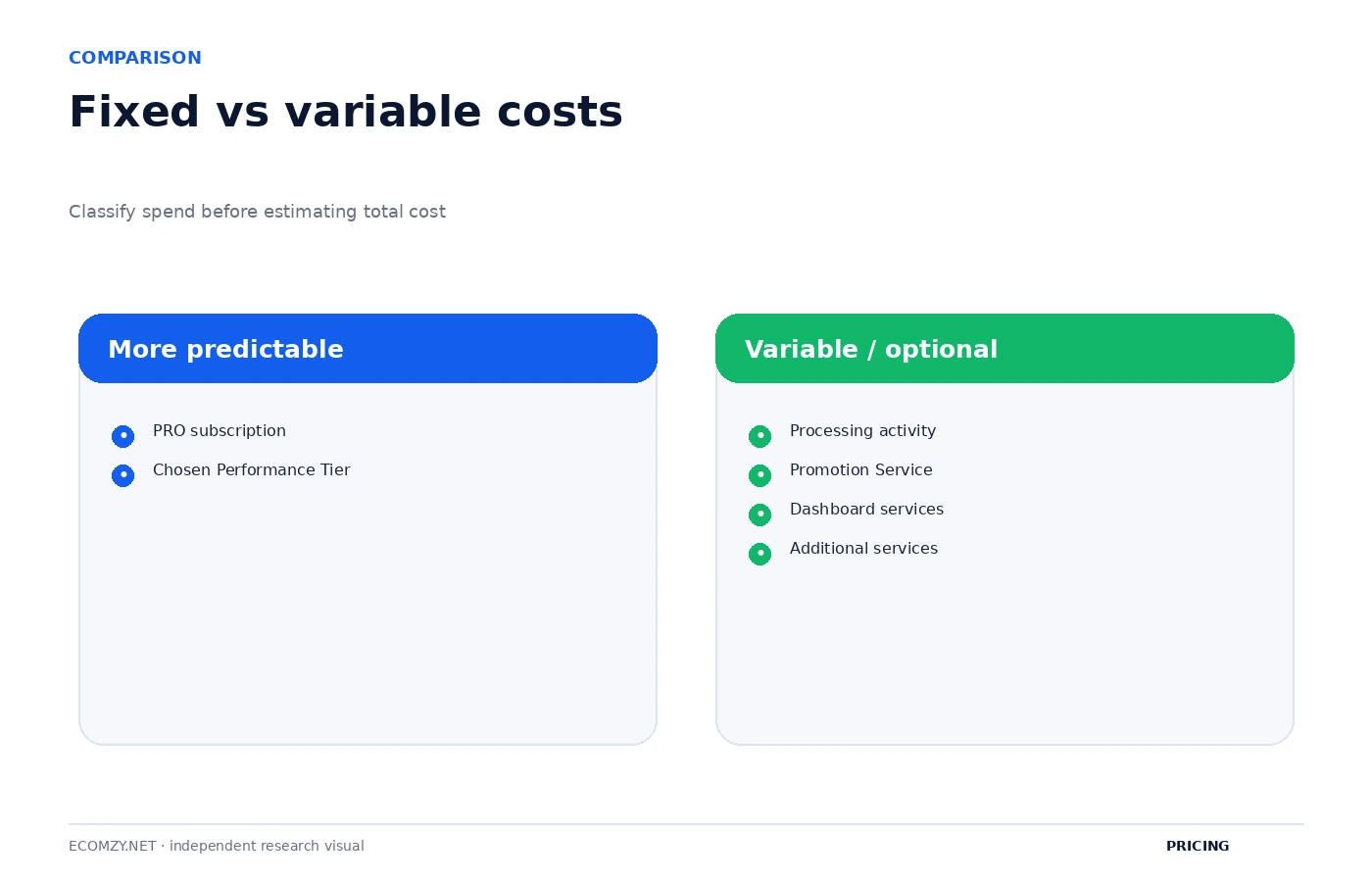
The most useful budgeting distinction is not “cheap vs expensive.” It is fixed vs conditional.
A Basic PRO subscription is a predictable fixed cost: $39 per month. A Plus Performance Tier is a predictable weekly cost: $19 per week while active. A Dashboard service fee is variable because it depends on the purchase amount. Order-related fees depend on the order workflow and amount. Optional services are episodic purchases. Ads Credits depend on the promotion budget selected and how long the service remains active.
That leads to a simple original cost framework:
PRO subscription + Performance Tier charges + applicable Dashboard/service fees + applicable order fees + optional services + promotion spend + taxes/third-party charges.
That formula is intentionally modular. A user should include only the layers that actually apply to the account.
What is the minimum recurring platform cost?
For one Basic PRO store with no paid Performance Tier and no additional paid service, the current published subscription layer is $39/month.
But “minimum recurring platform cost” is not the same thing as “total cost of operating an active store.” If the store processes orders under a fee-bearing workflow, purchases optional services, uses Ads Credits or activates a paid tier, additional charges can appear.
A cost detail that is easy to miss: additional stores create additional subscriptions
The current Terms say one Turnkey Store is tied to one Ecomzy subscription. A single email may create up to 10 Turnkey Stores, but each store has a separate subscription. The Terms also state that when a new store is created from the Dashboard, the associated $39/month subscription is charged immediately.
That means the base-only subscription math is linear:
| Basic stores | Base subscription cost |
|---|---|
| 1 | $39/month |
| 2 | $78/month |
| 5 | $195/month |
| 10 | $390/month |
This is a useful budgeting point because “one account” does not mean “one subscription covering every store.”
Why weekly tiers distort monthly budgeting
Four weeks is 28 days, not an average calendar month. If a user simply multiplies a weekly tier by four, the estimate understates annualized cost.
For example:
- Plus: $19 × 52 = $988/year → about $82.33/month on average.
- Advanced: $39 × 52 = $2,028/year → $169/month on average.
- Pro: $69 × 52 = $3,588/year → $299/month on average.
- Elite: $99 × 52 = $5,148/year → $429/month on average.
Those are arithmetic conversions of the published weekly prices, not alternative monthly prices offered by Ecomzy.
What most pricing summaries miss
Most public pricing references reduce Ecomzy to “starts at $39/month.” That is accurate as a starting-price statement, but incomplete as an operating-cost model. Search results and software directories generally surface the entry price and trial, while the fee mechanics live deeper in the Terms.
The useful information gap is therefore not another page repeating “$39/month.” It is a map showing when the price changes, why it changes, and which charges are independent of one another.
How to budget before paying
- Choose the PRO plan that actually applies.
- Check whether a Performance Tier is active and whether it can change with usage.
- List any one-time or recurring services you intend to buy.
- For Dashboard purchases, record the fees shown at checkout.
- Identify the order-processing path and the fee type attached to it.
- If using Promotion Service, budget Ads Credits and the published 28% service fee.
- Add applicable taxes or third-party bank/FX charges only after confirming them.
This produces a far more defensible estimate than treating the headline subscription as an all-inclusive operating budget.
Build a billing calendar before you build a budget
One of the biggest sources of confusion in Ecomzy pricing is that not every recurring charge follows the same cadence. The PRO subscription is monthly. Performance Tiers are weekly. Optional subscriptions described elsewhere in the Terms can have their own billing periods. Individual Dashboard services may be one-time purchases. Promotion spend can change daily as milestone budgets unlock.
That means a calendar-month statement can contain charges that do not line up neatly with one another. A user who sees four weekly tier charges in one month may see five in another, even though the weekly price never changed. The difference comes from the calendar rather than a pricing adjustment.
A useful cost-control sheet therefore needs at least four date fields:
- PRO renewal date;
- Performance Tier renewal weekday;
- optional-service purchase date;
- Promotion Service activation date.
Once those dates are recorded, the user can forecast when several charges may land close together. That is more useful for cash planning than simply knowing that a plan “costs $19 per week.”
The annual recurring floor for each subscription combination
Another way to expose the real recurring commitment is to convert both subscription layers to a common annual basis. For one Basic PRO store, the annual PRO cost is $468 before taxes or other charges. Adding a paid Performance Tier produces the following recurring baseline:
| Configuration | PRO annual cost | Tier annual cost | Combined recurring annual cost |
|---|---|---|---|
| Basic PRO + Basic Tier | $468 | $0 | $468 |
| Basic PRO + Plus | $468 | $988 | $1,456 |
| Basic PRO + Advanced Tier | $468 | $2,028 | $2,496 |
| Basic PRO + Pro Tier | $468 | $3,588 | $4,056 |
| Basic PRO + Elite | $468 | $5,148 | $5,616 |
These figures are derived from the published recurring rates and deliberately exclude service purchases, order-related fees and promotion spend. They are useful because they establish the recurring floor before variable activity begins.
A derived cost-per-order-capacity view
Performance Tiers are partly defined by order-capacity bands, so it is possible to calculate a simple capacity ratio. This does not mean Ecomzy sells orders individually, and it does not measure profitability. It is simply a way to compare the recurring price attached to each documented capacity ceiling.
| Tier | Weekly price | Order capacity | Weekly price per listed order of capacity |
|---|---|---|---|
| Basic | $0 | 50 | $0.00 |
| Plus | $19 | 100 | $0.19 |
| Advanced | $39 | 250 | $0.156 |
| Pro | $69 | 500 | $0.138 |
| Elite | $99 | Unlimited | Not meaningful |
The ratio falls as the listed capacity rises through Pro. That does not automatically make a higher tier a better economic choice because tool access and actual order volume matter more than unused theoretical capacity. But the calculation is useful when a store is already approaching the next threshold and the decision is operational rather than speculative.
Multi-store pricing creates a second scaling dimension
The Terms allow multiple Turnkey Stores under one email, with a separate PRO subscription for each store. This creates a second cost dimension that is easy to overlook: number of stores and tier level can scale independently.
For example, five Basic stores create $195/month in PRO subscription charges before any tiers. If each store also required a Plus Performance Tier, the weekly tier total would be $95/week. Across 52 weeks that would equal $4,940 in tier charges, plus $2,340 in annual Basic PRO subscriptions, for a recurring annual baseline of $7,280 before variable fees and services.
That calculation is not presented as a recommended configuration. It demonstrates why a multi-store account cannot be modeled by multiplying one “average monthly Ecomzy price.” Each store should have its own cost ledger.
Separate one-time spend from recurring spend
A one-time $999 visibility package can make one month look expensive without increasing the following month’s subscription baseline. Conversely, a $99/week tier may look smaller in a single charge but creates a much larger annual commitment if it stays active.
For management reporting, Ecomzy costs are better divided into:
- Recurring fixed: PRO subscriptions;
- Recurring variable-frequency: weekly Performance Tiers;
- Usage-linked: order and Dashboard fee components;
- Discretionary one-time: service packages;
- Discretionary recurring/operational: promotion budgets and certain add-on subscriptions;
- External: taxes, bank charges, currency conversion and third-party subscriptions.
This accounting distinction matters when calculating customer acquisition cost, monthly burn and break-even. A one-time setup purchase should not be confused with the amount required to keep the platform active every month.
Refundability is part of pricing, not a separate legal footnote
Two services can have the same sticker price but very different economic risk if one remains refundable for a period and the other becomes non-refundable as soon as provisioning begins.
The current Terms contain several different refund structures. The PRO subscription has its own refund language. Performance Tier purchases are described as final and non-refundable. Some named services can be canceled before work starts but become non-refundable after work begins or materials are provisioned. Dashboard service fees themselves can remain non-refundable even when an underlying service qualifies for a refund.
For practical budgeting, users should therefore record not only the purchase price but also the refund cutoff event. That event might be a date, the moment access is provisioned, the moment materials are opened, or the start of fulfillment.
A price with a narrow refund window creates a different risk profile from the same nominal price with a broader cancellation right.
Sticker price and effective checkout price can differ
Suppose an optional Dashboard service is listed at $699. If the checkout applies the standard 8% Processing Fee and 15% Service Fee, the fee components would be $55.92 and $104.85 respectively. The combined illustrative checkout amount would become $859.77 before any international adjustment or tax.
Again, this is not a claim that every $699 service checkout will produce that amount. It shows why a service catalog should store two numbers:
- published service price;
- actual checkout total.
The difference between them is the most reliable way to audit fee impact for the user’s own account.
Promotion Service needs its own budget ledger
Ads Credits should not be blended into subscription cost because they behave more like an operating budget. The Terms describe milestone-based daily amounts and a separate 28% Promotion Service fee on Ads Credits purchases.
A useful ledger for Promotion Service should therefore track:
- date credits were purchased;
- credits purchased;
- 28% fee component;
- daily package active at that time;
- number of service days delivered;
- any pause or change in campaign settings.
This makes it possible to distinguish “platform cost” from “promotion budget,” which is essential when comparing Ecomzy with platforms where ad spend is paid directly to third-party networks.
A simple cash-flow stress test
Before activating a higher tier or optional service, a user can run a three-level stress test:
- Minimum month: only recurring subscriptions that cannot be avoided while the store stays active.
- Normal month: recurring subscriptions plus expected service and promotion spend.
- Heavy month: normal month plus the highest plausible order-related fees, service purchases and five weekly tier charges if the calendar produces them.
The heavy-month model is particularly important for small operators because a service purchase, weekly renewal and monthly PRO renewal can occur within a short period even though each item was budgeted separately.
Monthly pricing audit checklist
At the end of each month, reconcile Ecomzy spending with a structured audit rather than a single card statement total:
- count active PRO subscriptions and verify the number of stores;
- record each Performance Tier charge and confirm the tier in the Dashboard;
- match Dashboard service purchases to receipts or invoices;
- separate Processing, Service and Promotion fee line items;
- record order-related fees against the relevant orders;
- record Ads Credits purchases separately from the 28% fee;
- flag any international adjustment or tax;
- separate bank or currency charges imposed by third parties;
- compare actual spend with the previous month and explain the variance.
This approach produces a usable operating-cost history. Over several months, it also reveals which layers are genuinely recurring for the account and which were one-off experiments.
Where exact forecasting remains impossible
Some Ecomzy costs can be modeled exactly from public rates. Others cannot. A public pricing analysis cannot know the account’s future order mix, which exact order-related fee will apply, whether an International Service Adjustment will appear, what taxes are due, or which optional services the user will choose.
Those unknowns should remain unknown until the Dashboard or checkout supplies the missing value. Filling the gap with a guessed “average fee” would make the model look complete while making it less accurate.
That is why this hub distinguishes published facts, derived arithmetic and account-specific unknowns. The separation is more useful than pretending every user has one predictable all-inclusive monthly price.
FAQ
Is Ecomzy $39 per month?
The current public Pricing page advertises Basic Ecomzy PRO at $39/month after the 14-day trial. The Terms also describe higher PRO plans and additional cost layers.
Are Performance Tiers included in $39?
The free Basic Performance Tier can coexist with PRO, but paid Plus, Advanced, Pro and Elite tiers are billed separately on a weekly basis.
Are all fees charged to every user?
No. Different fees apply to different purchase and order workflows. The relevant checkout or order path matters.
Can the total cost be calculated exactly before using the service?
Fixed subscriptions can be calculated exactly. Variable fees, promotion spend, optional services and taxes depend on what the user actually activates and purchases.
Primary sources
Research checked September 29, 2026. Derived calculations are Ecomzy.net calculations based on the published rates above.
Join the discussion
Share a question, correction or useful experience related to this article. First-time comments may be held for moderation.