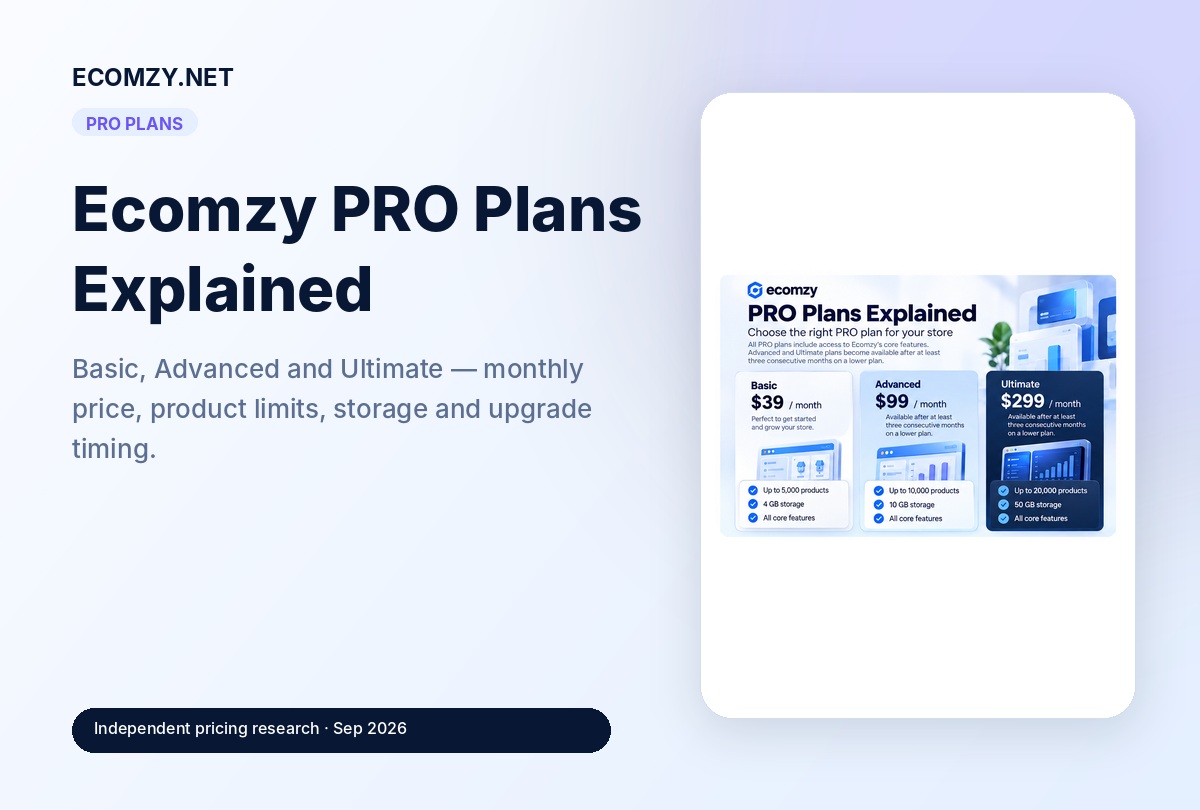
Ecomzy PRO is the platform subscription layer. The current public Pricing page emphasizes the $39/month offer, while the Terms of Service describe three PRO plans: Basic, Advanced and Ultimate. The important differences are not marketing labels — they are monthly price, product limit, server-space allocation and when the higher plans become available.
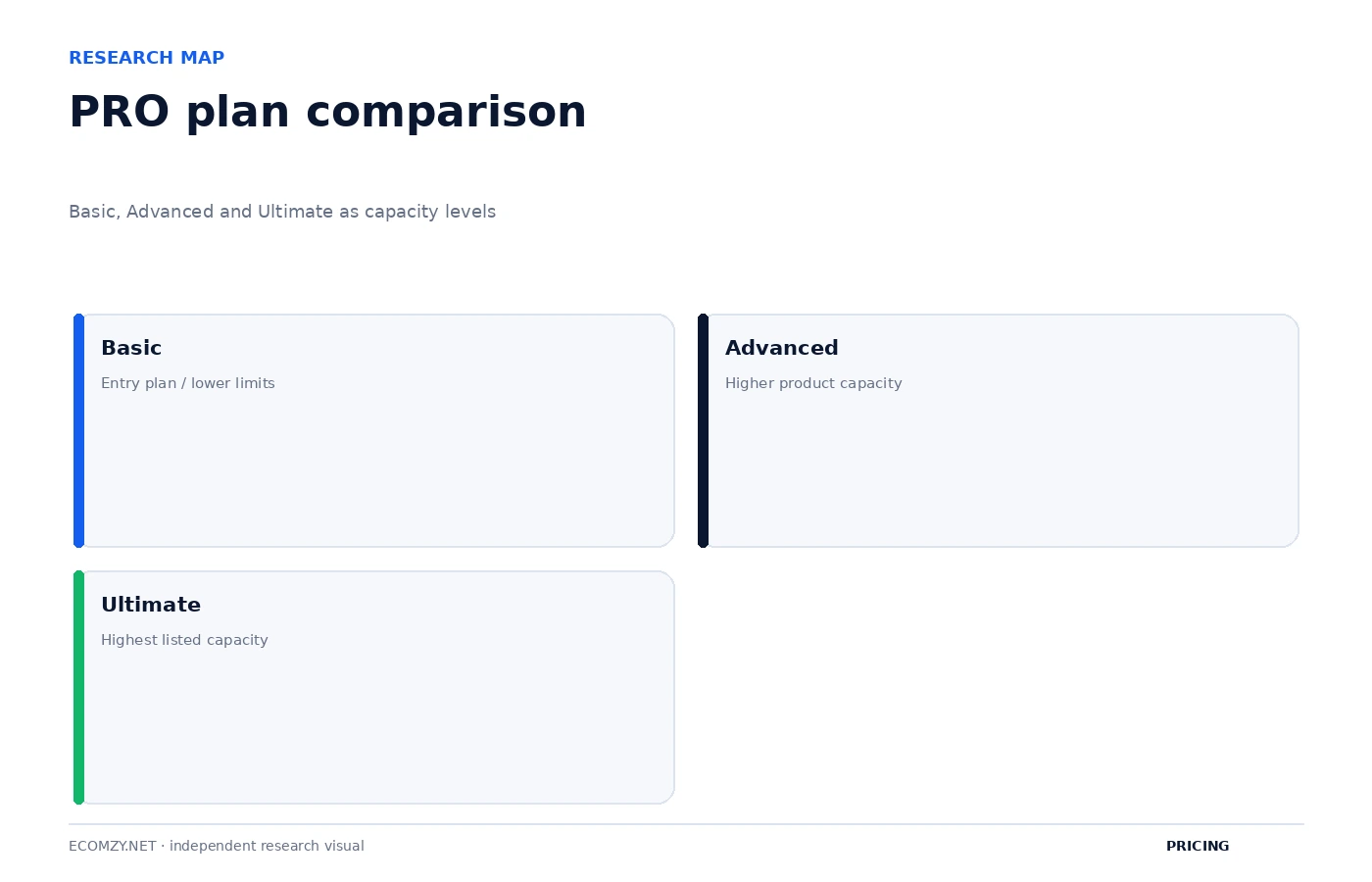
The three current PRO plans
| PRO plan | Price | Products | Server space | Availability |
|---|---|---|---|---|
| Basic | $39/month | Up to 5,000 | 4 GB | Entry plan |
| Advanced | $99/month | Up to 10,000 | 10 GB | After at least 3 consecutive paid months |
| Ultimate | $299/month | Up to 20,000 | 50 GB | After at least 3 consecutive paid months |
The public Pricing page currently says “One plan” and foregrounds the $39 Ecomzy PRO offer. The Terms, however, contain the broader three-plan structure. For pricing research, the correct interpretation is that $39 is the current public entry offer, while the contractual plan framework also provides Advanced and Ultimate levels.
Basic: the $39/month entry plan
Basic is the easiest plan to understand because it aligns with the headline public price. Under the current Terms it supports up to 5,000 products and includes 4 GB of available server space.
The public Pricing page lists the core service bundle around that offer: online store and hosting, domain, SSL certificate, built-in payments, fraud protection, Ecomzy Dashboard, advanced analytics and priority support.
Basic is therefore the right reference point when someone says “Ecomzy costs $39/month.” But it is still only the PRO subscription layer. A Performance Tier, optional services or applicable order fees can sit on top of it.
Advanced: $99/month after the eligibility period
The current Terms describe Advanced as $99/month, with a product limit of 10,000 and 10 GB of server space. It becomes available after the user has completed payment for at least three consecutive months.
That eligibility rule means Advanced is not simply a higher-priced checkout option shown to every brand-new user on day one. It is a later-stage plan inside the contractual structure.
The incremental subscription cost relative to Basic is $60/month. In exchange, the documented capacity doubles from 5,000 to 10,000 products and server space rises from 4 GB to 10 GB.
Ultimate: $299/month for the highest documented capacity
Ultimate is listed at $299/month, up to 20,000 products and 50 GB of server space. Like Advanced, it is described as becoming available after at least three consecutive months of payment.
Compared with Basic, the subscription difference is $260/month. The documented product ceiling is four times higher and the server-space allocation is 12.5 times larger.
Those ratios are derived from the published limits; they are useful for capacity planning, but they do not imply that every user needs to move up simply because the higher plan exists.
What a PRO upgrade does not automatically replace
Moving from Basic to Advanced or Ultimate does not replace the Performance Tier system. The Terms explicitly describe Performance Tiers as supplementary to PRO.
That means a user can theoretically have:
- a higher PRO plan for platform capacity;
- plus a paid weekly Performance Tier for tool access and order capacity;
- plus optional Dashboard services;
- plus applicable order or promotion fees.
Those are different commercial layers. A higher PRO plan should not be assumed to absorb every other charge.
How upgrades are described
The Terms say a customer can upgrade in the Ecomzy account under the Plans tab or by contacting Ecomzy Support. That is useful operationally because it shows the plan change is account-level, not something that requires opening a separate account.
Users should still check the Dashboard for the price and the exact plan available to them before confirming an upgrade.
The multi-store rule changes the economics
One of the more important details buried in the Terms is that each Turnkey Store has its own subscription. A single customer email may create up to 10 stores, but each one is tied to a separate subscription.
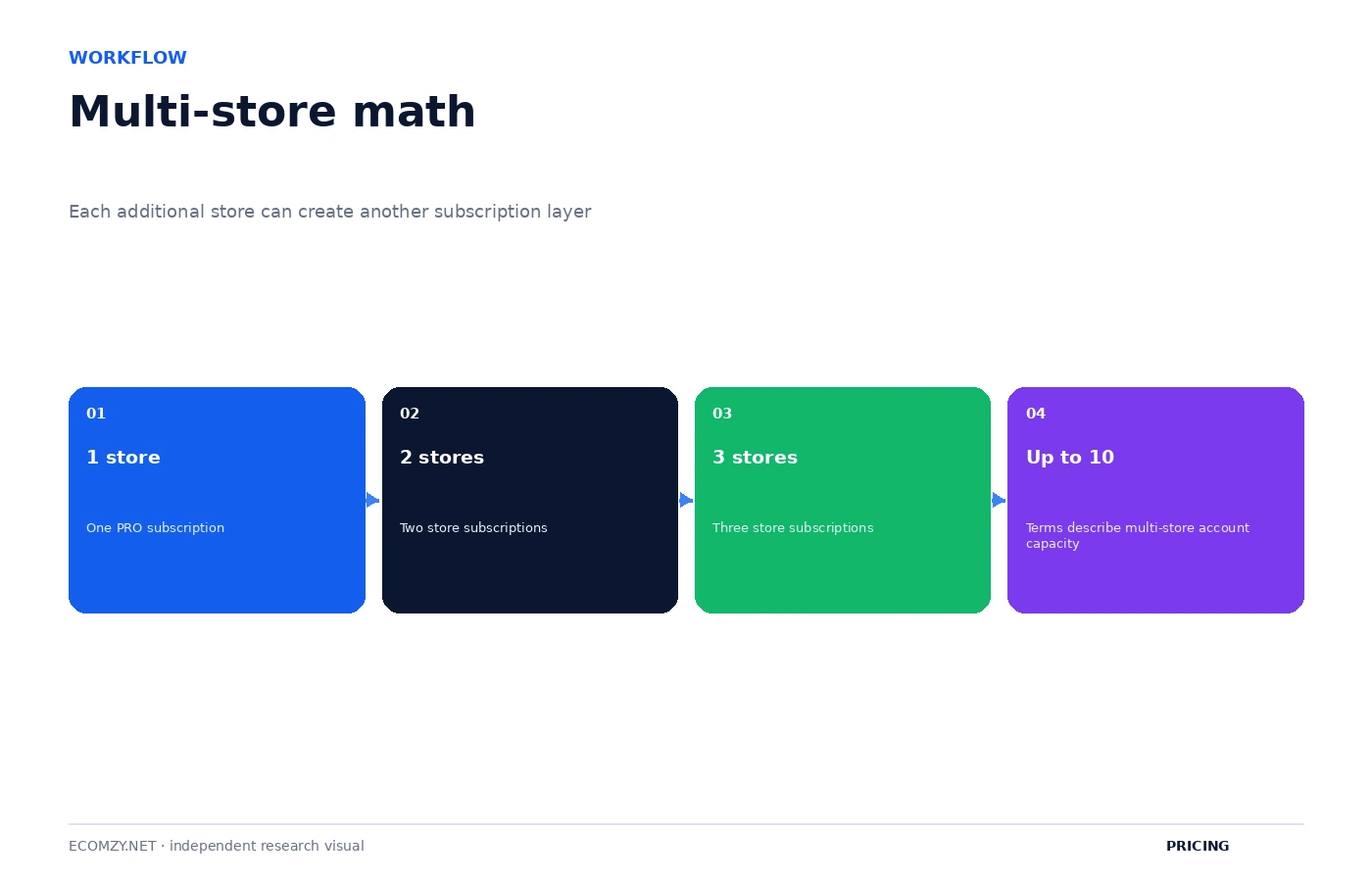
At the Basic plan price, the arithmetic is straightforward:
| Stores | Basic subscriptions | Monthly base cost | Annualized base cost |
|---|---|---|---|
| 1 | 1 × $39 | $39 | $468 |
| 2 | 2 × $39 | $78 | $936 |
| 5 | 5 × $39 | $195 | $2,340 |
| 10 | 10 × $39 | $390 | $4,680 |
The Terms also say the first $39 charge for a new additional store occurs immediately when the store is created from the Dashboard. Services and purchases tied to one store do not transfer to another.
That makes “how many stores?” a first-order pricing question, not merely an account-management detail.
How to think about product and storage limits
It is tempting to calculate a simple “price per product slot” or “price per GB.” Those ratios can be mathematically computed, but they can be misleading because the plans bundle an entire service, not raw hosting capacity.
For example, Basic’s $39 divided by 5,000 product slots is less than one cent per theoretical slot per month, but that does not mean product slots are sold individually. Similarly, server space is only one component of the plan.
The limits are better used as capacity thresholds: if the current store is nowhere near 5,000 products or 4 GB, higher capacity alone may not be a relevant upgrade driver.
Does the 14-day trial apply to every PRO plan?
The Terms state a 14-day free trial for Ecomzy PRO beginning when store access details are provided. The public Pricing page markets the trial around the $39 offer. Because Advanced and Ultimate require at least three consecutive months of payment before becoming available, the practical trial experience is centered on the entry plan rather than a brand-new user immediately trialing Ultimate.
A cleaner way to choose a PRO plan
Instead of asking “which plan is best?”, ask four factual questions:
- How many products does the store actually need to support?
- How much server space is being used?
- Has the account completed the eligibility period for higher plans?
- Is the extra monthly subscription cost justified by the required capacity?
This keeps the PRO decision separate from Performance Tier and marketing-tool decisions.
Annualized subscription cost by PRO plan
The PRO plans are billed monthly, so the annualized subscription commitment is straightforward if the price remains unchanged for twelve months:
| PRO plan | Monthly | 12-month arithmetic | Difference vs Basic per year |
|---|---|---|---|
| Basic | $39 | $468 | — |
| Advanced | $99 | $1,188 | +$720 |
| Ultimate | $299 | $3,588 | +$3,120 |
These annual figures are simple arithmetic, not annual-plan discounts. The Terms describe monthly pricing. Their value is budget comparison: upgrading from Basic to Advanced adds $60 for each month the higher plan remains active; Ultimate adds $260 per month versus Basic.
What the extra monthly spend buys in documented capacity
Because Ecomzy publishes both product limits and server-space limits, we can isolate the documented capacity increase attached to each upgrade.
Moving from Basic to Advanced:
- adds 5,000 product slots;
- adds 6 GB of server space;
- adds $60/month to the PRO subscription.
Moving from Advanced to Ultimate:
- adds another 10,000 product slots;
- adds 40 GB of server space;
- adds $200/month.
Moving directly from Basic to Ultimate:
- adds 15,000 product slots;
- adds 46 GB of server space;
- adds $260/month.
These are capacity deltas, not value judgments. They make the plan decision measurable: a store can compare current utilization with the next threshold instead of upgrading because the higher plan sounds more advanced.
A practical utilization rule before upgrading
A simple internal metric is capacity utilization:
If a Basic store uses 1,200 of 5,000 product slots, product utilization is 24%. If it uses 3.2 GB of 4 GB, storage utilization is 80%. Those two percentages point to very different upgrade pressure.
This is why product count alone should not control the decision. A store can be far below its product limit and still approach its storage allocation, or the reverse.
Ecomzy does not publish a universal “upgrade at 80%” rule. The ratio is an independent planning tool that helps identify which documented limit is actually becoming restrictive.
The three-month eligibility condition changes upgrade timing
The current Terms say Advanced and Ultimate become available after at least three consecutive months of payment. That creates a practical planning constraint: a new Basic subscriber should not design a launch plan that assumes an immediate move to Ultimate unless the Dashboard explicitly offers it.
The eligibility condition also makes the first three months a useful observation period. During that time the user can collect real data on:
- product count growth;
- storage consumption;
- order volume;
- which Performance Tier tools are actually used;
- whether multiple stores are needed;
- which optional services are being purchased.
By the time higher PRO plans become eligible, the upgrade decision can be based on actual usage rather than forecasts made before the store existed.
PRO plan capacity and Performance Tier capacity solve different problems
It is easy to confuse the two systems because both use names such as Basic, Advanced and Pro. They are not the same ladder.
The PRO plan controls the underlying subscription level and documented product/server capacity. The Performance Tier controls a separate weekly service-access layer with order thresholds and additional tools.
For example, an account could be on Advanced PRO because it needs more product/storage capacity while remaining on a lower Performance Tier if its tool and order requirements allow it. Conversely, a Basic PRO user could theoretically need a higher Performance Tier because of order volume or tool access.
This two-axis structure is one of the most important pieces of information missing from simplistic “Ecomzy plans” summaries.
A two-axis planning matrix
| Primary need | Plan layer to inspect first | Why |
|---|---|---|
| More product capacity | PRO plan | Product limits are documented at the PRO level |
| More server space | PRO plan | Storage allocation is documented at the PRO level |
| Higher order capacity | Performance Tier | Order thresholds are defined by tier |
| Access to additional marketing tools | Performance Tier | Tool progression is tied to tier |
| Second or third store | Additional PRO subscription | Each Turnkey Store has its own subscription |
| Specific marketing/service deliverable | Dashboard paid service | Separate service purchase, not a PRO upgrade |
This matrix prevents users from paying for the wrong layer in an attempt to solve a different limitation.
Multi-store costs at higher PRO levels
The Terms say each store has its own subscription. If multiple stores are eventually eligible for and placed on higher PRO plans, the subscription cost scales quickly.
| Stores | All Basic | All Advanced | All Ultimate |
|---|---|---|---|
| 1 | $39/mo | $99/mo | $299/mo |
| 2 | $78/mo | $198/mo | $598/mo |
| 5 | $195/mo | $495/mo | $1,495/mo |
| 10 | $390/mo | $990/mo | $2,990/mo |
This table is arithmetic based on the published per-store subscription rule. It does not imply that Ecomzy recommends putting every store on the same plan. In practice, independent stores may have different capacity requirements.
A mixed-store example
Consider an account with three stores:
- Store A: Basic PRO at $39;
- Store B: Advanced PRO at $99;
- Store C: Ultimate PRO at $299.
The combined PRO subscription layer would be $437/month. If only Store C used a Pro Performance Tier at $69/week, the average recurring monthly cost of that tier would add about $299, producing an average recurring platform-plus-tier baseline of roughly $736/month before services and variable fees.
This example shows why a multi-store account needs store-level accounting. A single account-wide plan label is not enough.
A capacity-based upgrade breakpoint model
There is no official Ecomzy break-even rule for upgrading, but a user can build one from internal constraints. An upgrade becomes operationally necessary when staying on the lower plan would prevent the store from meeting a documented capacity requirement.
A simple decision sequence is:
- Identify which lower-plan limit is approaching.
- Estimate when that limit will be reached at the current growth rate.
- Verify higher-plan eligibility in the Dashboard.
- Calculate the incremental monthly subscription cost.
- Compare the cost of upgrading with the cost or feasibility of reducing usage.
For example, if storage — not product count — is the constraint, deleting unused media or optimizing assets may delay an upgrade. If product count is the constraint and all products are required, an upgrade may be the cleaner operational choice.
What about downgrading PRO?
The current public Terms section we reviewed clearly explains how to upgrade and the eligibility of higher plans, but it does not provide the same level of detail about every downgrade scenario. That is a point where users should check the current Dashboard or contact support rather than assuming a symmetric downgrade path.
This is an example of an information gap that should remain explicit. A pricing guide is more useful when it marks what the source does not clearly specify instead of filling the gap with an assumption.
Subscription continuity has an operational cost dimension
The Terms say site data may be irreversibly deleted if an Ecomzy PRO subscription is not renewed for longer than a week after the due payment date. That clause means subscription continuity is not only about keeping features active; it can also have implications for the underlying store data.
For budgeting, this means the PRO subscription belongs in the “must-fund” category for any store the user intends to keep operational. Optional services can be paused or skipped. The core subscription cannot be treated the same way if the store itself needs to remain available.
Quarterly PRO plan audit
A useful quarterly review asks:
- How many products are actually active versus the plan limit?
- How much server space is consumed?
- Is the store eligible for a higher plan?
- Is the current plan creating unused capacity?
- Are multiple stores being maintained unnecessarily?
- Are paid services being confused with plan features?
- Does a Performance Tier, rather than a PRO upgrade, solve the actual need?
This keeps the PRO subscription decision grounded in capacity and continuity rather than marketing labels.
What to record before requesting an upgrade
Before changing PRO plans, save a snapshot of the current account: active product count, server-space usage, current Performance Tier, number of stores, recent service purchases and the date the higher plan became available. That creates a before-and-after record that makes later billing changes easier to explain.
It also helps separate two questions that are often mixed together: whether the account can upgrade and whether the account needs to upgrade. Eligibility is a contractual condition; need is an operational decision based on capacity.
FAQ
Does Ecomzy have only one plan?
The public Pricing page currently foregrounds one $39/month offer. The Terms list Basic, Advanced and Ultimate PRO plans.
How much is Ecomzy Advanced?
The current Terms list Advanced at $99/month, with up to 10,000 products and 10 GB of server space.
How much is Ecomzy Ultimate?
The current Terms list Ultimate at $299/month, with up to 20,000 products and 50 GB of server space.
Can I open multiple stores under one email?
The Terms say up to 10 Turnkey Stores can be created under one email, but each store has its own subscription and associated purchases do not transfer between stores.
Primary sources
Research checked September 29, 2026.
Join the discussion
Share a question, correction or useful experience related to this article. First-time comments may be held for moderation.