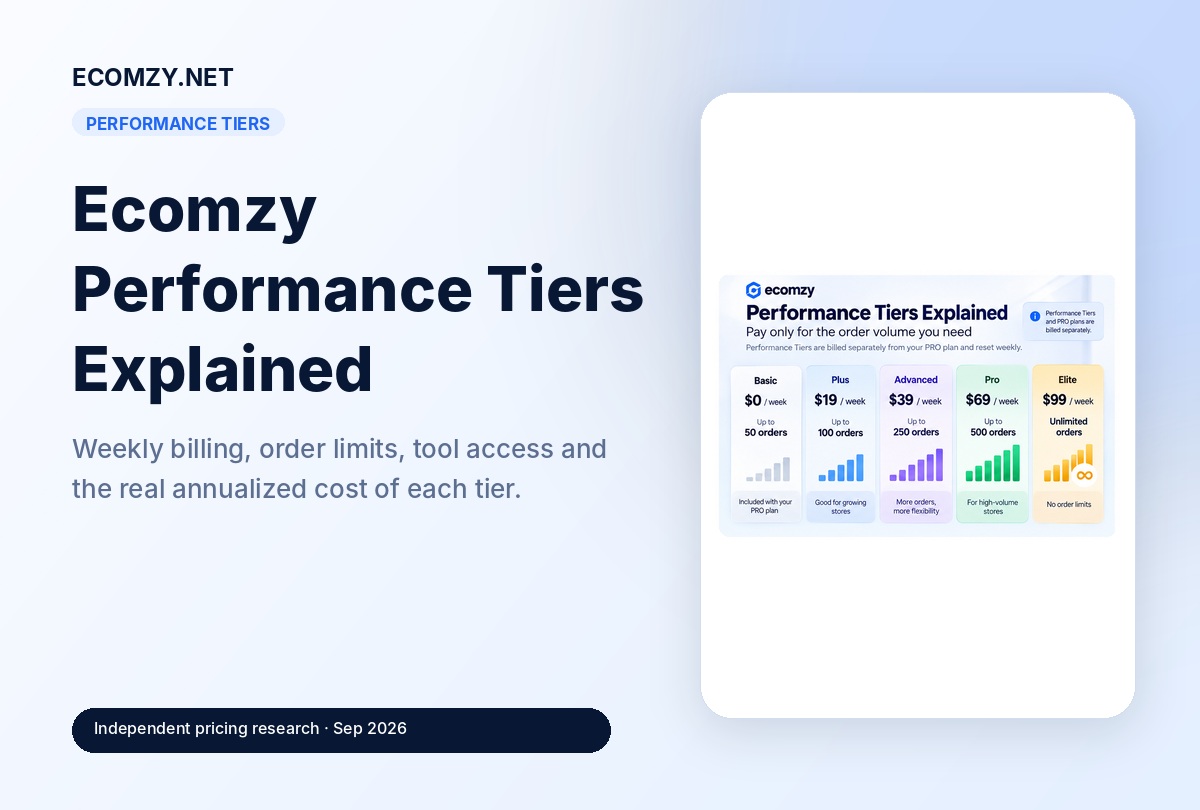
Ecomzy Performance Tiers are a second subscription layer, not a replacement for Ecomzy PRO. They are billed separately, use a weekly price rather than a monthly one, and combine order-capacity limits with access to additional platform tools.
This guide focuses only on the tier system: published order limits, tool progression, weekly billing, automatic upgrades, downgrade restrictions and the true annualized cost of a weekly subscription.
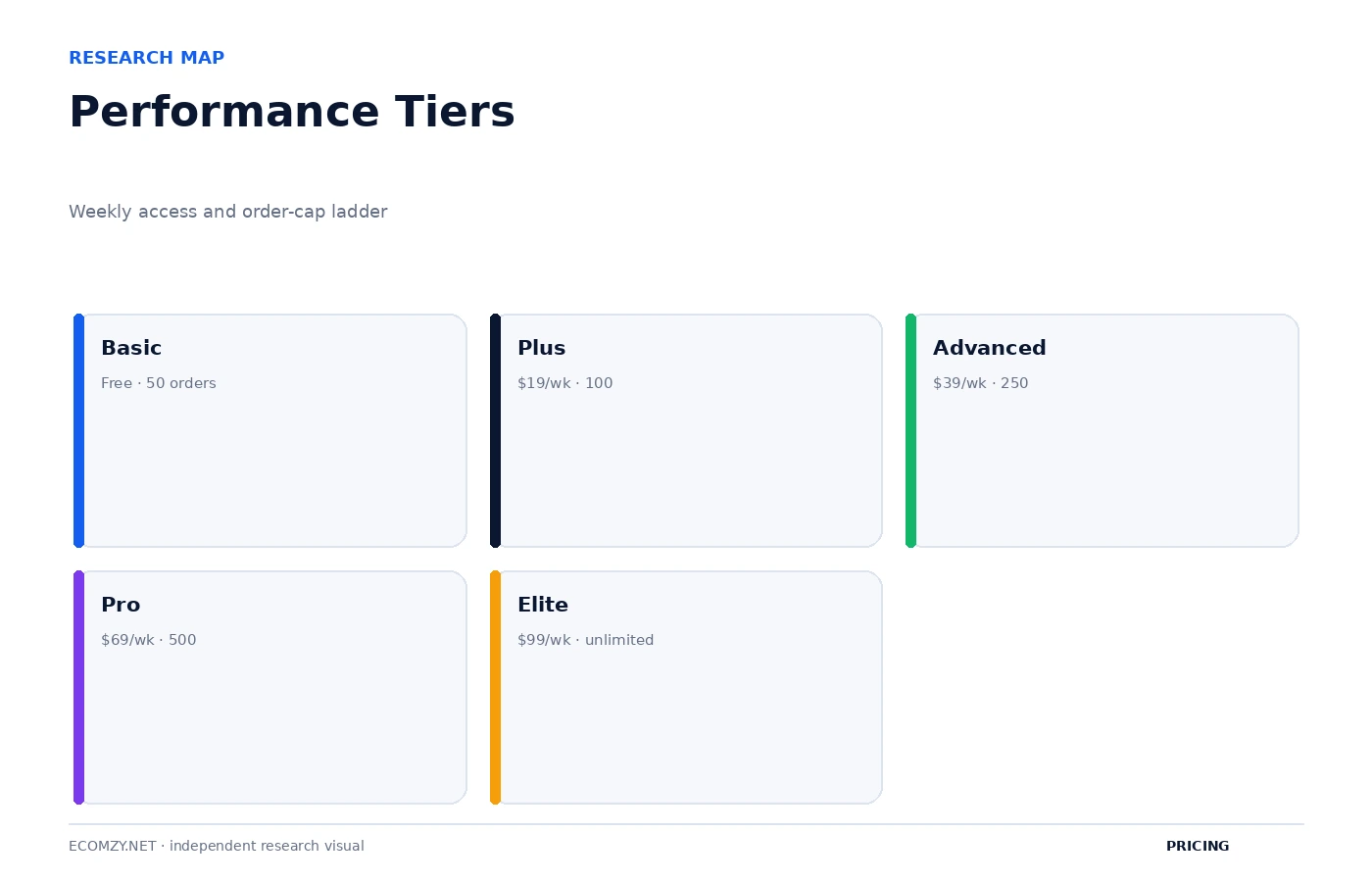
Current Performance Tier levels
| Tier | Price | Order capacity | Published tool progression |
|---|---|---|---|
| Basic | Free | Up to 50 orders | Limited functionality |
| Plus | $19/week | Up to 100 orders | Email Marketing, Google Backlinks |
| Advanced | $39/week | Up to 250 orders | Plus Social Media Marketing, SEO Blog Posts, Design Customization |
| Pro | $69/week | Up to 500 orders | Plus YouTube Marketing and Promotional Videos |
| Elite | $99/week | Unlimited | Full listed set including Instagram & TikTok tools and Themes Access |
The Terms say specific features, limits and tool availability can change and are defined by the Dashboard or applicable service descriptions. That means the tier table should be treated as a current snapshot, not a permanent entitlement matrix.
Performance Tiers require active PRO
The contractual relationship is explicit: Performance Tiers are supplementary to Ecomzy PRO. If the PRO subscription is canceled, suspended or expires, access to associated Performance Tier features is suspended until PRO is reactivated.
Upgrading or downgrading a Performance Tier does not, by itself, change the underlying PRO billing cycle.
This produces two independent recurring clocks:
- PRO: monthly;
- Performance Tier: weekly.
That matters when reconciling statements because the charges do not have to land on the same date.
The weekly-to-monthly conversion most summaries omit
A common mental shortcut is to multiply a weekly price by four. That is useful for a four-week window, but it underestimates annual cost because 52 weeks equal 13 four-week periods.
| Tier | Weekly | 4-week spend | 52-week spend | Average month | Average month + $39 Basic PRO |
|---|---|---|---|---|---|
| Basic | $0 | $0 | $0 | $0 | $39.00 |
| Plus | $19 | $76 | $988 | $82.33 | $121.33 |
| Advanced | $39 | $156 | $2,028 | $169.00 | $208.00 |
| Pro | $69 | $276 | $3,588 | $299.00 | $338.00 |
| Elite | $99 | $396 | $5,148 | $429.00 | $468.00 |
The “average month” column is Ecomzy.net arithmetic: weekly price × 52 ÷ 12. It is not an alternative monthly billing option. A real calendar month may contain four or five weekly charges depending on the billing dates.
Automatic upgrades are an important cost-control rule
The current Terms say Performance Tier upgrades may occur automatically based on account usage, including activation of additional tools or reaching applicable order-volume thresholds.
That makes the tier system different from a purely manual subscription menu. A user cannot safely assume the weekly tier will remain unchanged if usage moves beyond the current tier’s compatible limits.
The Terms say applicable tier changes and pricing are displayed in the Dashboard. For budgeting, that means the Dashboard should be checked after major usage changes or when new tier-gated tools are enabled.
Downgrades are not necessarily automatic
Customers may request a lower tier through support, but the Terms say downgrade requests are subject to review. A downgrade can be declined if current account activity, enabled tools or usage levels are incompatible with the requested lower tier.
This is economically important. It means “I can always drop back next week” should not be assumed without checking whether the account qualifies for the lower tier.
Tier purchases are described as final
The Performance Tier section states that purchase of a tier grants immediate access and is considered final and non-refundable. That is more restrictive than the refund framework described for some other types of Dashboard services.
This is a good example of why Ecomzy service-specific terms matter: a general refund assumption should not be applied across every product category.
No additional processing/service fee on the tier subscription itself
The Terms specifically say no additional processing, transaction or service fees are applied to Performance Tier subscription payments.
That sentence is useful because it separates the tier charge itself from fees that may arise elsewhere in Dashboard purchases or operating workflows.
How to interpret the order limits
The tier names are partly a tool-access ladder and partly an operational-capacity ladder. Basic supports up to 50 orders, Plus 100, Advanced 250, Pro 500 and Elite unlimited order capacity under the current Terms.
Because the Terms also allow automated tier upgrades based on usage, the order thresholds can affect cost even if the user’s original reason for choosing the tier was access to a particular marketing tool.
That is why the correct planning question is two-dimensional:
- Which tools does the store need?
- Which order-capacity band does current activity require?
The effective recurring cost with Basic PRO
If Basic PRO remains at $39/month, the annualized recurring platform-plus-tier combination looks approximately like this before other fees:
- PRO + Basic Tier: $39/month.
- PRO + Plus: about $121.33/month average.
- PRO + Advanced: about $208/month average.
- PRO + Pro: about $338/month average.
- PRO + Elite: about $468/month average.
These figures deliberately exclude optional services, Ads Credits, applicable order fees, taxes and bank/FX costs. They isolate only the two recurring subscription layers.
Weekly billing creates five-charge months
Performance Tiers renew on a weekly cadence rather than a monthly one. Over a full year that produces 52 billing events. Because calendar months are longer than exactly four weeks, some months can contain five weekly charges depending on the renewal weekday.
For example, a $39/week Advanced Tier produces $156 in a four-charge month but $195 in a five-charge month. The underlying price has not changed; the number of weekly renewal dates falling inside the calendar month has changed.
This is why a business using monthly bookkeeping should not use “weekly price × 4” as its only forecast. The 52-week annual amount or the actual renewal calendar is more accurate.
Four-charge versus five-charge months
| Tier | 4 weekly charges | 5 weekly charges | Difference |
|---|---|---|---|
| Plus | $76 | $95 | $19 |
| Advanced | $156 | $195 | $39 |
| Pro | $276 | $345 | $69 |
| Elite | $396 | $495 | $99 |
For cash planning, the difference matters most at the higher tiers. A user on Elite can see a $99 difference between a four-renewal and five-renewal calendar month even before the monthly PRO subscription and any variable costs are added.
The marginal cost of moving up one tier
Looking only at the absolute tier price hides the incremental step between levels. The current weekly jumps are:
- Basic → Plus: +$19/week;
- Plus → Advanced: +$20/week;
- Advanced → Pro: +$30/week;
- Pro → Elite: +$30/week.
Annualized, those incremental commitments are approximately $988, $1,040, $1,560 and $1,560 respectively if the higher tier stays active for a full 52 weeks.
This marginal view is useful when a store is already paying for one tier and needs to understand the additional cost of the next threshold rather than the full sticker price from zero.
Use a buffer below the documented order limit
The Terms tie tier compatibility partly to order volume and say upgrades may occur automatically when thresholds are reached. For planning purposes, waiting until the exact limit is exceeded can create a surprise renewal or upgrade event.
An independent operational approach is to create a warning buffer. For example, a store on Plus could flag itself internally at 80 or 90 orders rather than waiting for 100. Advanced could flag at 220–230 rather than 250. The specific buffer is not an Ecomzy rule; it is a planning technique that gives the operator time to review the next tier before usage forces the issue.
Tool-driven upgrade versus volume-driven upgrade
A Performance Tier can become necessary for two different reasons: the store needs a tool that is only available at a higher level, or the store’s order activity is no longer compatible with the current level.
These two cases should be evaluated separately because the economic logic differs.
Tool-driven: the operator should estimate how often the extra tool will be used, whether a separate paid service could solve the same problem, and whether the recurring weekly increase is justified.
Volume-driven: the operator should compare the extra tier cost with the operational value of supporting the higher order band. In this case, the tier can be viewed as capacity infrastructure rather than a marketing-tool purchase.
How the published tool ladder expands
The Terms currently describe a cumulative progression. Plus introduces selected tools such as Email Marketing and Google Backlinks. Advanced adds Social Media Marketing, SEO Blog Posts and Design Customization. Pro adds YouTube Marketing and Promotional Videos. Elite includes the full listed set, including Instagram & TikTok Ads Tool, Instagram & TikTok Store and Themes Access.
That cumulative structure means a move to a higher tier can solve more than one requirement at once. But it can also create unused access. A store that only needs one feature from the next level is still paying the tier price for the whole access bundle.
For internal budgeting, record which unlocked tools are actually used each week. After several months, the account can distinguish “available” tools from “valuable” tools.
A derived cost-per-active-tool concept
Because Ecomzy sells tier access as a bundle, there is no official price per tool. But an operator can calculate an internal utilization ratio:
If a $69/week Pro Tier is active and the account genuinely uses seven tier-gated tools, the internal cost allocation is about $9.86 per actively used tool per week. If only one tool is used, the allocation is $69 to that one use case.
This is not an Ecomzy price and should never be presented as one. It is a management metric that reveals whether the bundle is being meaningfully utilized.
How to reduce surprise from an automatic tier upgrade
The Terms allow automatic tier upgrades based on usage, enabled tools or order thresholds. A practical control process is therefore:
- record the current tier and weekly price;
- record the next tier and its weekly price;
- monitor order count and newly activated tools;
- set an internal warning before the documented capacity ceiling;
- review the Dashboard after major usage changes;
- keep a weekly screenshot or export of tier status when cost control matters.
This does not prevent an automated upgrade. It makes the change easier to anticipate and verify.
Downgrade review can create cost persistence
The Terms say a downgrade request may be declined if current activity, enabled tools or usage is incompatible with the lower tier. That means the recurring cost of a higher tier can persist until the account is actually compatible with the lower level.
A user planning to downgrade should therefore identify the dependency first: which tool, usage pattern or order volume keeps the account on the higher tier? Turning off a tool or reducing activity may be operationally necessary before support can approve the lower tier.
That is different from a consumer subscription where the user simply selects a cheaper plan and waits for the next billing cycle.
Recurring combinations with higher PRO plans
The earlier table uses Basic PRO because it is the public entry plan. Higher PRO plans produce larger recurring combinations:
| PRO plan | + Plus avg month | + Advanced Tier avg month | + Pro Tier avg month | + Elite avg month |
|---|---|---|---|---|
| Basic $39 | $121.33 | $208 | $338 | $468 |
| Advanced $99 | $181.33 | $268 | $398 | $528 |
| Ultimate $299 | $381.33 | $468 | $598 | $728 |
These figures are derived averages using weekly price × 52 ÷ 12 plus the published monthly PRO price. They exclude all other service, order, promotion and tax costs.
Build a tier cost history
Because tier status can change with usage, the most useful long-term record is not “our tier is Advanced.” It is a timeline:
- date tier started;
- weekly price at that time;
- reason for upgrade;
- order volume around the change;
- tools enabled;
- date downgrade was requested, if any;
- date downgrade was approved or declined.
That history helps explain cost changes and gives future plan decisions more evidence than memory or marketing descriptions.
What “no additional processing, transaction or service fees” means here
The Terms say those additional fees are not applied to the Performance Tier subscription payment itself. That sentence should not be generalized to the entire account.
An account can pay $39/week for the Advanced Tier without an extra Dashboard service fee on that tier charge and still incur other fees when it buys a separate service or processes an order under a fee-bearing workflow.
Separating “fee on the tier payment” from “fees elsewhere in the account” prevents a common interpretation error.
A five-question tier decision framework
- What is the current order count relative to the tier limit?
- Which higher-tier tools are actually required now?
- What is the incremental weekly and annual cost of moving up?
- Could the account remain compatible with a lower tier after disabling unused tools?
- What would a five-charge calendar month look like for cash flow?
Answering those five questions produces a much more realistic decision than choosing a tier from the name alone.
Create a tier budget envelope before enabling higher-level tools
A practical way to control weekly tier spend is to define a maximum recurring envelope before enabling tools that may require a higher tier. For example, an account can decide that recurring platform subscriptions must stay below a specific monthly average, then compare each possible tier against that ceiling using the 52-week conversion rather than a four-week shortcut.
This turns the decision from “do we want this tool?” into “does this tool plus the required tier fit the recurring cost structure?” The distinction matters because a tool may be inexpensive in isolation if sold separately, but access through a higher tier creates a recurring weekly commitment for as long as that tier remains necessary.
Review tier compatibility weekly, not just monthly
Because the billing period itself is weekly, a monthly review can be too slow when order volume or tool usage changes quickly. A short weekly check of tier status, order count and enabled tools can catch an approaching threshold before another renewal cycle begins.
The review does not need to be complicated: current tier, next tier price, current order count, active tier-gated tools and any pending downgrade request are enough to make the recurring cost visible.
A simple weekly forecast template
For each coming week, record the current tier, the expected order count, the next tier threshold, the tools that must remain enabled and the renewal date. If projected activity approaches the next limit, calculate the incremental weekly cost before the account changes tier. This turns Performance Tiers into a predictable operating line rather than a charge discovered after the fact.
The same template can also document why a higher tier remains necessary. If order volume falls but a higher-tier tool is still required, the account has a tool-driven reason to stay. If neither the volume nor the tools justify the level, that is the right moment to investigate a downgrade request.
FAQ
Is the Performance Tier included in Ecomzy PRO?
Performance Tiers are separate from PRO. Basic Tier is free; the paid tiers have their own weekly billing.
Can Ecomzy automatically upgrade my Performance Tier?
The current Terms say upgrades may occur automatically based on usage, enabled tools or applicable order-volume thresholds.
Can I downgrade immediately?
A downgrade can be requested, but the Terms say it is subject to review and can be declined if the lower tier is incompatible with current usage or enabled tools.
Are Performance Tier charges refundable?
The current Terms describe a Performance Tier purchase as final and non-refundable once access is granted.
Primary source
Research checked September 29, 2026. Monthly-equivalent and annual figures are independent arithmetic based on the published weekly prices.
Join the discussion
Share a question, correction or useful experience related to this article. First-time comments may be held for moderation.