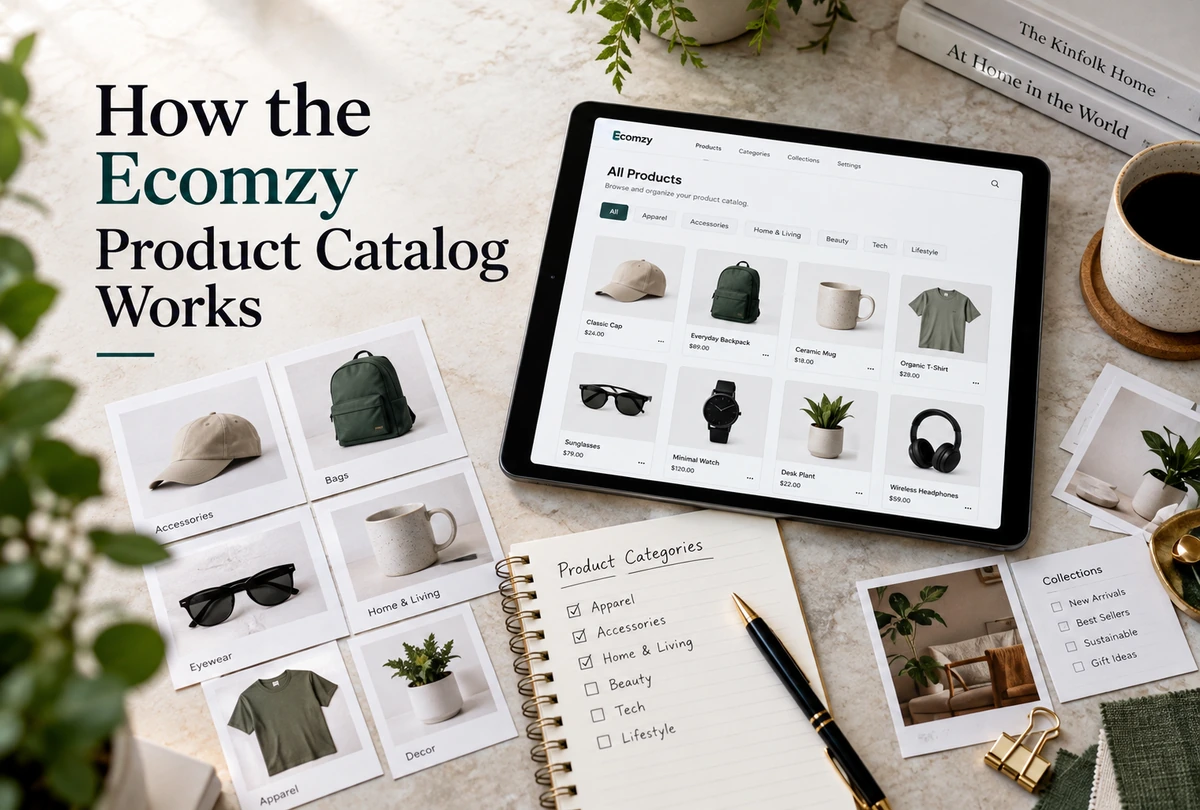
The Ecomzy Catalog is the product-supply layer behind the turnkey store. The current Terms say the subscription provides access to thousands of catalog products available for import, while free store creation includes 50 random Ecomzy products uploaded by default. The current homepage and Fulfillment Policy position Ecomzy around digital products and digital fulfillment. Those facts explain how a new store can arrive with an assortment already in place, but they do not answer every merchandising question. This guide focuses on the catalog as an operating system: what access means, how default products differ from a curated assortment, how import should fit into the workflow, which limits belong to the PRO plan, and which conclusions the public documentation does not support.
1. Catalog access is part of the subscription layer
Ecomzy’s Terms describe catalog access as one of the benefits attached to the subscription and turnkey store. That wording matters. The user is being given access to a platform catalog and the ability to import Ecomzy products into the store. The Terms do not describe the relationship as a permanent transfer of the entire catalog or as a separate asset that exists independently of the subscription.
This distinction is easy to miss because imported products appear inside the user’s store and can look like ordinary store content. Operationally, however, the source of those products is the Ecomzy Catalog. That means a careful store owner should keep track of which products originate from Ecomzy, which ones were imported from the platform and which content was added independently. Knowing the source helps when a listing changes, a catalog item is updated or a product is no longer suitable for the store.
The current public site emphasizes digital products, and the Fulfillment Policy says Ecomzy offers only digital products and services. The Terms also include digital delivery examples such as license or seat provisioning, secure hosting, gated downloads and LMS enrollment where applicable. That makes digital fulfillment a central part of the current catalog model. A catalog article should therefore be read in the context of digital products rather than physical-shipping logistics.
2. The first 50 products are starter inventory, not a merchandising strategy
The Terms say 50 random Ecomzy products are uploaded into the store by default. That single sentence explains why a newly provisioned store can look populated before the owner has made any product decisions. It also explains why the first product-review task should be curation, not simply adding more.
Random starter products solve a technical onboarding problem: they make the store usable and demonstrate how listings are structured. They do not necessarily solve the business problem of creating a coherent niche, offer stack or customer journey. A user who keeps every default product solely because it is already present may end up with a store that feels broad or inconsistent. The platform documentation does not say that all 50 starter products should remain published.
A better workflow is to treat the initial set as a sample assortment. Review each item for audience fit, price logic, page quality and relationship to the rest of the store. Keep the products that support the intended positioning, replace weak fits from the broader catalog, and organize the final assortment so the store has a reason for customers to browse rather than a random collection of unrelated offers.
3. Import is a publishing workflow, not just a button
The Terms say products are available for import, which makes importing the central catalog action. But an independent operational guide should expand the process into several checkpoints: discover, evaluate, import, review, organize and publish. The technical import step may be fast; the quality-control steps around it are where the store owner adds judgment.
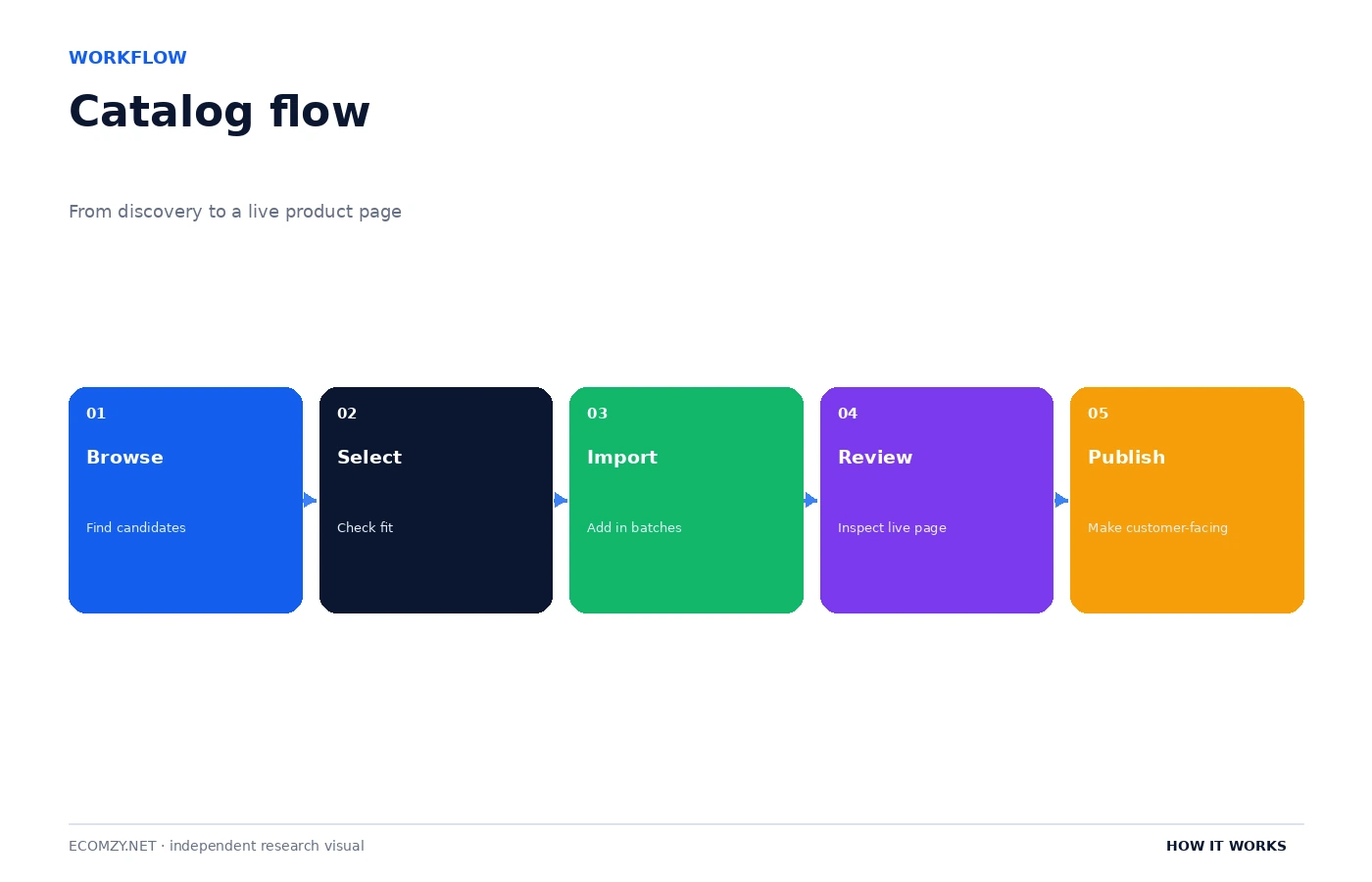
The discovery stage is about finding potentially relevant catalog items. Evaluation asks whether the product belongs in the store at all. Import moves the platform item into the storefront. Review checks how the title, image, description, price and call-to-action appear in the user’s actual theme. Organization puts the item into the correct category or navigation path. Publication is the point at which the owner decides the listing is good enough to be customer-facing.
This workflow prevents a common “catalog abundance” mistake: assuming that more imported products automatically make a stronger store. Ecomzy’s PRO plans permit different maximum product counts, but maximum capacity is a technical limit. It does not imply an optimal catalog size. A smaller curated store can be easier to understand than a large unfocused one, and the public Ecomzy documents do not promise that filling the plan limit improves traffic or conversion.
4. Product limits belong to the PRO plan, not the catalog itself
The current Terms list PRO Basic with up to 5,000 products, Advanced with up to 10,000 and Ultimate with up to 20,000. Those numbers describe subscription capacity. They are not separate catalog tiers and they do not mean every user should import to the maximum. Capacity tells you how much the plan can hold; catalog strategy tells you what should actually be present.
The distinction matters for two reasons. First, plan upgrades should not be triggered by abstract fear of “running out of catalog” if the live assortment is nowhere near the limit. Second, a catalog audit should focus on what is published and useful, not on how many unused product slots remain. The Pricing Hub covers the economics of the plans; this article treats the limits only as a structural boundary around the catalog workflow.
Advanced and Ultimate also have eligibility conditions in the current Terms: they become available after completing payment for at least three consecutive months. That is another reason to separate a long-term product-cap plan from immediate catalog work. A new store should first establish a coherent assortment before treating higher plan capacity as a growth requirement.
5. Digital products change what “fulfillment” means
Ecomzy’s Fulfillment Policy says the platform offers only digital products and services, so fulfillment should not be imagined as a physical warehouse shipment. The Terms’ processing-fee section gives digital examples: license, seat or key provisioning, secure hosting or CDN delivery, gated downloads and LMS enrollment where applicable. The exact mechanism can differ by product, but the common theme is access delivery rather than parcel movement.
For the catalog owner, that means product-page quality should explain what the customer receives and how access works. A digital guide, course, template, checklist or software-like asset can have very different fulfillment expectations even if all of them are “digital.” The platform can automate or manage delivery, but the storefront still benefits from clear customer-facing descriptions of the product format and access process.
This is also why catalog curation should include post-purchase clarity. A product that looks attractive in the catalog can still create support friction if the store page does not make the delivery format obvious. The Terms mention customer support for access or download issues as part of the broader processing infrastructure, but preventing confusion on the product page is usually better than relying on support after purchase.
6. Reviews and product content need to be read as merchandising assets
The Terms say the turnkey store includes access to Ecomzy Catalog products with reviews. Reviews can make a listing feel more complete, but a store owner should still understand what those reviews represent and how they are displayed. The public Terms establish that reviews can be part of imported catalog content; they do not, by themselves, establish the methodology behind every review displayed on every product page.
The same caution applies to descriptions, images and other product assets. Importing platform content can save setup time, but it can also make multiple stores look similar if every merchant leaves the imported presentation untouched. The operational question is not whether imported assets are allowed; it is whether the final store presentation is sufficiently clear, accurate and consistent with the store’s positioning.
Where Ecomzy controls an element, the user should avoid editing it in a way that creates factual inconsistencies. Where the storefront allows customization, the goal should be clearer communication rather than unsupported claims. A catalog is not just a database of SKUs; it is the raw material from which the customer experience is assembled.
7. What the public documentation does not establish
A rigorous catalog guide is defined as much by what it refuses to assume as by what it explains. The public Ecomzy sources establish catalog access, import capability, starter products, plan product limits and a digital-product focus. They do not establish guaranteed performance for any particular product, guaranteed permanence of every catalog item, guaranteed exclusivity, or guaranteed search demand.
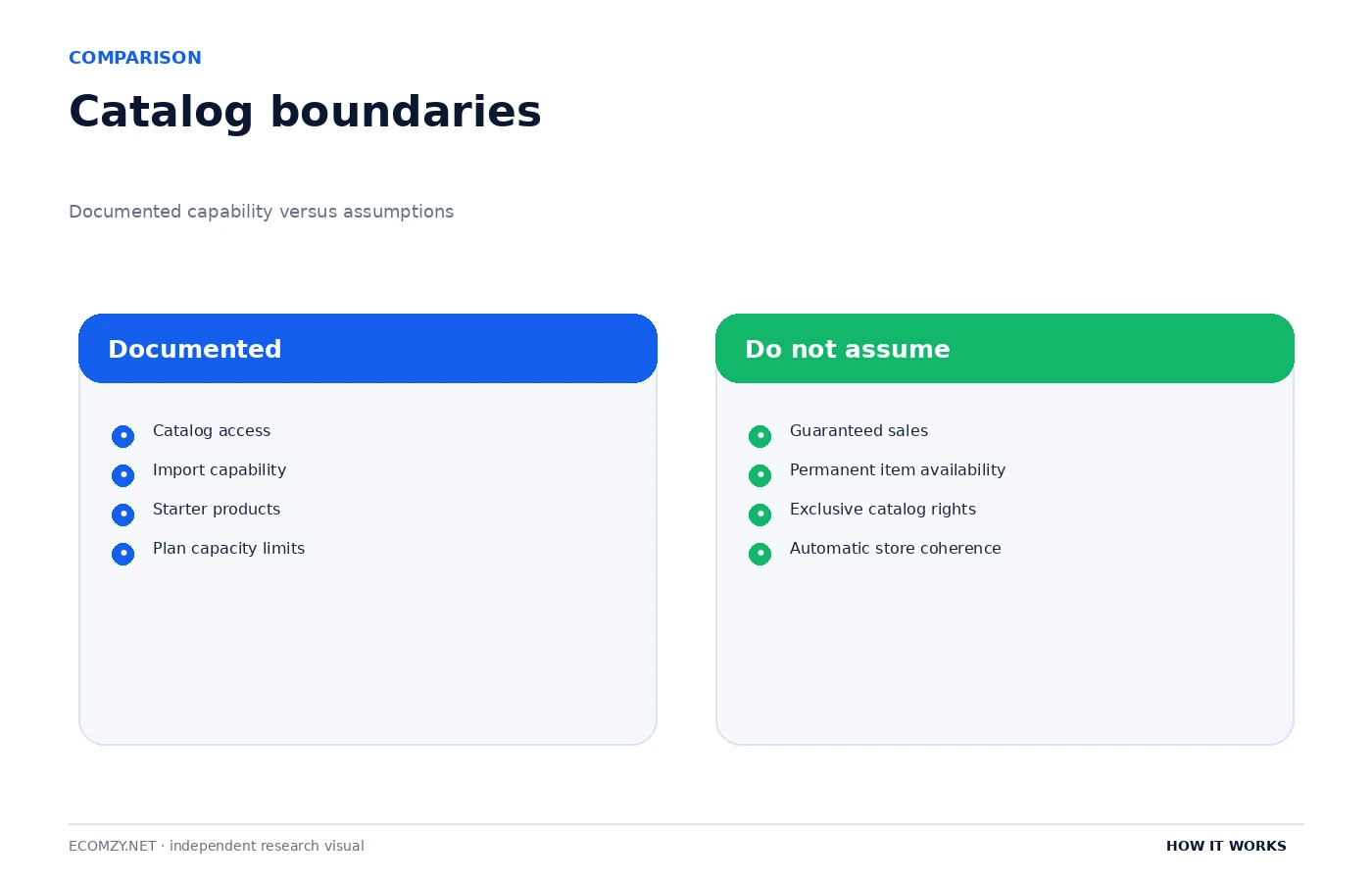
That does not make the catalog weak or strong; it simply keeps the analysis inside the evidence. A product can be available for import without being a good fit for a specific audience. A plan can allow thousands of products without making a large catalog desirable. A product can contain reviews without those reviews being a substitute for the store owner’s own quality-control process. Independent research becomes more useful when those distinctions are explicit.
The same rule applies to changes over time. Ecomzy says subscription plans and their features can change. Catalog availability can therefore be operationally dynamic. A store owner who depends heavily on a particular product should monitor the live catalog and account rather than assuming a snapshot from an old article will remain authoritative indefinitely.
8. A practical catalog-management routine
A repeatable routine is more valuable than a one-time import spree. Start by deciding the store’s target problem or audience. Then review the default products against that target. Use the catalog to fill obvious gaps rather than to maximize item count. After importing, inspect the live page on desktop and mobile, verify the product format and customer expectations, and place the item in a logical category. Finally, review performance and support feedback before expanding the assortment further.
- Define the audience or store theme before importing more products.
- Audit the 50 default products and remove obvious mismatches.
- Shortlist catalog products based on fit, not quantity.
- Import one group at a time so presentation can be checked.
- Review titles, images, descriptions and delivery expectations on the live storefront.
- Organize categories and navigation so related products are discoverable.
- Watch customer questions and order data for signs that a listing is confusing.
- Revisit the catalog periodically because platform availability and features can change.
This routine keeps catalog work connected to store operation rather than turning it into a separate hobby. The purpose of the catalog is to supply a coherent storefront. The number of available products is useful capacity, but the quality of the final assortment is a separate decision that belongs to the store owner.
9. Catalog breadth and store identity are different goals
A platform benefits from a broad catalog because it can serve many kinds of stores. An individual store benefits from relevance. Those goals are not contradictory, but they are not identical. The owner should use the breadth of the Ecomzy Catalog as a sourcing pool and then narrow it into an assortment that makes sense to one audience. That filtering step is where a generic catalog becomes a specific storefront.
This is also where internal linking and category architecture matter. A customer who lands on one product should be able to discover related offers without returning to a random homepage grid. Product relationships can be built through categories, collections, comparison content and contextual recommendations. The catalog provides the inventory; the store provides the path through it.
10. Why imported content still needs editorial review
Import automation reduces manual entry, not editorial responsibility. A product can be technically correct and still have a title that feels inconsistent with neighboring offers, an image that does not match the store’s visual system or a description that assumes knowledge the customer does not have. Editorial review is the layer that converts platform content into a coherent customer experience.
A useful rule is to review imported content at the same standard as content written from scratch. Does the page explain the problem, product format, access method and customer expectation clearly? Does it avoid claims the underlying product cannot support? Does the pricing presentation match the actual checkout? If the answer is no, the import should not be treated as finished simply because the data transfer succeeded.
Frequently asked questions
How many products does Ecomzy put in a new store by default?
The current Terms say 50 random Ecomzy products are uploaded by default as part of free turnkey-store creation.
Does Ecomzy provide access to more than the default 50 products?
Yes. The Terms say the subscription provides access to thousands of products in the Ecomzy Catalog that are available for import.
Are Ecomzy products currently digital?
The current Ecomzy homepage positions the store around digital products, and the February 2026 Fulfillment Policy says Ecomzy offers only digital products and services.
Does catalog access mean I own the catalog permanently?
The public Terms describe access and import rights through the subscription. They do not describe a permanent transfer of the entire catalog.
Should I import as many products as my PRO plan allows?
The plan limits are capacity ceilings, not a recommendation. The public documents do not promise better results from maximizing product count.
Where to go next
- How Ecomzy Works
- How Ecomzy Store Setup Works
- How Ecomzy Orders and Order Processing Work
- Ecomzy Pricing Hub
Official sources reviewed
This article was checked against Ecomzy’s public documentation on September 30, 2026. Where marketing copy and policy language describe the same topic differently, the distinction is stated instead of silently choosing one version.
Catalog quality-control questions
Before keeping an imported product live, ask whether the title is understandable without platform context, whether the product format is obvious, whether the main image matches what the customer receives, whether the price makes sense next to neighboring products, and whether the description sets realistic access expectations.
Next, check navigation. A product can be technically published and still be functionally invisible if it is placed in the wrong category or buried under unrelated items. Review the store as a shopper with one problem to solve and count how many clicks are required to reach the product.
Finally, keep a removal rule. Products that repeatedly create support questions, do not fit the store’s positioning or remain irrelevant to the intended audience should not stay merely because import was easy. A curated catalog is an ongoing process, not a one-time setup task.
What to re-check after a catalog change
After changing the assortment, verify more than the product grid. Check whether navigation labels still make sense, whether category counts and featured sections update correctly, whether internal links point to live products, and whether any homepage or email content still references items that were removed. A catalog change can affect multiple parts of the storefront even when the import or deletion itself appears successful.
It is also useful to compare the live store with the current Ecomzy Catalog before planning a campaign around a specific item. If the product has changed, moved or become unavailable, update the customer-facing material first. This simple check reduces the risk of promoting an offer whose storefront presentation no longer matches the current catalog source.
Join the discussion
Share a question, correction or useful experience related to this article. First-time comments may be held for moderation.