
A shopper sees an offer, visits a store and places an order. From the outside, this looks like one continuous journey. Inside Ecomzy, however, the Promotion Service and the Order Processing Service are different operations, with different credits, rules and charges. Confusing the two can produce an inaccurate budget, a stalled workflow, or the mistaken belief that unused credits are cash waiting to be withdrawn.
Ecomzy Ads Credits activate the platform’s own promotional service. Ecomzy Order Processing Credits are prepaid service units used to initiate a separate order-processing service. Neither is described in the October 2026 Terms of Service as a deposit, wallet balance or financial asset. This guide compares them on the questions that matter: what triggers use, whether they can be moved or refunded, what additional fees exist, and what an owner should monitor daily.
The short answer: two services, two credit types
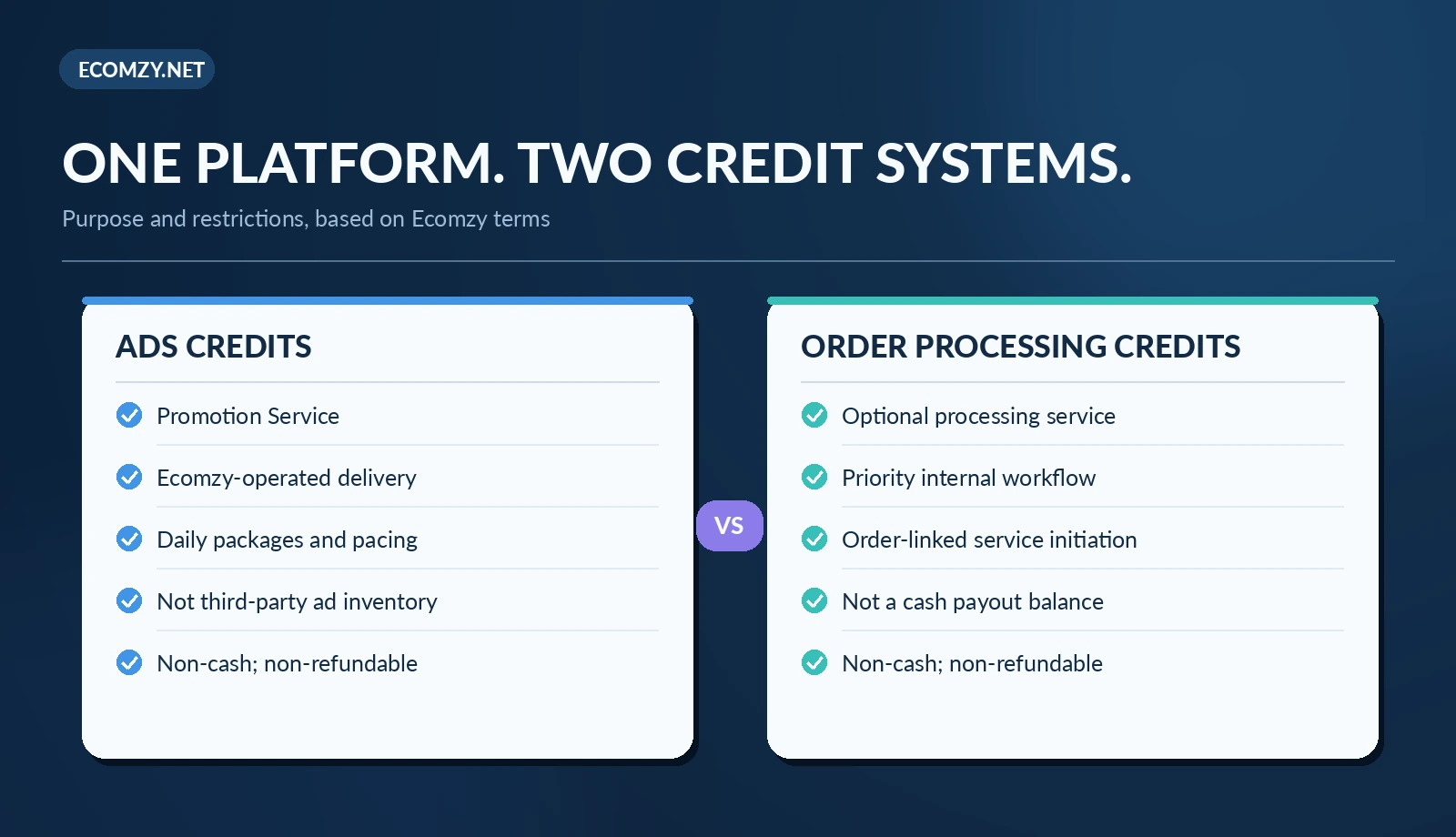
Ads Credits belong to promotion. The terms say they are applied to Ecomzy-operated promotional delivery and may be used for features such as Accelerated Delivery or Remarketing when those settings are enabled. They do not represent the purchase of outside advertising inventory and should not be treated as funds inside a social advertising account. The Promotion Service itself operates through Ecomzy-controlled properties and internal channels, according to its specific service terms.
Order Processing Credits belong to the optional Order Processing Service. That service is described as priority handling, faster verification and accelerated execution of Ecomzy’s internal fulfillment workflow for orders submitted from a Partner Storefront. The credits are service units used to initiate that workflow. They are not interchangeable with Ads Credits simply because both names include “credits.”
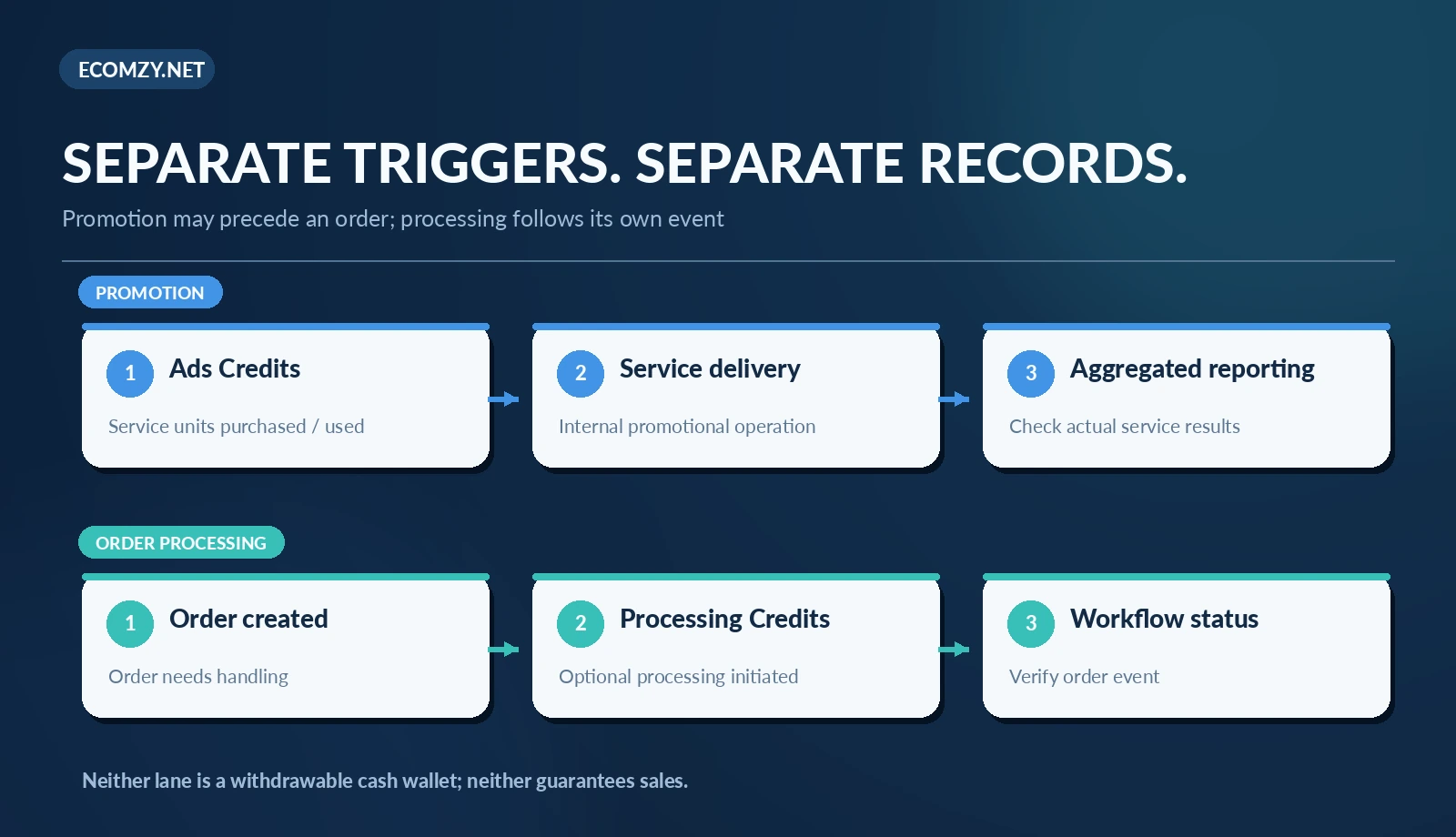
A useful memory aid is to separate two events: promotion happens before a potential order; processing follows an order that needs handling. Spending on the first cannot prove that the second has occurred. An order can require attention even after promotional activity pauses. Equally, paying for processing does not create a new promotional campaign.
What counts as an Ads Credit in Ecomzy?
The October 2026 service terms define Ads Credits as prepaid, non-cash units for activating and delivering the Ecomzy Promotion Service. Ecomzy distinguishes that service from reselling third-party ad inventory or running campaigns through a customer’s personal advertising account. It says customers do not need personal advertising or social accounts for this internal service, and detailed placements may not always be individually visible because reporting is aggregated.
This is important when interpreting a dashboard. A credit used by Ecomzy’s Promotion Service is not equivalent to a dollar of documented spend in Google Ads or Meta Ads. Those platforms have their own billing records, audiences and placement reports; the Ecomzy terms describe an internally operated service instead. Expect the disclosure and metrics specified for Ecomzy, not a foreign ad-account statement.
The name also should not be confused with general social media toolkits, which provide content assets for owner-managed publication, or with separate editorial placement services. Those are different purchased offerings. Before treating a marketing line item as an Ads Credit charge, match it to the service name and invoice detail.
The current homepage additionally advertises $40 in starter marketplace ad credit. That is a marketing offer with its own conditions; the public-facing snippet alone does not prove the promotional bonus is identical to purchased Ads Credits under section 2.14. Check the offer conditions, where the bonus can be used, and whether it expires. Do not combine a promotional bonus with a paid credit purchase in the same ledger unless the account expressly treats them as the same units.
What Order Processing Credits do and do not do
The Order Processing Service is presented in the terms as an optional way to accelerate internal order handling: priority queue, verification and workflow execution. Order Processing Credits initiate that service. They do not represent customer money, a payout entitlement, or a transferable asset. The terms explicitly say they cannot be withdrawn, converted into cash, transferred or used to pay third parties.
Do not confuse the service with a guarantee that an order is successful, that every eligibility condition disappears, or that support work is unnecessary. A credit is an input to a workflow. The final order state still needs confirmation from the actual order record. Processing credits also do not determine how much a sale earns; separate commissions and other fees have their own definitions.
For daily operations, examine the credit service state separately from order state. If an order remains pending, ask which processing step is incomplete. If credits show consumption but the order record has not advanced, retain the transaction reference and request a reconciliation. The correct question is not “why did the balance go down?” alone; it is “which service event consumed the units, and where is the corresponding order event?”
Different triggers and different timing
Under the published Promotion Service terms, Ads Credit charges are processed daily. A failed daily payment pauses promotional delivery. The daily package can rise as the service reaches specified milestones, unless the owner reduces the daily charge to an earlier attained level under the documented rules. Optional accelerated pacing can affect daily usage without changing the base tier itself.
Order Processing Credits do not follow this same campaign ladder. Their function is tied to initiating the Order Processing Service, not reaching a particular number of days of promotion. The terms refer to a multi-stage lifecycle for the credits; they do not establish that the owner may use them as a universal subscription payment balance. A credit purchase and an order-specific use are separate recordable events.
A practical reconciliation therefore needs two clocks. For promotion, monitor calendar-day charges, active settings and pauses. For order processing, monitor the creation time of an order, the processing event, resulting status and any exception. Combining both into one “marketing spend” column hides whether a cost was incurred to attract interest or to handle work after an order appeared.
The five published promotional package milestones
The Ecomzy terms list a default Bronze level of 10 Ads Credits per day, then 15 after five days of continuous service delivery, 20 after ten days, 30 after twenty days, and 50 after thirty days. These are advertised with dollar-reference prices. Increases are tied to the milestone ladder, not to an unrestricted manual increase button. Users may reduce daily charges to a previously attained level under the stated terms.
This is a schedule of potential service usage, not a promise of daily orders. More credits consumed do not guarantee more customers, and individual campaign placements may not be visible. The terms also allow optional settings, including Accelerated Delivery, to alter pacing. With acceleration enabled, pacing may be as much as fifty percent above a given day’s applicable usage. That provision should be read with the actual account configuration and checkout before making a budget decision.
If you are forecasting cash needs, do not simply multiply 10 by 30 and call it the total cost of promotion. The milestone changes, optional acceleration, purchase-related fees and any pauses make the actual path different. Build a date-by-date model using the tier you expect to be on and the charges that are expressly shown before authorization.
Fees: don’t combine rates that apply at different points
Ecomzy’s published fee schedule lists a 28% Promotion Service (Ads) Fee on Ads Credits purchases. In a separate section it lists a 15%–23% auto-processing fee for cases where the Order Processing Service is initiated through Order Processing Credits. The terms also contain other fees relating to transactions and commission redemption. Those figures refer to different events and should not be piled into a single blanket percentage without checking which services the transaction actually uses.
The same document says purchases of Order Processing Credits may attract platform service fees at checkout, including a different processing-fee and service-fee treatment from certain other dashboard purchases. This is a further reason to distinguish an initial credit purchase from later use of a credit against an order. An illustration using only the 15%–23% figure would be incomplete if additional checkout fees apply to the underlying purchase.
Use a real invoice or proposed checkout summary when estimating the total. Write down the credit amount, fee labels, and final authorized total. If an unexpected fee appears, capture the line item and ask support what event it covers. Avoid treating an advertised daily level as an all-inclusive charge unless that conclusion is supported by the actual screen.
Credits are not a cash wallet
The terms expressly classify both Ads Credits and Order Processing Credits as non-cash service units. They cannot be treated as funds held for you, exchanged into cash or used like a bank account. For Ads Credits, Ecomzy also states that they cannot be transferred, paid to third parties, or redeemed for outside advertising inventory. For Order Processing Credits, the corresponding restriction includes withdrawal, transfer and conversion into other value.
This affects accounting language. A screenshot showing “credits remaining” is not proof of a liquid asset or an amount available for payout. You might describe a credit as purchased but unconsumed service capacity, subject to the applicable terms; you should not describe it as “money owed to the owner.” Whether a local accounting system recognizes a prepaid service expense is a separate question for an accountant, not something decided by the dashboard’s label.
It also affects transfers between stores. If two stores have different active workflows, do not assume unused credits from one can be moved to the other. The credit-level transfer restrictions are explicit, and the actual allocation of purchases should be confirmed before paying. A shared login does not create a shared spendable pool.
Can unused credits be refunded?
For both credit types, the published October 2026 terms describe credit purchases as final and non-refundable. The Ads Credit section says this remains true even if the service is canceled, the account terminates, or some credits were unused. The Order Processing Credits section likewise says unused units are not refundable funds. These are contractual statements from the vendor, not a general rule that removes mandatory consumer rights in every jurisdiction.
Do not rely on the generic refund provisions for other Ecomzy services as if those terms automatically supersede the specific credit clauses. The document has multiple service-specific cancellation policies. Find the clause governing the item actually purchased, keep a copy of the checkout disclosure, and ask support if the account screen appears inconsistent with it.
If you believe a charge was made in error or that the contracted service was not supplied, document the transaction, service status and communication before requesting review. This is different from a request to cash out unused credits. The first asks whether the transaction and service conformed to the agreement; the second asks for a conversion the stated credit terms do not offer.
Promotion is not the same as order fulfillment
Imagine a store has an active promotional service and a customer later places an order. The promotion may be one of several factors that led to discovery, but the order still enters its own workflow. The eventual processing action can incur separate conditions and charges. A campaign’s active status does not prove that an order was processed, and the existence of an order does not prove which promotional placement caused it.
This separation matters when troubleshooting. Suppose a daily Ads Credit payment fails and promotion pauses. Existing customer orders should not be dismissed as promotional issues; they require their own review. Conversely, adding Order Processing Credits will not normally correct an Ads Credit payment failure because they authorize a different service. A single “credits problem” message to support can delay resolution if it never names the affected service.
Use two dashboards or two report sections if your account exposes them. In an owner-maintained ledger, record promotional service state and order processing events in separate rows, linked only where the platform actually provides an order or attribution identifier. Do not construct a causal link from matching dates alone.
A worked example without invented sales numbers
Consider an illustrative week in which a store is at a 10-credit daily promotional level. It is tempting to call that a 70-credit weekly budget. That number is only the base package usage for seven days with no milestone change, optional pacing increase, pause or extra charge. It is not a statement of what every Ecomzy user will pay. Under the actual terms, the day-five milestone can move an eligible active service to 15 per day, so a continuous-service scenario may need more than seven identical rows.
Now imagine an order appears on the same day as a promotional charge. Its order-processing event should have its own record. There is no evidentiary basis to deduct the processing credit usage from the promotional-credit balance. Equally, neither credit type tells you the customer’s purchase amount, the applicable commission or the final payout. Those belong in the order and commission records.
A good planning sheet has four distinct columns: Ads Credit usage, Ads Credit purchase-related fees, Order Processing Credit usage, and other charges documented for actual transactions. It is entirely reasonable to add a fifth column for notes such as “promotion paused” or “processing verification pending.” The purpose is not to create a complicated accounting model; it is to prevent charges with different explanations from disappearing inside one number.
What to check before you buy either credit type
First, identify the feature you are trying to activate. If the aim is to increase visibility inside Ecomzy’s promotional system, review the Promotion Service terms, current level and optional pacing controls. If the aim is to initiate accelerated order handling, review the Order Processing Service conditions and the related order states. Buying the wrong type of credit is not a harmless naming error if transfers and refunds are restricted.
Second, inspect the entire checkout summary. Capture the units purchased, any platform fee, tax or adjustment, and the amount authorized. Third, decide what evidence will count as successful delivery. For promotion, you may need a service-activity record or aggregated metrics; for processing, a traceable order workflow event is more relevant. Fourth, confirm which store or account the purchase applies to. Finally, review the service-specific non-refundability conditions before you confirm the payment.
These are standard purchasing controls, not hidden features we claim exist inside every dashboard. When a term or field cannot be found, ask for written clarification. Do not make assumptions based on what a similarly named feature does on another platform.
How to reconcile credit activity each day
A daily reconciliation can be completed in a few minutes. Record the date, service type, units used, service tier or order reference, invoice amount where relevant, and any pause or error. Compare the entries with account notices and checkout records. Do not try to infer credit usage solely from bank charges; one purchase can differ in timing from the later use of those service units.
For Ads Credits, look for the active promotional level and any optional settings. An unexplained increase may be a milestone or allowed pacing behavior, but should be checked against the actual recorded event. For Order Processing Credits, look at orders awaiting the processing service, the initiation event and the resulting state. A unit consumed without an identifiable service event warrants a documented support query.
Frequently asked questions
Can Ads Credits pay for Order Processing Service?
The published definitions assign each credit type to its own service and describe restrictions on transfers or conversion. Do not assume cross-service payment is permitted. Check the specific checkout and terms before purchasing.
Can I withdraw either credit balance as money?
No cash-out right is described. The current Ecomzy terms explicitly classify both as prepaid non-cash service units, not a bank balance or wallet holding customer funds.
Why can my daily Ads Credit charge change?
The promotional service has published milestone levels and optional pacing controls. Review the active tier, uninterrupted-service days and enabled settings before concluding that a change is unexplained.
Are purchases of unused credits refundable?
Both credit-specific sections say purchases are final and non-refundable, including unused credits. Any dispute about a billing error or applicable mandatory rights is a different question and should be documented separately.
Editorial conclusion
Use Ads Credits when evaluating Ecomzy’s internal promotion service and Order Processing Credits when evaluating its distinct accelerated order-processing service. The most useful practical rule is to record purpose, triggering event, applicable fees and service evidence independently. Both are restricted prepaid units, not freely transferable money. Once that distinction is made, the budget becomes easier to read and support questions become easier to resolve.
Sources and review date: Ecomzy Terms of Service (sections 2.6, 2.14 and 3), reviewed October 28, 2026. Related reading: Ecomzy Fees Explained and How Ecomzy Orders and Order Processing Work. This article is independent editorial analysis, not individualized financial or legal advice; checkout disclosures and current terms govern actual purchases.
Join the discussion
Share a question, correction or useful experience related to this article. First-time comments may be held for moderation.