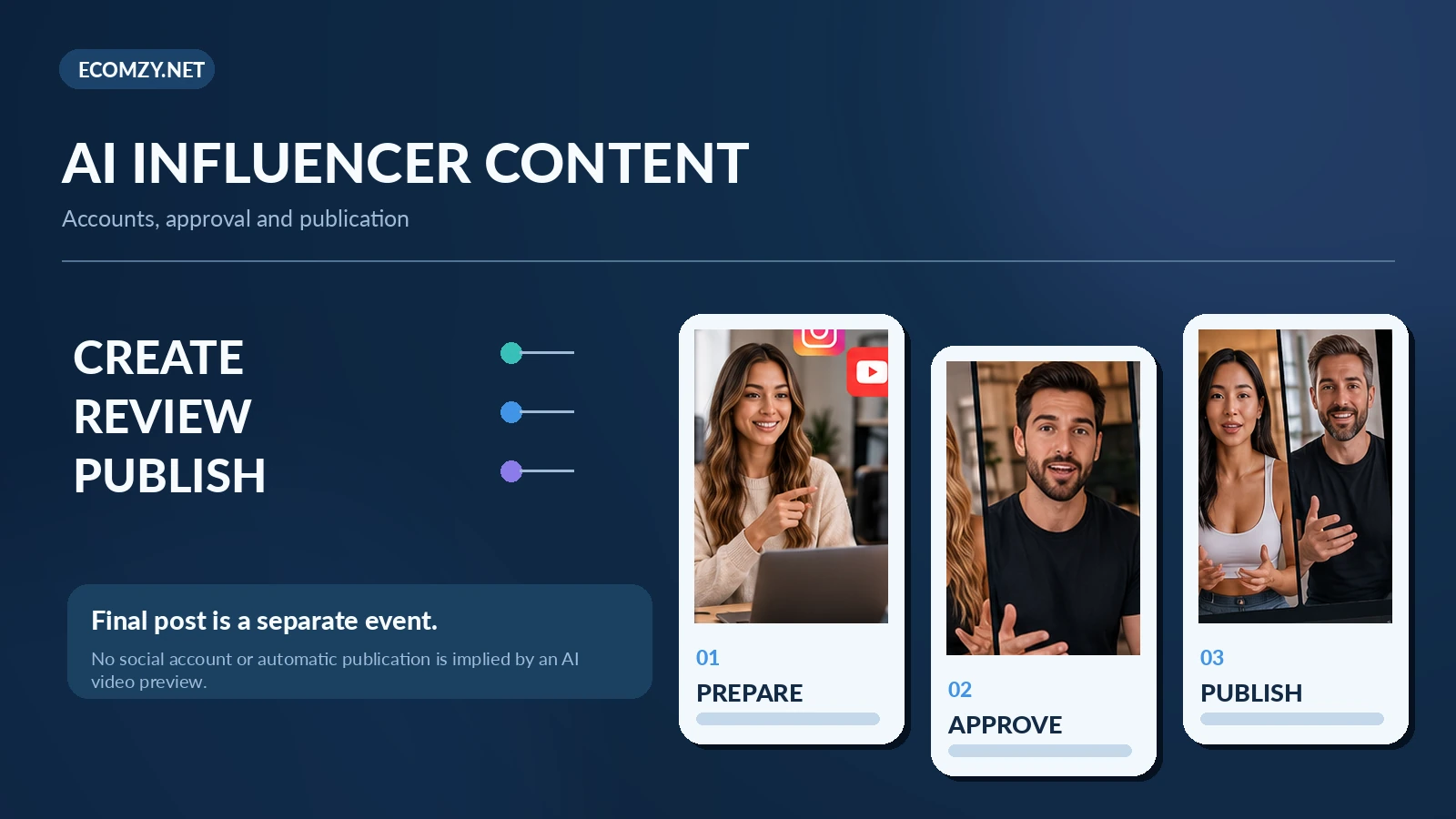
Ecomzy promotes AI presenters that introduce digital products through short videos and posts. That immediately raises a more useful question than how realistic an avatar looks: where does the content actually appear? Does Ecomzy post to its own social accounts, connect to the store owner’s Instagram, or simply provide a finished video? Who chooses the caption and publication time? And how can an owner tell the difference between a ready-to-publish asset and a post that is live?
The public materials give a clear starting point, but not a complete integration manual. Ecomzy’s current homepage describes AI influencer videos and branded posts formatted for Instagram, TikTok and YouTube Shorts. It also explicitly says the owner chooses what goes out and when, and that nothing posts without the owner. Its separate Social Media Packages have additional, stricter terms placing third-party account setup and publication on the customer. This guide turns those distinctions into a practical workflow without inventing dashboard buttons or account connections that have not been verified.
The most important distinction: ready to publish is not published
A video can be edited, exported, approved and scheduled while still attracting no audience at all. Those are different states. The homepage describes the AI influencer content as ready to publish and highlights ready-made captions and hashtags. This establishes a content-creation proposition; it does not establish that Ecomzy has posted the clip to a particular public account or that a specific network has accepted it.
The statement “you choose what goes out and when” makes owner control central. It is a stronger indication of deliberate publication than the suggestion that an AI character works independently. If a user sees a video preview in the dashboard, the safest interpretation is that there is an asset to review, not proof of a completed posting action.
Before telling anyone a campaign is live, capture the public post URL, the account handle and the actual publication date. A thumbnail and a draft caption are not substitutes for those three facts. This distinction also protects against reporting generated media as reach or traffic. Content production and content distribution are related, but they are not the same service outcome.
Which networks does Ecomzy name?
On the current homepage, Ecomzy specifically names Instagram, TikTok and YouTube Shorts as output formats for its AI influencer and promotional videos. The emphasis is on vertical short-form content, including a displayed 9:16 format. That is a useful specification for planning an asset library. It is not, by itself, a list of social accounts that Ecomzy registers, owns or operates on behalf of each customer.
A portrait-format file can often be adapted across multiple services, but each network maintains its own rules about music rights, disclosure, captions, links, supported duration and account access. Preparing a 9:16 clip does not make it suitable for every platform without review. A buyer may also be unable to click a website link directly from every video format, which affects how the accompanying caption or profile directs a viewer to a product.
The platform names are also not a guarantee of distribution. A clip marked “for Shorts” might be ready for upload while the customer still needs to publish it. The exact route—download, share, connected publishing integration or third-party scheduling—must be confirmed from the user’s actual dashboard or support. The publicly visible marketing page does not provide a complete technical publishing protocol.
Who controls the final publication?
The homepage’s owner-control language is unusually direct: the owner chooses the content and timing, and it says nothing posts without that choice. That should shape the operating process even when Ecomzy generates a lot of material quickly. Have one person responsible for approving factual product claims, pricing, links, tone and brand fit before public release. Do not build a process where a ready-made script becomes an unreviewed claim merely because it came from a built-in creator.
For each proposed post, note the product, intended audience, the source of the product claims and the final destination. An AI presenter may sound confident even when the script is inaccurate. Verify what the product actually does, the access terms and whether a price or discount is current. If a page changes after a video is produced, check whether the old wording remains safe to use.
Approval also includes a publishing choice: your account, an authorized partner account, or a separate purchased placement service. Do not treat those destinations as interchangeable. A person authorized to approve a clip for one profile has not necessarily approved it for every profile in an organization.
Your social accounts and Ecomzy’s own channels are different
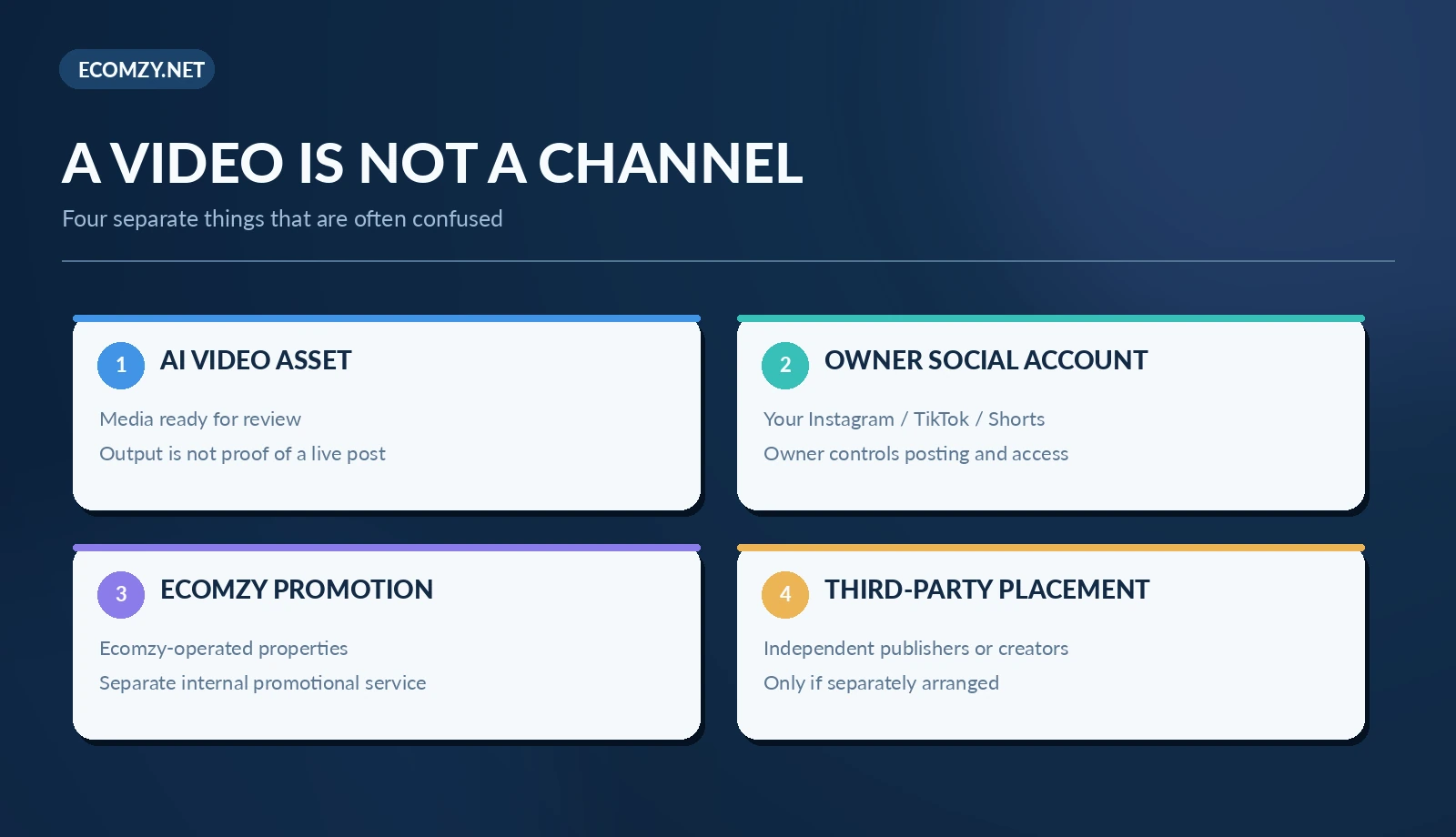
Ecomzy’s Terms of Service describe its Promotion Service as delivery through Ecomzy-owned or operated digital properties, with no personal advertising or social account required. That is a distinct commercial service from producing AI influencer videos for an owner to post. The terms also describe separate external editorial or creator placement services. In other words, an account could encounter several ways for promotional content to reach audiences, each with its own conditions.
A private social media profile you operate is not automatically an Ecomzy-controlled channel. A video in the content library is not proof that an official Ecomzy account will publish it. A paid third-party placement does not mean you own or can administer the creator’s account. The proper question is always: which specific service has been ordered, which entity controls the destination, and what proof of publication will be supplied?
What the Social Media Packages terms actually say
The separate Social Media Packages section is explicit: these packages provide dashboard access and prepared materials, while the customer is responsible for creating and managing third-party accounts and for posting or scheduling the content. The service does not include Ecomzy creating, configuring, posting, moderating or managing those accounts on the customer’s behalf. The package details name channels such as Facebook, Instagram, Pinterest, X, TikTok and YouTube at different plan levels.
Those package rules should not automatically be applied to every AI influencer feature; the products have distinct descriptions. But they do provide an important warning against assuming that delivery of a video automatically includes distribution. If you are looking at a purchased social toolkit rather than the core AI influencer feature, the specific toolkit terms explain much of the responsibility split.
The same section says third-party account handles, approvals and verification are the customer’s responsibility and are not guaranteed. It excludes paid media activation and analytics integration from the basic packages. A promotional asset and an operational social media campaign are therefore not equivalent purchases. Read the named service on the invoice before deciding what work Ecomzy owes you.
How a practical AI video review should work
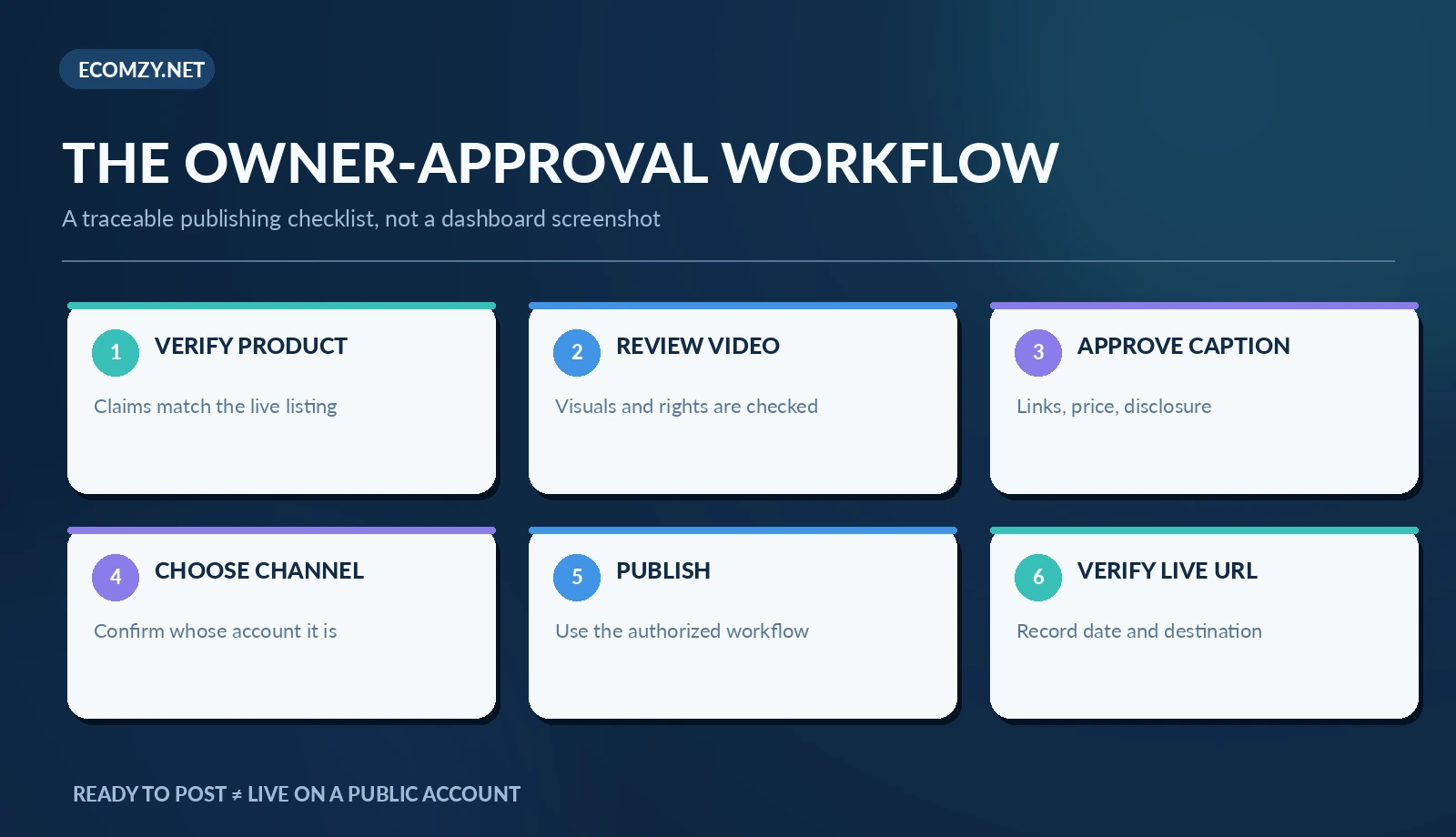
A useful review workflow has five records: the source product, the generated asset, the approved version, the chosen destination and the public URL after posting. This can live in a spreadsheet or a project board. The goal is not bureaucracy; it is to prevent a large library of appealing clips from turning into untraceable claims and duplicated publications.
Start by checking the product page against the script. Verify names, pricing context, benefits, deliverables and any limitations. Next, review the video itself for distorted hands, unnatural facial movements, unreadable overlays and captions that misstate the product. AI-generated imagery can be attractive without being factually correct. On a high-trust editorial or business account, a visually flawed clip is often worse than no clip.
Then check whether the caption offers a concrete reason to visit the product page, rather than a vague “check this out.” Confirm links and any required disclosures before approving. After publication, record a real public post URL. If a scheduler reports success but the post is not visible, distinguish a software delivery report from independent verification on the social platform.
Ownership, permissions and disclosure checks
A generated presenter’s image does not automatically establish who owns every element of the finished asset. Check usage rights for background images, music, logos, templates and any uploaded footage. If a real person’s likeness is being simulated, confirm that permission exists. Do not use a synthetic presenter to imply an endorsement by a real individual or a customer testimonial that never happened.
Where commercial content must be identified as advertising or synthetic media, follow the applicable platform and local disclosure requirements. These are not the same across all countries or networks. They may depend on whether a paid partnership exists, whether a realistic AI-generated person is depicted, and how the content is used. Review the current platform rules before publication rather than relying on one generic hashtag to handle every case.
Store owners should also know who can approve assets and access connected profiles. Limit permissions to those who need them. A shared marketing folder is convenient; a shared personal login with no audit trail is not. If a creator leaves the project, revoke authorized access through the social platform rather than assuming changing an Ecomzy password will remove every external connection.
The publishing calendar should describe confirmed actions
A content calendar is useful only when each status means one thing. We recommend separating idea, draft, ready for review, approved, scheduled, published and verified. Do not mark a clip published merely because its due date has arrived. A post could fail because of an upload error, an account restriction, a missing disclosure or a scheduling connection that expired.
The workflow can stay small. One brand may produce three well-checked posts each week instead of thirty nearly identical clips. The publication frequency should be determined by content quality, audience response and available oversight, not by the number of assets the software can produce. A library is capacity; a calendar is a commitment.
How to avoid posting the wrong product claims
Product descriptions evolve. A new digital tool may change its supported format, price, access conditions or included features. An older video can continue circulating after the original statement stops being accurate. Before posting, compare the script to the current live product page rather than to a copy saved when the video was first created.
Watch for strong outcome claims such as a tool “guarantees a job,” “removes every medical charge,” or “delivers a fixed monthly income.” Such statements require unusually strong evidence and may violate platform or advertising rules. Describe what the product provides and how it works. A guide can help someone prepare; that is not proof of a guaranteed external result.
Also verify that the product has not entered a workflow in which listing modifications are restricted. Ecomzy’s Promotion Service terms prohibit certain edits to products under active promotion. If a video needs a correction but the associated product cannot currently be edited, resolve the mismatch through an authorized process instead of forcing a change through WordPress. A good creative workflow protects the underlying store operation.
Does an AI influencer have a social account of its own?
The public site displays AI influencer profiles and video examples, including a sample handle-like label. That illustrates the visual concept, but it does not establish that each customer receives ownership of seven public social profiles or that every illustrated handle is a live, transferable account. A synthetic character, an internal profile card and a public social identity are three different things.
Ask which identity appears in the final post. Is the presenter merely featured in a clip published by your store, or does a separate creator account post it? Who can access its analytics? Can the handle be changed? Does the owner retain access if a subscription ends? None of those ownership and access questions can be answered reliably by a mockup alone.
If the feature includes public account publishing in your actual plan, obtain written clarification of permissions and handover terms. If it provides media assets only, create or use the channels you control and publish through their authorized interfaces. That is not a lesser option; it can offer clearer ownership of the brand relationship with customers.
Measuring publication results without inventing attribution
Once the post is live, measure only the data the platform exposes. Start with public post URL, date, account, impressions or views where available, and link clicks if trackable. When practical, use distinct campaign-tagged destination URLs. Then compare the destination analytics against the social platform’s own report. Attribution is still imperfect: people may discover a product through one post and buy later after another visit.
If the dashboard only shows aggregate promotional results, do not invent a per-influencer conversion figure. If a post receives a thousand views but no website visits, investigate the call to action and link placement rather than announcing a successful sales campaign. If a social network provides no reliable outbound click metric for that placement, state that limitation in the report.
A sensible weekly review asks three questions: Were approved assets actually published? Did audiences engage with the intended message? Did the website observe relevant traffic or orders that can reasonably be linked to the campaign? Keep these as separate layers of evidence. You can improve a content program without pretending every downstream action has a single source.
Three publishing scenarios to distinguish
Scenario A: owner-managed channel. The store owner receives a finished vertical clip, checks the claims, and publishes it to the business’s own Instagram account. The brand manages the account, caption, publication, comments and analytics. The content-creation benefit is separate from social channel operations.
Scenario B: packaged social materials. The owner purchases an Ecomzy Social Media Package, receives an asset library and implements the materials independently under the package terms. The relevant plan may provide additional formats and channel-specific assets, but it does not include managed posting merely because the assets are ready.
Scenario C: separately coordinated placement. An Ecomzy service may coordinate content with a third-party creator or publisher. The terms for that service should specify delivery, review and exclusions. The owner should not assume control over the creator’s account, guaranteed impressions or a permanent publication unless those terms expressly establish them. These scenarios are illustrations of the responsibility split, not screenshots of current dashboard paths.
Questions to settle before the first publication
Ask Ecomzy support what the AI influencer feature supplies on your actual plan: downloadable clips, shareable assets, connected posting, or another route. Confirm whether any social account must be authorized and whose credentials or permissions are required. Ask whether the selected creator’s handle is an internal label or a public channel. Verify whether there are restrictions on editing, reusing or republishing generated media and whether captions and music are licensed for commercial use.
Then test one low-risk post. Choose an accurate product, review the asset, publish through the authorized mechanism, and check the public URL. Record the time and any errors. Only after that small test should you build an elaborate schedule. A one-post test provides more operational clarity than assuming a preview animation proves a fully automated multi-platform setup.
If the response from support conflicts with a current sales page or package terms, save both sources and request the precise applicable conditions for your order. Product features can vary by plan and change over time. A written clarification is more useful than an unsupported tutorial that names buttons no one can find.
Frequently asked questions
Does Ecomzy post AI influencer videos automatically?
Its current homepage says the owner decides what goes out and when, with nothing posting without the owner. It advertises prepared videos and posts, but the public page alone does not document a universal automatic third-party publishing integration.
Is an Instagram, TikTok or YouTube account included?
The homepage names those channels as video formats, not as guaranteed customer-owned profiles. The separate Social Media Packages terms explicitly put account management and posting on the customer. Confirm which service you actually have.
How do I know a clip was published?
Verify the real destination account, public URL and date on the social platform. A video preview, approved caption or “ready” label is not independent proof of publication.
Can I post the same clip everywhere?
Potentially, but first check format requirements, captions, music and image rights, disclosure policies, product claims and the usefulness of the call to action on each platform. One exported video is not automatically optimized for every audience.
Editorial conclusion
Ecomzy’s AI influencers can make content creation less laborious. The responsible next step is to separate generation, approval, publication and performance measurement. Ecomzy publicly names Instagram, TikTok and YouTube Shorts and emphasizes owner choice, while its separate social package terms allocate third-party posting work to customers. Until a particular account’s integrations are verified, ready to post should be read literally. The best evidence of distribution is a verified public post, not a promising preview.
Sources and review date: Ecomzy homepage (AI influencers and promotion sections) and Ecomzy Terms of Service (sections 2.3, 2.4 and 2.14), reviewed October 28, 2026. Related reading: Ecomzy Marketing Guide and How Ecomzy Marketing Tools and Performance Tiers Work. Independent editorial analysis; workflow graphics are illustrative, not screenshots of private controls.
Join the discussion
Share a question, correction or useful experience related to this article. First-time comments may be held for moderation.