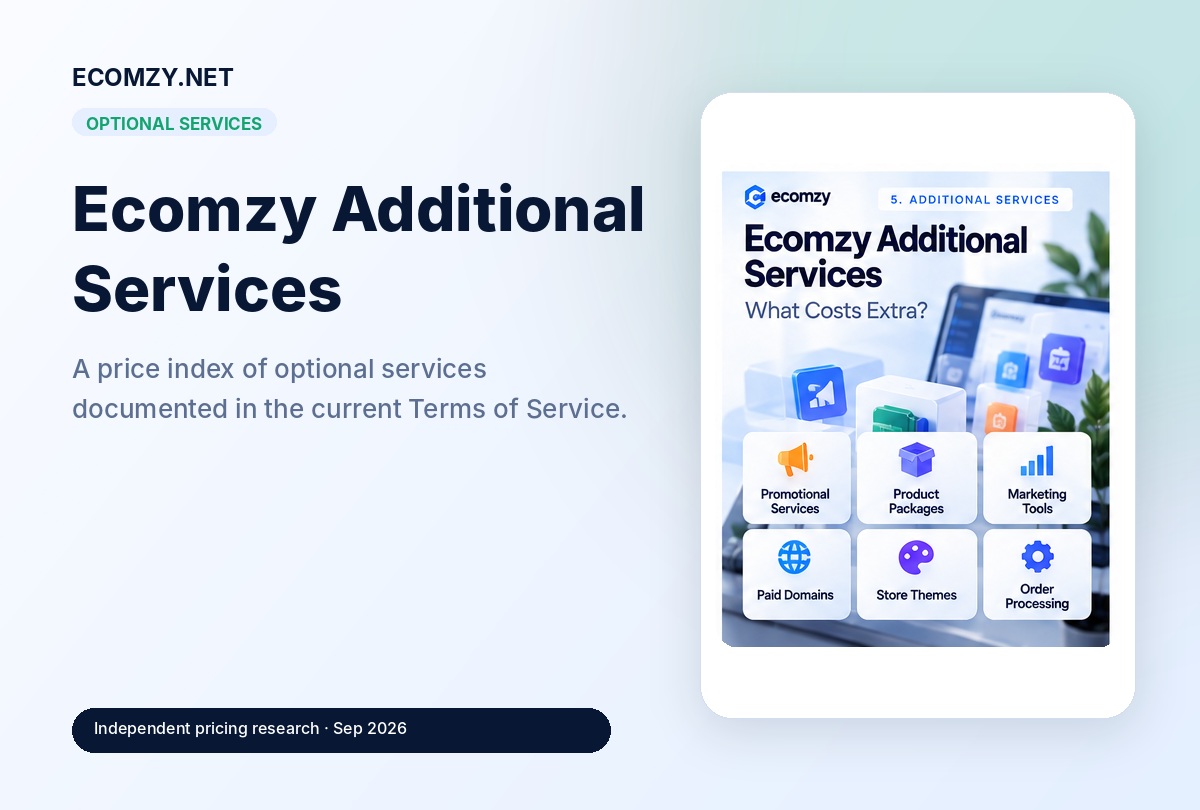
The Ecomzy subscription is only one product inside a much larger paid-service catalog. The current Terms describe optional content, social, promotional, catalog and product packages with their own prices, delivery windows, revision charges and refund rules.
This article creates something the public Pricing page does not provide: a consolidated price index of documented add-on services, separated from the $39/month platform subscription.
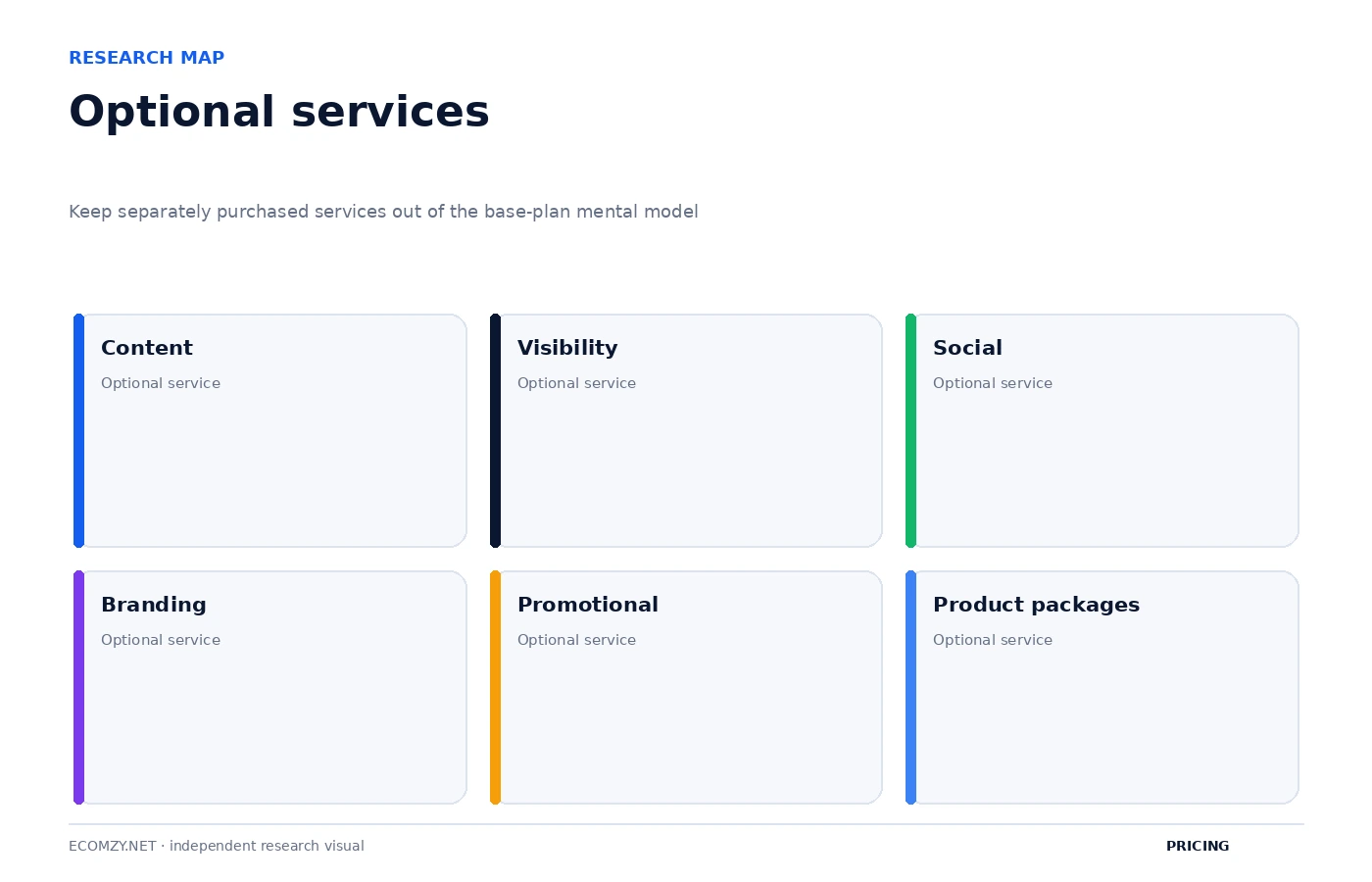
Current documented service prices
| Service | Documented price | Billing style |
|---|---|---|
| Content Visibility Packages | $399 / $699 / $999 | Package purchase |
| Product Catalog Upgrade | $29 / $49 / $99 | 100 / 200 / 1,000 products |
| Social Media Packages | $149 / $339 / $499 | Silver / Gold / Platinum |
| Brand Awareness | $439 / $749 / $949 | Silver / Gold / Platinum |
| Promo Tools Bundle | $399 | Bundle purchase |
| External Content Distribution | $99 | Single service |
| Multi-Channel Content Placement | $349 / $549 | 500K / 1M package names |
| High-Ticket Products | $490 / $890 / $2,490 / $5,990 | Bronze / Silver / Gold / Platinum |
The Terms contain additional named services beyond this table, and prices can change. This list focuses on services whose price was explicitly visible in the current Terms at the time of research.
Content Visibility: $399–$999
Content Visibility Packages are described as branded content preparation and third-party editorial distribution. The current Terms list Silver at $399, Gold at $699 and Platinum at $999.
The service is explicitly described as not selling guaranteed traffic, rankings, backlinks or authority. That matters when interpreting the price: the purchase is for content creation/coordination, not a guaranteed performance outcome.
Product Catalog Upgrade: $29–$99
The current Terms list product-import packages at $29 for 100 products, $49 for 200 products and $99 for 1,000 products.
This is a good example of a small optional purchase that would be invisible in a pricing summary focused only on the monthly subscription.
Social Media Packages: $149–$499
The Social Media Packages are described as Dashboard access plus pre-prepared materials rather than a fully managed social-media service. Current prices are $149 Silver, $339 Gold and $499 Platinum.
The Terms say the customer is responsible for account creation, posting, scheduling, moderation and campaign management. Paid media spend is not included.
Brand Awareness: $439–$949
Current prices are $439 Silver, $749 Gold and $949 Platinum. The service covers content preparation and coordination of third-party editorial or creator placement.
Again, the Terms state there is no guaranteed traffic, engagement, reach or conversion outcome.
Promo Tools Bundle: $399
The Terms list a $399 Promo Tools Bundle involving installation and setup of promotional/conversion-related add-ons. The service description says the tools are provided as a bundle rather than individually.
Because the service is implementation-oriented, refundability changes once work begins.
External and multi-channel placements
The Terms currently list External Content Distribution at $99, Multi-Channel Content Placement (500K) at $349 and Multi-Channel Content Placement (1M) at $549.
The package names can sound like audience guarantees, but the Terms specifically say reach, impressions, engagement and downstream traffic are not guaranteed. The labels should therefore be treated as product names, not guaranteed delivery metrics.
High-Ticket Products: $490–$5,990
The High-Ticket Products section contains the widest documented service price range in this index:
- Bronze: $490;
- Silver: $890;
- Gold: $2,490;
- Platinum: $5,990.
The packages combine different quantities of products and promotional articles, with additional channel-related elements at higher levels. Because these are large one-time purchases relative to the $39 subscription, they should be budgeted separately rather than blended into a generic “monthly platform price.”
The listed service price may not be the final checkout total
The Dashboard Services section says platform-related Processing and Service Fees may apply to purchases made through the Dashboard. It also describes a possible International Service Adjustment.
Therefore a $399 service should not automatically be modeled as a $399 cash outflow if the checkout adds applicable fees. For example, if both standard Dashboard percentages — 8% processing and 15% service — apply to a $399 purchase, the mathematical fee component would be $91.77 and the combined amount would be $490.77 before any international adjustment or tax.
That calculation is illustrative. The actual checkout is authoritative.
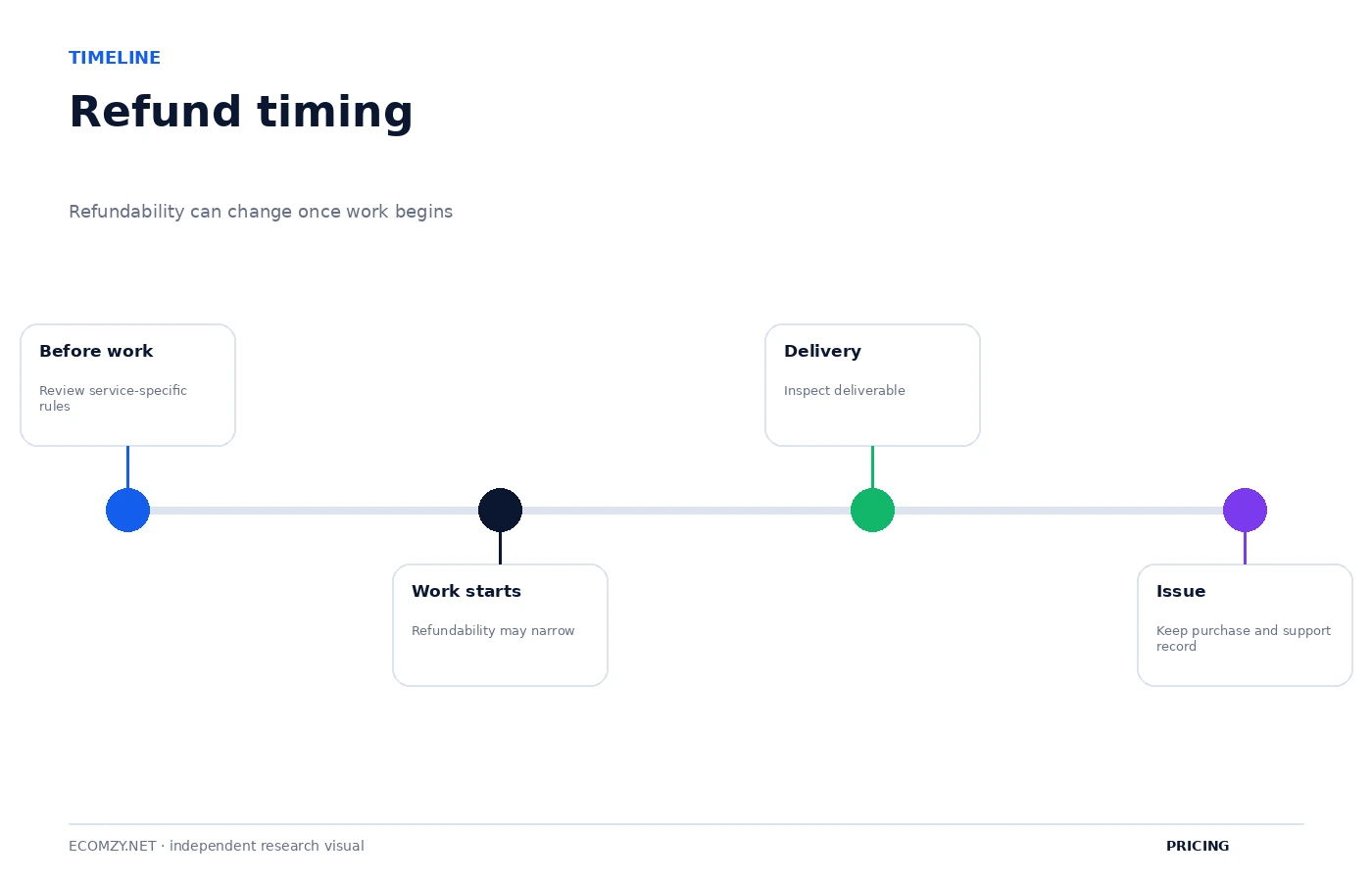
Why refund rules need to be checked service by service
The general Dashboard Services section describes a 30-day refund framework: a full refund within seven days, then 30% retained for requests between days 8 and 30, with additional fees non-refundable.
However, multiple named services contain stricter provisions. Some become non-refundable as soon as work begins, access is provisioned, or materials are opened/downloaded.
That means the safest hierarchy is:
- read the specific service section;
- then read the general Dashboard refund section;
- confirm the checkout terms before paying.
Why this matters for comparing Ecomzy with another platform
Many platform comparisons treat optional service ecosystems as though they were “apps” or “features.” Economically, that can hide a large difference.
A $399 content service is not the same type of cost as a $39 monthly subscription. A $5,990 high-ticket product package is not a normal recurring platform fee. A $99 external content service is not equivalent to an order-processing fee.
Separating service purchases by category prevents one-time spend from distorting the apparent monthly platform cost.
The add-on catalog is easier to understand by service category
The current Terms list optional services across many sections. Reading them in document order makes the catalog feel fragmented, so a more useful structure is to group services by the problem they are intended to solve.
Catalog expansion: services that add or package products, such as Product Catalog Upgrade and High-Ticket Products.
Content and visibility: services such as Content Visibility, External Content Distribution, Premium Long-Form Editorial Blog Article and Press Release Writing & Third-Party Distribution.
Social and brand promotion: Social Media Packages, Brand Awareness and Multi-Channel Content Placement.
Store tooling: Promo Tools Bundle, themes and other Dashboard-delivered functionality.
Operational services: Order Processing Service and related Credits.
This grouping matters because the buying logic is different in each category. A catalog expansion is a store-content purchase. A social package is a marketing asset package. Order Processing is an operating workflow. Treating them all as “marketing add-ons” hides those differences.
The documented optional-service price range is unusually wide
Within the current Terms, explicitly priced services range from small purchases such as a $29 Product Catalog Upgrade to multi-thousand-dollar High-Ticket Products packages. That creates a very broad discretionary-spend range around the same $39 Basic PRO subscription.
For budgeting, it is useful to separate optional services into three internal bands:
- Low-ticket: under $100;
- Mid-ticket: $100–$999;
- High-ticket: $1,000 and above.
This is an Ecomzy.net classification, not an official Ecomzy label. Its purpose is to make approval rules easier. A business can require a more detailed ROI case or management approval for high-ticket purchases while allowing small operational add-ons under a simpler process.
Price is only one dimension — delivery time affects cash efficiency
Many optional services also publish estimated delivery periods. A $399 service delivered in roughly a week and a $399 software bundle installed in one or two business days tie up the same cash amount for different periods before the user receives the complete deliverable.
For cash-flow analysis, record:
- purchase date;
- estimated delivery window;
- actual delivery date;
- date the service became non-refundable;
- date the deliverable could first be used.
This produces a simple “cash-to-usable-deliverable” interval. It can be more informative than price alone when comparing two services intended to solve the same problem.
Revision fees create a second price after delivery begins
Several service sections publish paid revision fees. Content Visibility currently lists domain-change revision fees of $30, $85 and $120 depending on package level. Brand Awareness lists $35, $90 and $105. Other services have their own smaller revision charges.
These amounts are easy to ignore because they are not part of the initial package price. But they make incomplete preparation more expensive. If a domain, brand name or campaign direction is likely to change, the user should finalize those inputs before fulfillment starts.
A useful internal metric is avoidable revision cost: any post-purchase fee caused by information that could have been finalized before ordering.
Effective service price after standard Dashboard fees
If an eligible Dashboard purchase is subject to both the standard 8% Processing Fee and 15% Service Fee, the effective cash outflow can be modeled as 1.23 × the base service price before any international adjustment or tax.
| Base service price | 8% component | 15% component | Illustrative total |
|---|---|---|---|
| $99 | $7.92 | $14.85 | $121.77 |
| $149 | $11.92 | $22.35 | $183.27 |
| $399 | $31.92 | $59.85 | $490.77 |
| $699 | $55.92 | $104.85 | $859.77 |
| $999 | $79.92 | $149.85 | $1,228.77 |
These are illustrations only. The Terms say applicable fees are shown at checkout, so the actual checkout total should replace the modeled figure whenever it is available.
Buying several services in one month can dominate platform cost
Consider a month in which a Basic PRO subscriber buys a $399 Content Visibility package and a $149 Social Media Package. The base service prices alone total $548, more than fourteen times the $39 monthly PRO subscription.
If both purchases were subject to the standard Dashboard percentage stack, the illustrative fee components would add another $126.04, producing $674.04 in service-related outflow before the $39 subscription and any other activity.
This example demonstrates why optional services should be budgeted in a separate discretionary-spend category. The subscription price may remain stable while total monthly cash outflow changes dramatically.
Watch for functional overlap between service purchases
Several services address adjacent goals such as visibility, content, social promotion and brand awareness. That creates the possibility of buying overlapping deliverables in the same period.
Before purchasing a second service, ask:
- What deliverable from the first service is still active or unused?
- Does the second service reach a genuinely different channel?
- Is the new service a recurring need or a one-time experiment?
- Can the result be measured separately enough to learn from it?
- Will the second service duplicate content, placement or tooling already purchased?
This is not an argument against using multiple services. It is a way to prevent overlapping spend from making attribution impossible.
Clarify what the user receives at the end of the service
Different services deliver different kinds of outputs: published content, files, Dashboard access, installed functionality, product imports or managed operational work. Those outputs have different levels of portability.
For each purchase, record whether the deliverable is:
- a downloadable asset;
- a publication on a third-party platform;
- functionality available only while the Ecomzy subscription remains active;
- an installed component on the store;
- a managed service with no separate asset to retain.
This helps evaluate long-term value. Two services with the same price can have very different residual value after the service period ends.
Use a refund hierarchy instead of one global assumption
The current Terms contain a general Dashboard refund framework, but individual services often define stricter conditions. A safe reading order is:
- read the named service’s cancellation and refund section;
- identify the event that makes it non-refundable;
- then read the general Dashboard refund rules;
- confirm any non-refundable fee line items at checkout;
- save written cancellation confirmation if a refund is requested.
This avoids the common mistake of assuming “30-day refund” applies unchanged to every service.
Create an optional-service portfolio, not a list of purchases
A business using several Ecomzy add-ons should track them as a portfolio. A simple table can contain:
- service name;
- purchase price;
- fees paid;
- purchase and delivery date;
- business objective;
- deliverable received;
- measurable outcome;
- refund/revision deadline;
- whether the service would be purchased again.
After several months, that portfolio makes it possible to identify which optional services repeatedly create value and which were one-off experiments. That is far more useful than evaluating the catalog from descriptions alone.
Set a discretionary service-spend cap
Because add-ons can range into hundreds or thousands of dollars, a user can define a monthly or quarterly cap for discretionary Ecomzy service purchases. The cap should exclude required subscriptions and unavoidable order-processing costs.
The purpose is not to restrict growth. It prevents several attractive one-time offers from collectively exceeding the amount the business intended to risk during the period.
What cannot be determined from the public Terms alone
The Terms provide prices and descriptions for many services, but they do not provide account-specific conversion rates, profitability, or a universal expected return on each package. Third-party placement services explicitly disclaim guaranteed reach, engagement and downstream traffic.
Therefore a public analysis can compare price, scope, timing and refundability, but it cannot responsibly assign a universal ROI. That information must come from the user’s own post-purchase results.
Prioritize services by evidence, not by package size
A larger package is not automatically more appropriate because it includes more deliverables. Before moving from a smaller service to a higher package, define the metric the purchase is supposed to change. That might be catalog breadth, publication count, social assets delivered, production speed or another measurable output.
After delivery, compare the expected output with the actual deliverable and the total checkout cost. If a smaller package already satisfies the operational need, buying the higher package only because it appears more comprehensive can increase spend without creating additional usable value.
Derive cost per deliverable where the package makes that possible
Some packages publish quantities. For example, the Product Catalog Upgrade lists 100, 200 and 1,000-product options at $29, $49 and $99. That allows a simple derived cost per imported product:
| Package | Price | Quantity | Derived base price per product |
|---|---|---|---|
| 100 products | $29 | 100 | $0.29 |
| 200 products | $49 | 200 | $0.245 |
| 1,000 products | $99 | 1,000 | $0.099 |
This does not include applicable checkout fees and does not mean individual products can be purchased at those unit prices. It simply shows how the published package economics change with scale.
Keep a decision log for high-ticket purchases
For any optional purchase above a chosen threshold, record why it was bought, which alternative was rejected, the expected deliverable, the refund cutoff and the maximum acceptable total checkout amount. A short decision log makes it much easier to evaluate the purchase later without rewriting the original reasoning in hindsight.
This is especially useful for four-figure packages, where the one-time purchase can exceed many months of base subscription fees.
Treat the checkout as the final price checkpoint
Because service prices, platform fees and international adjustments can change, the final pre-purchase checkpoint should always be the Dashboard checkout. Save the displayed base price, each fee line and the authorized total. That turns a public price guide into a planning reference while keeping the actual transaction record authoritative for the individual account.
FAQ
Are Ecomzy marketing services included in $39/month?
Not all of them. The Terms list numerous separately priced marketing and promotional services.
What is the cheapest documented add-on in this index?
The Product Catalog Upgrade currently starts at $29 for 100 products. Other small named services can exist elsewhere in the Terms.
What is the most expensive documented package in this index?
The High-Ticket Products Platinum package is currently listed at $5,990.
Do Dashboard fees apply to every optional service?
The Terms say Ecomzy may apply platform-related service fees to Dashboard purchases and that applicable fees are shown before checkout. Verify the specific purchase rather than assuming one rule for every service.
Primary source
Research checked September 29, 2026. Service catalog and pricing can change.
Join the discussion
Share a question, correction or useful experience related to this article. First-time comments may be held for moderation.