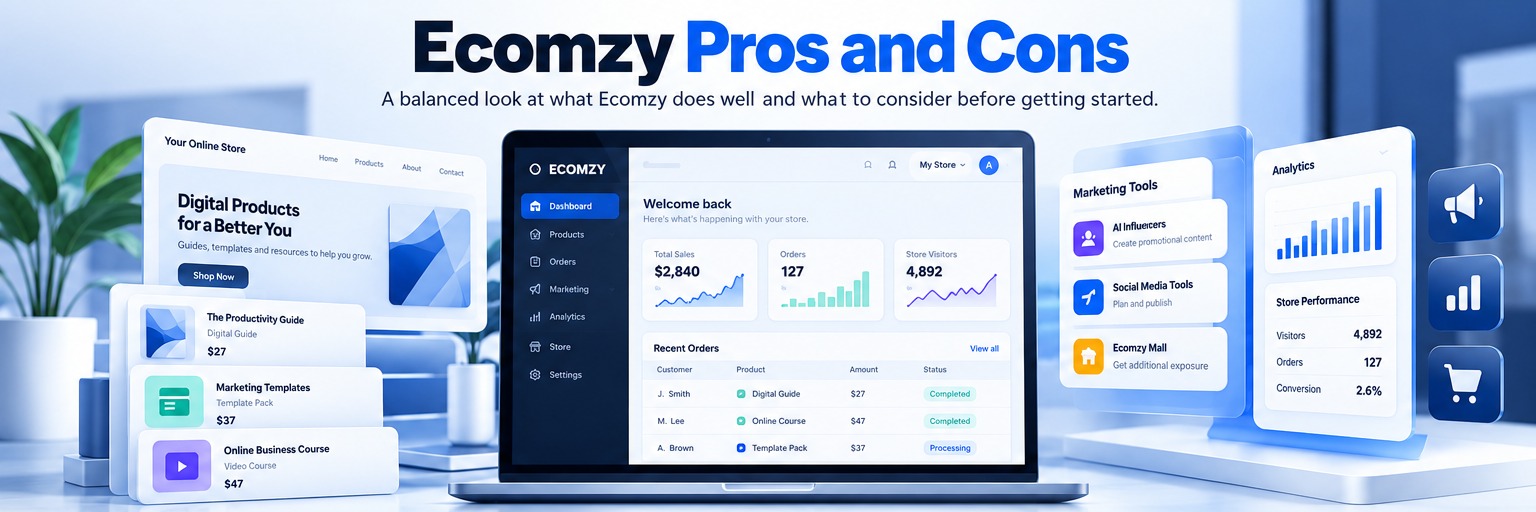
Ecomzy’s strengths and limitations come from the same design decision: it bundles a large part of the ecommerce stack into one managed environment. That can remove setup work and reduce the number of external tools a beginner has to assemble, but it also means the operator depends more heavily on Ecomzy’s platform rules, subscription structure and available services.
This article is a synthesis page. It does not duplicate our detailed pricing, support, trial or Terms guides; instead, it explains the practical trade-offs those pages reveal.
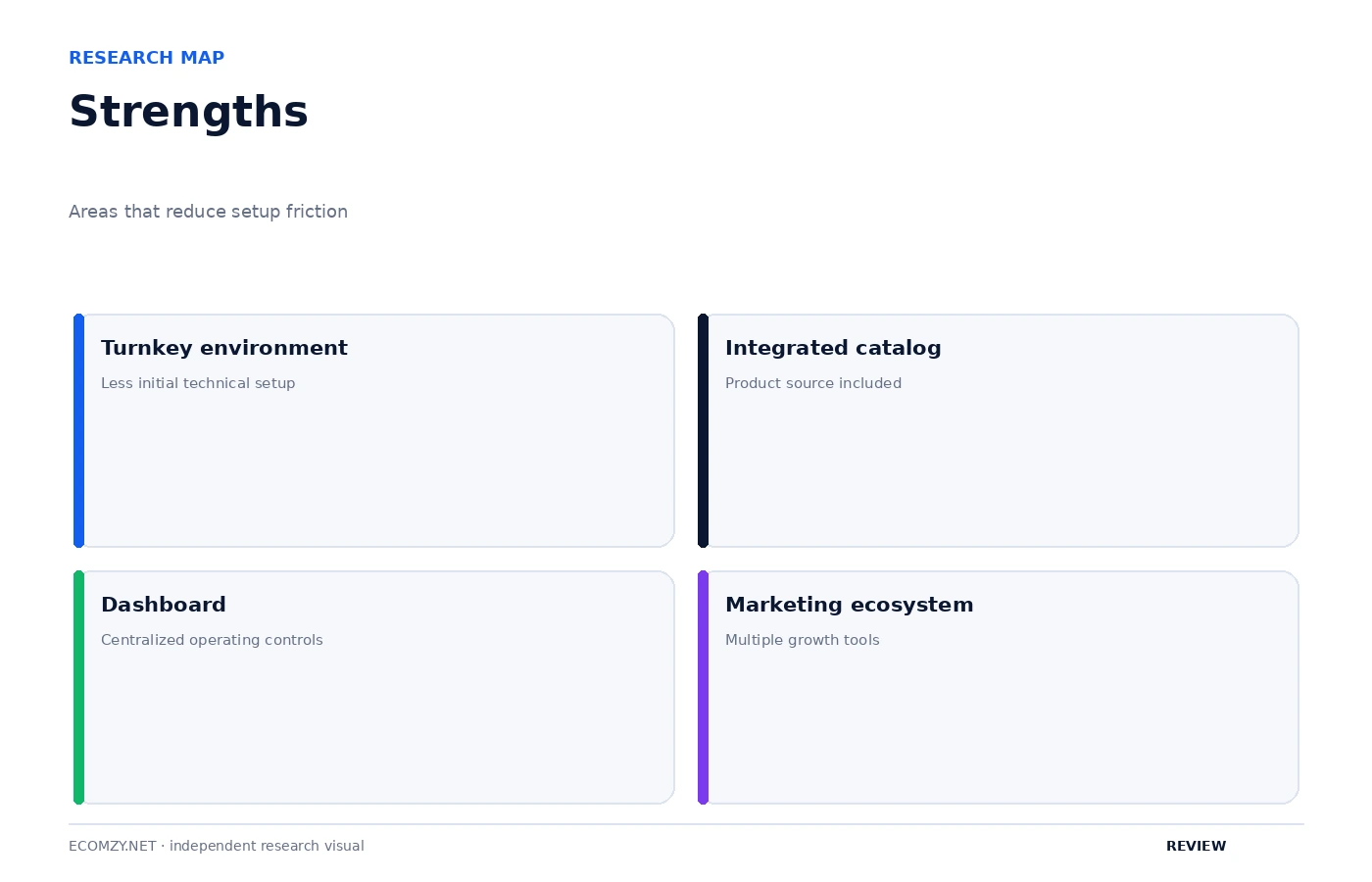
Strength: much of the technical stack is already assembled
Ecomzy’s current offer combines a prepared online store, hosting, domain support, SSL, built-in payments, Dashboard access and analytics.
For someone who does not want to build a WordPress ecommerce stack manually, that can remove a large amount of initial configuration work.
The advantage is not that these technologies are impossible to assemble independently. It is that the user does not have to coordinate them one by one before getting a functioning store environment.
Strength: digital products are part of the ecosystem
Current Ecomzy pages strongly emphasize a catalog of digital products. That can be useful for a user who wants to operate a store without first creating a full product library.
Digital delivery also removes conventional shipping and inventory work from the current consumer-facing model.
The trade-off is that product selection and product rights remain tied to the platform’s catalog structure and policies rather than being entirely independent.
Strength: owner tools are centralized
The Ecomzy Dashboard, account controls, analytics and access to additional services sit inside the same broader system.
Centralization can make daily operation easier because the owner has fewer disconnected systems to manage.
It also gives Ecomzy a single place to expose plan changes, Performance Tier tools and optional services.
Strength: payment functionality is pre-integrated
The current pricing FAQ says Ecomzy’s own payment system is installed and activated by default. That removes another common setup task from the owner.
For beginners, fewer integrations can mean fewer technical failure points during launch.
Strength: marketing tools are part of the broader product direction
Ecomzy now markets AI influencers, promotional tools, Ecomzy Mall exposure and other growth services as part of its ecosystem.
The advantage is convenience: users do not necessarily have to begin by building a separate marketing stack from scratch.
However, availability and cost vary by tool, tier and service. The existence of built-in marketing does not mean every marketing feature is included in the base subscription.
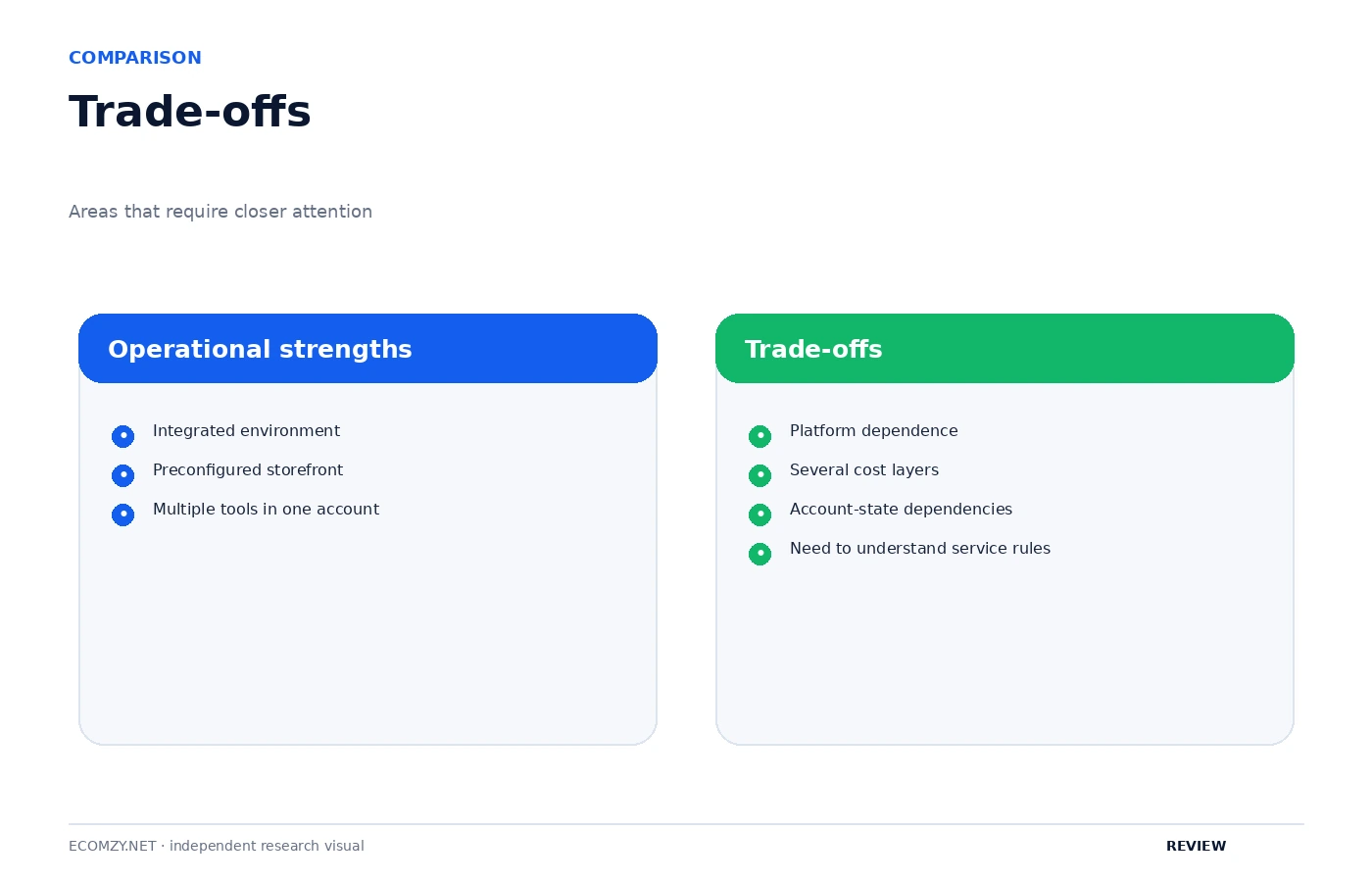
Trade-off: less infrastructure independence
A managed platform simplifies setup partly because the platform provider controls more of the underlying environment.
Ecomzy’s Terms describe the turnkey store as a WordPress site with the Ecomzy platform plugin and hosting service. Cancellation of the core subscription also affects the store and feature access.
Users who prioritize portability, self-hosting and complete software independence may therefore view the same integration that helps beginners as a limitation.
Trade-off: the commercial structure has several layers
The public pricing page emphasizes a $39/month offer, while the Terms also describe Advanced and Ultimate PRO plans, separate weekly Performance Tiers, additional Dashboard services and platform service fees on certain transactions.
That does not make the service inherently expensive or inexpensive. It means the total cost depends on which layers the user activates.
Anyone evaluating Ecomzy should therefore look beyond the headline subscription price.
Trade-off: documentation requires careful reading
Ecomzy’s current consumer-facing pages emphasize digital products, no conventional inventory and rapid setup. The Terms contain broader language about catalogs, fulfillment, plans, services and account conditions.
Users should read both the marketing pages and the Terms rather than assuming one short description captures the entire platform relationship.
Trade-off: built-in marketing still requires business judgment
Marketing tools can reduce setup friction, but they do not remove the need to make decisions.
The owner still has to choose what to promote, decide which paid tools or services are worth using, interpret analytics and determine whether the resulting economics make sense.
A tool being integrated does not guarantee traffic, conversions or profit.
Trade-off: optional services can have separate refund conditions
The Terms contain many service-specific rules. Some additional services become non-refundable once work begins or access/materials are provided.
That makes it important to evaluate each purchase independently rather than assuming the main subscription refund policy applies everywhere.
Who may value this model most?
Ecomzy’s architecture is most naturally aligned with users who value:
- a prepared store instead of a blank build;
- digital products supplied through the platform;
- integrated payments and analytics;
- a centralized Dashboard;
- built-in access to marketing tools and services;
- support and guidance inside the same ecosystem.
These are structural preferences, not a guarantee that the platform is the right choice for a particular person.
Who may want more control than Ecomzy is designed to provide?
Users who strongly prefer to own and configure every layer themselves may find a managed ecosystem restrictive.
That includes people who want independent hosting, unrestricted software choice, complete product ownership outside a platform catalog or a business model built around custom integrations that Ecomzy does not expose.
Balanced summary
Ecomzy’s strongest characteristic is integration. The store, products, payments, Dashboard, analytics, support and marketing layer are designed to feel like parts of one system.
The main limitation is also integration: the more of the business environment that comes from one platform, the more important that platform’s rules, pricing structure, documentation and long-term fit become.
That is why the most useful way to evaluate Ecomzy is not to ask whether “all-in-one” is automatically good or bad. The question is whether the convenience of a managed stack is worth the corresponding reduction in independence for the way the user wants to operate.
FAQ
What is the biggest advantage of Ecomzy?
The clearest structural advantage is that much of the ecommerce stack is already assembled: store infrastructure, payments, product access, Dashboard tools and other services are brought into one environment.
What is the biggest limitation?
The trade-off is dependence on Ecomzy’s infrastructure, subscription rules, available features and policies instead of controlling every layer independently.
Does Ecomzy include marketing?
Marketing tools are a major part of the current platform direction, but exact availability can depend on the plan, Performance Tier or separate service.
Is the $39/month price the entire cost?
Not necessarily. The Terms describe additional plan levels, Performance Tiers, services and certain platform fees. Total cost depends on what the user activates and purchases.
Sources
Public materials checked September 28, 2026.
Join the discussion
Share a question, correction or useful experience related to this article. First-time comments may be held for moderation.