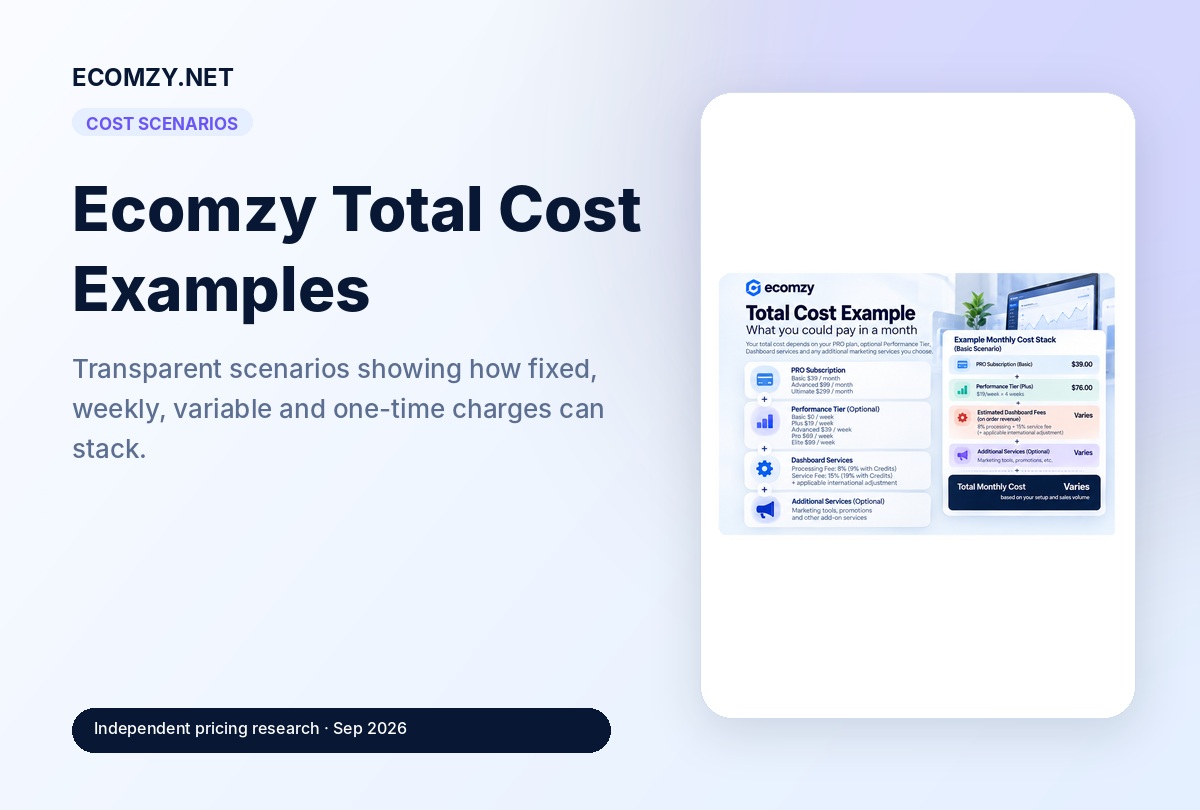
There is no honest single “monthly Ecomzy cost” because the platform combines monthly, weekly, variable and one-time charges. The only defensible way to estimate total cost is to define a scenario and then include only the layers that scenario actually uses.
This article builds transparent examples from the current published rates. It does not predict revenue or profitability.
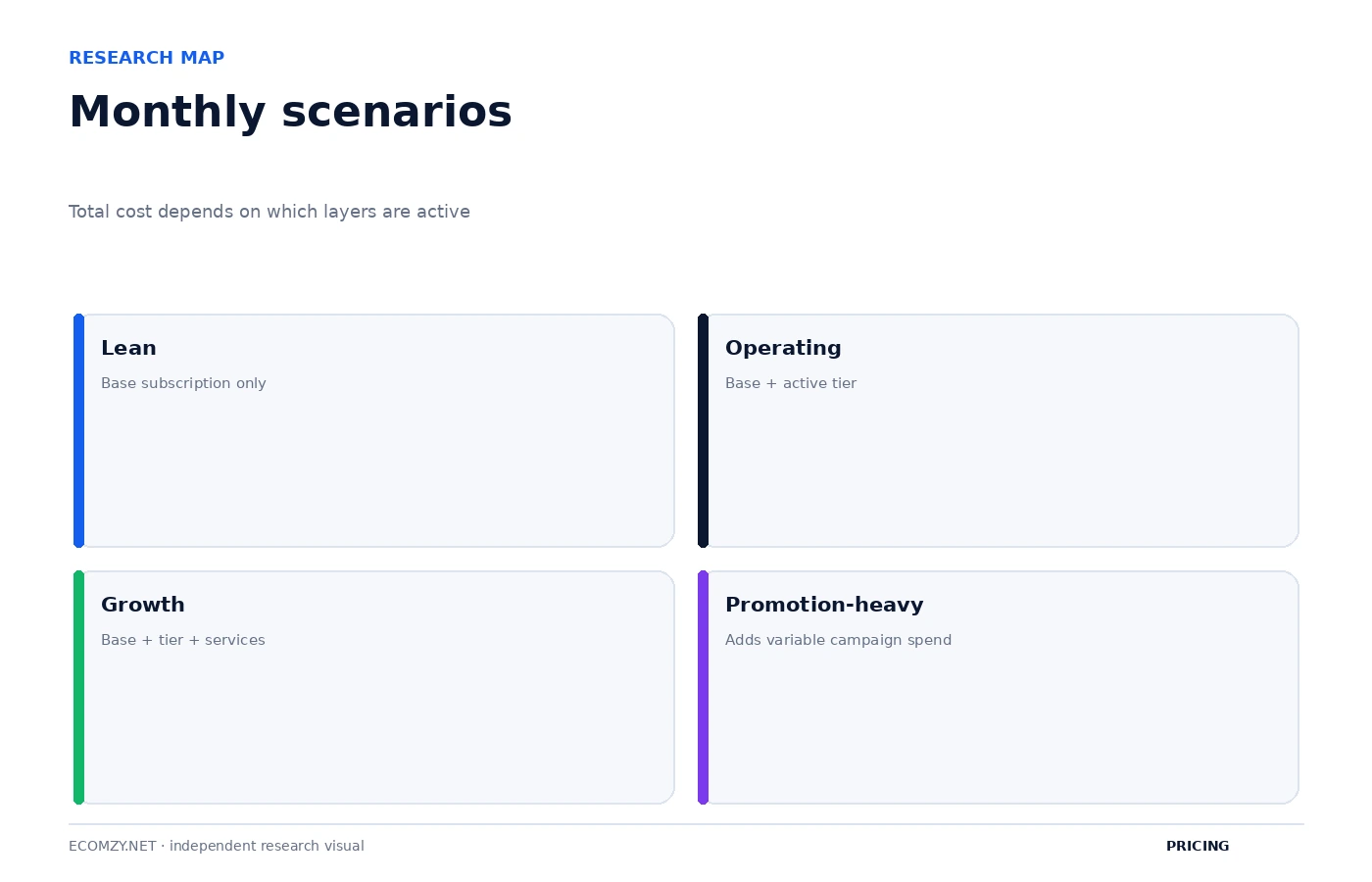
Our scenario method
Each example separates four questions:
- What fixed subscription is active?
- Is there a paid weekly Performance Tier?
- Were any optional services purchased?
- Do variable fees apply to the purchase or order workflow?
We deliberately keep taxes, bank charges and unknown international adjustments outside the model unless a rate is explicitly known.
Scenario A: one Basic store, no paid tier
The simplest scenario is one Basic PRO subscription and the free Basic Performance Tier.
This is the closest scenario to the public headline price. It does not assume additional service purchases, Ads Credits or fee-bearing order activity.
Scenario B: Basic PRO + Plus Performance Tier
Plus costs $19/week. In a simple four-week window:
Across a full year, however, the weekly tier produces 52 charges:
The difference between $115 and $121.33 is not a price change. It is the difference between a four-week estimate and a 52-week annualized average.
Scenario C: Basic PRO + Advanced Performance Tier
Advanced costs $39/week. Four-week view:
Annualized monthly average:
This example shows why quoting only the weekly tier can understate the recurring cash requirement when a user thinks in calendar months.
Scenario D: Basic + Plus + one $399 Dashboard service
Assume the user is on Basic PRO, uses Plus for a four-week window, and purchases a $399 service through a checkout where both standard Dashboard percentages apply: 8% Processing Fee and 15% Service Fee.
| Basic PRO | $39.00 |
|---|---|
| Plus for 4 weeks | $76.00 |
| Service price | $399.00 |
| 8% processing component | $31.92 |
| 15% service component | $59.85 |
| Illustrative total | $605.77 |
This is an illustration, not a universal Ecomzy invoice. It assumes both standard Dashboard fees apply to that $399 purchase and excludes any international adjustment, taxes, order fees or bank/FX costs.
Scenario E: first 30 days of Promotion Service milestone budgets
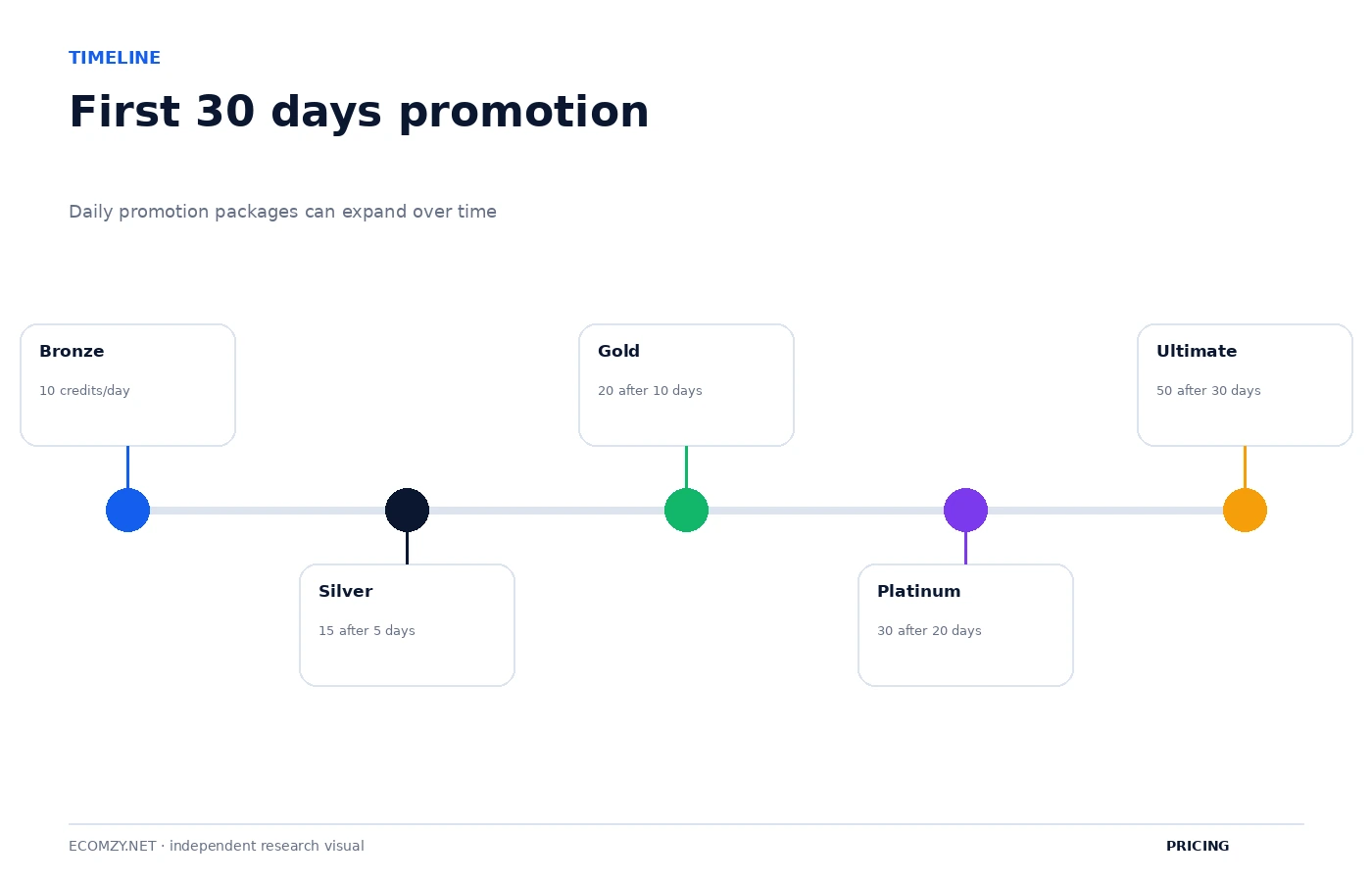
The current Terms describe Ads Credits budget milestones that unlock as the Promotion Service remains active:
- Days 1–5: 10 Ads Credits/day;
- Days 6–10: 15/day;
- Days 11–20: 20/day;
- Days 21–30: 30/day;
- after 30 days: 50/day becomes available.
If the service runs continuously and steps up exactly on those milestones, the first 30 days reference:
| Period | Daily reference | Period credits |
|---|---|---|
| Days 1–5 | 10 | 50 |
| Days 6–10 | 15 | 75 |
| Days 11–20 | 20 | 200 |
| Days 21–30 | 30 | 300 |
| Total | 625 |
At the published 28% Promotion Service fee, the fee component on a $625 reference purchase total is $175. If that fee is added on top of the credit amount, the promotion-related cash requirement would be $800 before the PRO subscription. The actual Dashboard checkout is authoritative.
Why we do not publish a fake “average user pays $X” number
Without account-level data, any universal average would mix unlike users:
- one-store and multi-store accounts;
- free and paid Performance Tiers;
- accounts buying no optional services and accounts buying $999+ packages;
- different order volumes and fee paths;
- different Promotion Service budgets.
A scenario model is more honest because every assumption is visible and editable.
What to include in your own cost sheet
For a monthly operating-cost model, use separate rows for:
- PRO subscription;
- Performance Tier charges during the period;
- optional service purchases;
- Dashboard fees shown at checkout;
- applicable order fees;
- Ads Credits and Promotion Service fee;
- taxes;
- bank/FX charges;
- any external tools not supplied by Ecomzy.
Do not bury one-time service purchases inside recurring subscription cost. Keep them separate so the budget remains interpretable.
Scenario F: two Basic stores with different Performance Tiers
Multi-store accounts need separate subscription and tier assumptions. Suppose Store A uses Basic PRO plus a Plus Tier, while Store B uses Basic PRO plus an Advanced Tier.
The monthly PRO layer is $78 for the two stores. In a four-week window, Plus contributes $76 and Advanced contributes $156. The four-week recurring total is therefore:
Using 52-week annualized averages instead, the combined tier average is about $251.33 per month, so the average recurring total becomes approximately $329.33/month before services and variable fees.
This example shows why one account with several stores can have multiple recurring cost profiles at the same time.
Scenario G: Basic PRO + Elite for one year
An Elite Tier at $99/week produces $5,148 over 52 weeks. Add twelve months of Basic PRO at $468 and the recurring annual baseline becomes $5,616.
That is equivalent to an average of $468/month before optional services, promotion spend, order-related fees, taxes or external charges.
This calculation is useful because the $99 weekly number can look modest next to a monthly SaaS plan while producing a much larger annual commitment than the $39 base subscription.
Scenario H: one $999 service in a heavy month
Suppose a Basic PRO subscriber remains on the free Performance Tier but purchases a $999 service. If the checkout applies the standard 8% Processing Fee and 15% Service Fee, the illustrative components are:
| Basic PRO | $39.00 |
|---|---|
| Service price | $999.00 |
| 8% Processing Fee | $79.92 |
| 15% Service Fee | $149.85 |
| Illustrative month total | $1,267.77 |
The next month could drop back near the recurring subscription baseline if no new service is purchased. This is why one-time services should be separated from recurring monthly run rate.
Scenario I: Plus Tier and a $149 service
A smaller optional purchase can still materially change the monthly picture. In a four-week month:
- Basic PRO: $39;
- Plus Tier: $76;
- service: $149;
- illustrative 8% fee: $11.92;
- illustrative 15% fee: $22.35.
The combined amount is $298.27 before other charges. Of that total, only $115 is the recurring subscription-plus-tier layer for the four-week window. The rest comes from the discretionary service purchase and modeled checkout fees.
A five-week month stress test
Because weekly tiers can renew five times in a calendar month, a stress test should include that possibility.
| Tier | 5 weekly charges | + Basic PRO |
|---|---|---|
| Plus | $95 | $134 |
| Advanced | $195 | $234 |
| Pro | $345 | $384 |
| Elite | $495 | $534 |
These amounts still exclude every other cost layer. They simply show the highest recurring subscription cash requirement that can arise in a calendar month because of the weekly billing cadence.
What happens after day 30 of Promotion Service?
The milestone schedule says the Ultimate Package reference of 50 Ads Credits/day unlocks after 30 continuous days of service delivery. If a user then remains at that reference budget for another 30 days, those days would represent 1,500 Ads Credits before the 28% Promotion Service fee.
At a 28% fee, the fee component on 1,500 credits is $420. If the fee is added to the credit purchase amount, that 30-day promotion-related cash requirement would be $1,920 before subscriptions.
This is derived arithmetic based on the published daily reference and fee rate. Actual account settings, pauses, eligibility and checkout behavior can change the realized amount.
A 90-day reference model
A simple 90-day reference model can be built from the published milestone ladder:
- first 30 days: 625 Ads Credits under the stepped schedule;
- next 60 days at the 50/day reference: 3,000 Ads Credits;
- 90-day reference total: 3,625 Ads Credits.
At a 28% fee, the fee component on 3,625 is $1,015. If paid on top of the credit amount, the combined promotion reference becomes $4,640 across 90 days, excluding subscriptions and any other account costs.
This is exactly why promotion spend should not be collapsed into a monthly platform-price claim. It is a separate operating budget that can become much larger than the subscription layer.
A normalized scenario table
| Scenario | Recurring platform layer | Optional/variable layer | Illustrative period total |
|---|---|---|---|
| Base only | $39/month | None assumed | $39 |
| Basic + Plus, 4 weeks | $115 | None assumed | $115 |
| Basic + Advanced, 4 weeks | $195 | None assumed | $195 |
| Plus + $149 service | $115 | $183.27 modeled service + fees | $298.27 |
| Plus + $399 service | $115 | $490.77 modeled service + fees | $605.77 |
| Base + $999 service | $39 | $1,228.77 modeled service + fees | $1,267.77 |
The value of this table is not the exact totals; it is the separation between recurring and episodic costs.
Why we do not subtract hypothetical revenue
A cost article should not turn into an earnings forecast. Ecomzy’s Terms contain performance disclaimers and do not guarantee revenue, profitability or customer acquisition outcomes.
Therefore these scenarios stop at cash outflow. A reader can later combine the cost model with real revenue and gross-margin data from the account, but inserting assumed revenue would make the analysis look more precise while actually making it less reliable.
A break-even template using real account data
Once a store has real sales data, the owner can calculate a break-even order count:
For example, if fixed recurring Ecomzy costs are $208/month and the store’s real contribution margin after all variable costs is $16 per completed order, the arithmetic break-even point is 13 orders after rounding up.
The $16 contribution margin in this example is hypothetical. The method is what matters: use actual account economics rather than a generic margin assumption.
A simple reserve rule for variable-fee accounts
Users with variable order fees or active promotion can maintain a reserve instead of budgeting only to the expected case. One approach is to hold enough cash for:
- next PRO renewal;
- next five weekly tier renewals;
- one planned service purchase;
- upper-bound expected order fees for the next batch of orders;
- one week of promotion at the current daily reference.
This is not an Ecomzy requirement. It is a conservative cash-management framework designed around the platform’s mixed billing cadence.
Reconcile modeled cost with actual cost
At month end, compare each modeled line with the real statement. Mark the variance as one of:
- timing difference;
- tier change;
- service purchase;
- fee-rate difference;
- tax or international adjustment;
- bank/FX charge;
- unplanned promotion spend;
- other.
After several months, the model becomes account-specific. At that point it is more valuable than any public “average Ecomzy monthly cost” estimate.
What these scenarios intentionally do not claim
The examples do not claim that a particular fee will apply to every service, that an account will remain on a specific tier, or that Promotion Service will generate a specific business result. They show how the published rates behave mathematically under stated assumptions.
That distinction is important. Good cost research should make assumptions visible enough that a reader can replace them with their own account values.
Scenario J: five Basic stores with no paid tiers
Five Basic Turnkey Stores create five separate $39 subscriptions under the current per-store rule. The recurring PRO layer is therefore $195/month or $2,340 across twelve paid months.
This scenario is useful because it shows that a user can have a high recurring platform bill without using any paid Performance Tier at all. Store count and tier level are independent cost drivers.
Scenario K: five stores plus one Plus Tier each
If all five Basic stores also use Plus at $19/week, the tier layer is $95/week. Over 52 weeks that equals $4,940. Add $2,340 in Basic PRO subscriptions and the combined recurring annual baseline becomes $7,280, or about $606.67 per month on average.
The calculation excludes optional services and all variable fees. Its purpose is to demonstrate how multi-store scaling and weekly tiers compound rather than replace one another.
Scenario L: a promotional month and a service purchase
Consider one Basic store using a Plus Tier for four weeks, purchasing a $399 service and purchasing $625 in Ads Credits during a 30-day Promotion Service reference period.
Using the earlier assumptions:
- Basic PRO: $39;
- Plus for four weeks: $76;
- $399 service plus illustrative 8% and 15% standard Dashboard fees: $490.77;
- 625 Ads Credits: $625;
- 28% Promotion Service fee on 625 credits: $175.
The combined illustrative cash requirement is $1,405.77 before taxes, international adjustments, order-related fees or bank charges.
This is not a forecast of what a typical user pays. It is a stress-test example showing how several legitimate cost layers can occur in the same period.
Why a public “average monthly cost” would still be misleading
Even if several user bills were available, a simple arithmetic average could be distorted by occasional large service purchases. A more useful dataset would report at least the median recurring cost, the distribution of optional-service spend and the frequency of paid tier usage.
Without that dataset, scenario analysis remains the more transparent method because every input is visible.
Build your own scenario in six lines
- Enter monthly PRO subscriptions for every active store.
- Enter the exact number of weekly tier renewals in the period.
- Add optional service base prices.
- Add only the checkout fees actually shown for those services.
- Add promotion credits and the related service fee if used.
- Add order-related fees from actual order records.
The result is the account’s actual Ecomzy operating cost for the period. Keeping every input on a separate line also makes the calculation auditable.
Do not confuse a heavy month with the recurring run rate
If a month contains a $999 one-time service, the total cash outflow can exceed $1,000 while the recurring run rate remains only the PRO subscription plus any active weekly tier. Conversely, a month with no one-time purchases can look inexpensive even though a high weekly tier creates a substantial annual commitment.
Management reporting should therefore show both numbers: cash spent this month and current recurring run rate.
Date every scenario
Every scenario should carry a date because plan prices, service prices and fee schedules can change. A dated model remains useful as a historical record even after the public terms are updated, while an undated model can silently become misleading.
FAQ
What is a realistic minimum Ecomzy monthly cost?
For one Basic PRO store without a paid tier or other paid activity, the current fixed subscription layer is $39/month.
How much is Basic + Plus?
A four-week window is $115. Annualizing the $19/week tier across 52 weeks produces an average of about $121.33 per month including $39 Basic PRO.
How much can the first 30 days of Ads Credits represent?
Using the published milestone budgets continuously, the first 30 days reference 625 Ads Credits. The current Terms list a separate 28% Promotion Service fee on Ads Credits purchases.
Why not just add every Ecomzy fee?
Because different fees have different triggers. Only include a fee if the relevant checkout or order workflow actually applies it.
Primary source
Research checked September 29, 2026. All scenario totals are independent calculations from published rates and explicit assumptions.
Join the discussion
Share a question, correction or useful experience related to this article. First-time comments may be held for moderation.