
Ecomzy is easiest to understand when you stop treating it as a single website. Its current public offer combines a prepared online store, product access, an owner account and dashboard, payments and analytics, plus a marketing layer that Ecomzy increasingly presents as part of the same operating environment.
This article focuses on one narrow question: what Ecomzy actually is as a platform. It does not try to duplicate our pricing research, trial and billing coverage, support analysis, user reviews, comparisons or future pros-and-cons articles.
Ecomzy in plain English
Ecomzy is a managed ecommerce environment aimed at solopreneurs who want more of the initial business stack supplied for them instead of beginning with an empty storefront. On its current pricing page, Ecomzy describes the core offer as a turnkey online store with hosting, a domain, SSL, built-in payments, fraud protection, the Ecomzy Dashboard, analytics and priority support.
Its current consumer-facing pages also emphasize digital products and marketing tools. That combination is why describing Ecomzy simply as a “website builder” is incomplete. The website is the customer-facing layer, but the service being sold extends beyond the website itself.
Why Ecomzy is not just a blank-canvas store builder
Most conventional ecommerce software starts with infrastructure. You open an account, choose a theme, configure the storefront, connect a domain, decide what to sell, install or connect marketing tools, and then build the rest of the operating stack around those choices.
Ecomzy’s public positioning starts from a different place. The company says the store is prepared for the user and that the surrounding technical components are already configured. Its pricing materials currently describe a process in which the customer provides store preferences and Ecomzy prepares the site.
That changes the starting question. With a conventional store builder, the user asks, “What do I need to build?” With Ecomzy, the more useful question is, “What has already been assembled, and which parts of the resulting environment do I operate?”
The four operating layers
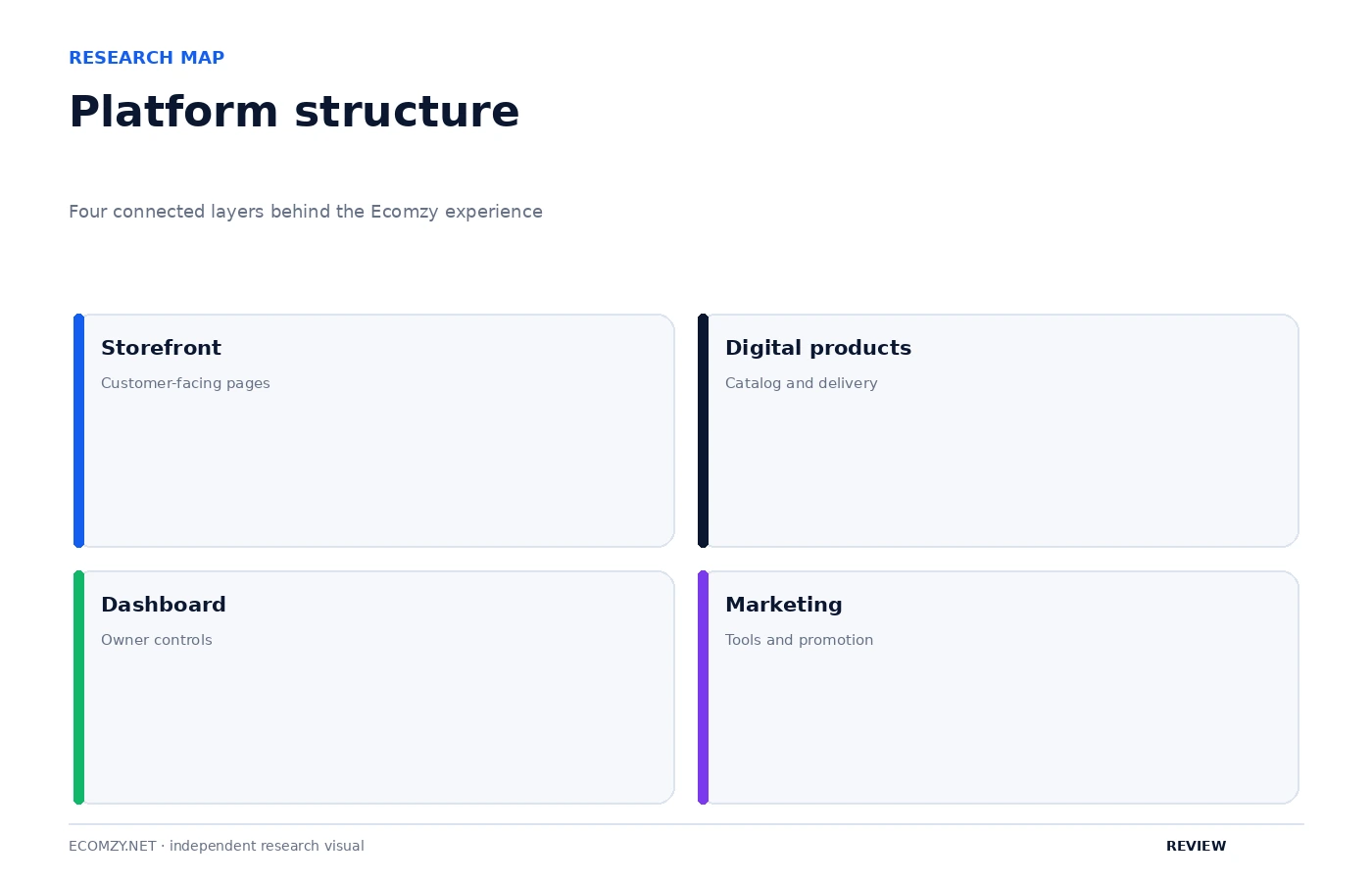
For research purposes, Ecomzy can be separated into four layers: the customer-facing storefront, the product layer, the owner-facing account and dashboard, and the marketing layer.
Separating them matters because different claims require different evidence. The fact that a dashboard exists is a platform-structure question. Whether the dashboard is easy to use is a usability question. Whether a marketing service produces profitable traffic is a performance question. They should not be treated as the same claim.
1. The storefront layer
The storefront is the part customers interact with. Ecomzy’s current pricing materials describe a turnkey online store with hosting, a domain, SSL and built-in payments. The company also says the store is delivered with the required software already installed.
The storefront therefore performs the conventional ecommerce job: it presents products, gives visitors a path to checkout and provides the public-facing brand surface. Structurally, however, it is only one part of the Ecomzy product.
Ecomzy’s Terms describe the turnkey store as a WordPress-based site running the Ecomzy platform plugin together with hosting supplied through the service. That helps explain why the model is more managed than a self-hosted WordPress project assembled independently by the merchant.
This overview does not judge storefront design quality or customization flexibility. Those are usability questions and should be examined separately.
2. The digital-product layer
Ecomzy’s current consumer-facing pages strongly emphasize digital products. Current public materials describe downloadable products and explicitly position the model around avoiding conventional physical inventory and shipping.
That changes the starting position of the operator. A conventional creator-commerce platform usually assumes the seller already owns or creates the product. Ecomzy’s current pitch is that product access is part of the environment being supplied.
This is an architectural distinction, not a claim about product quality, conversion rate or expected revenue. Those questions require different evidence.
For understanding the platform, the key point is that the catalog is not merely an unrelated add-on beside the store. It is presented as one of the inputs that helps make the store operable without the subscriber first building an entire digital-product library.
3. The account and dashboard layer
The Ecomzy Dashboard is the owner-facing side of the system. Ecomzy’s public pricing materials currently list the dashboard and analytics among the core components of the service, while the Terms describe the account as the place where customers manage platform-related activity and access additional services.
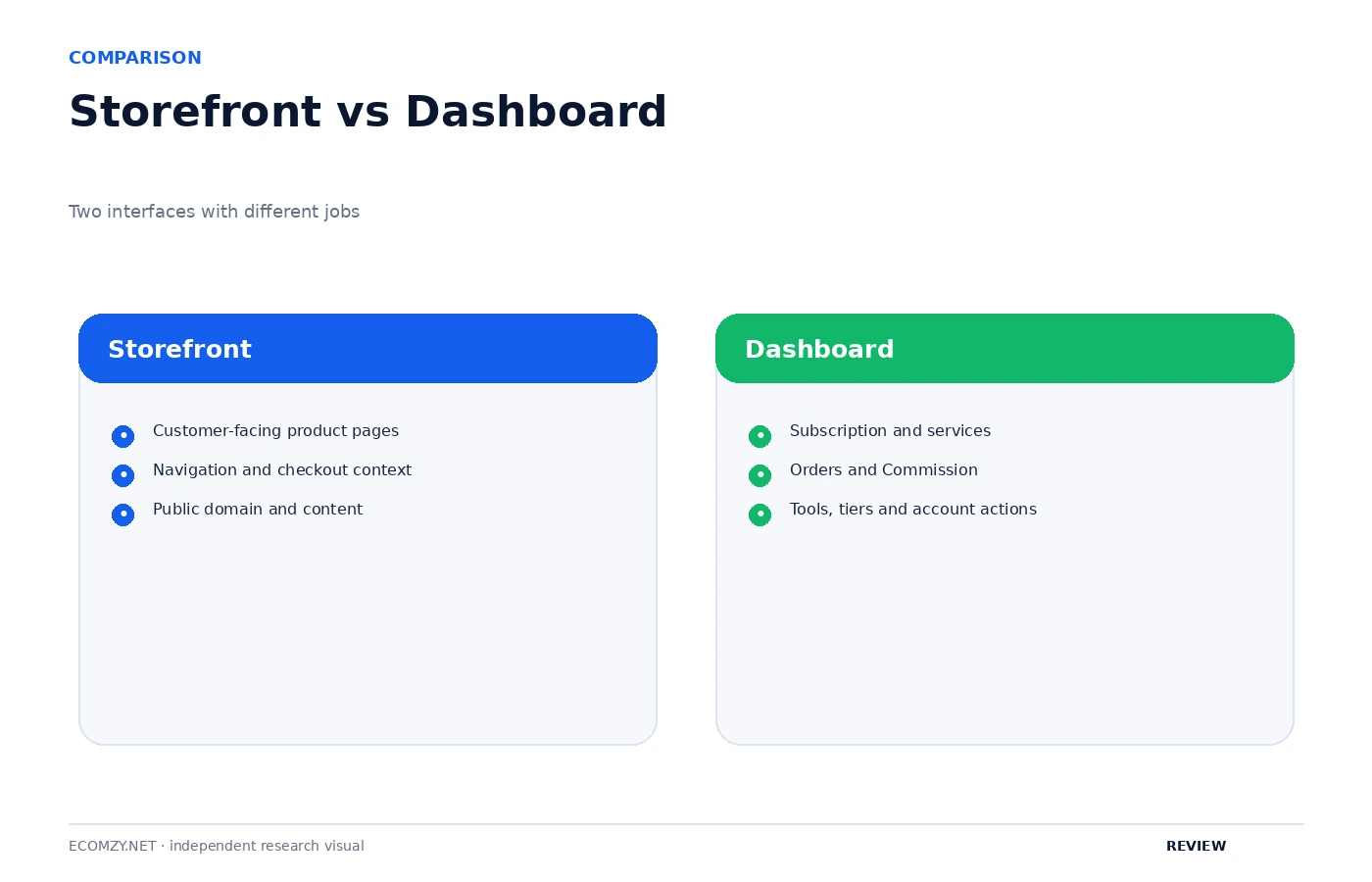
This creates two distinct experiences. The shopper primarily sees the store. The operator primarily sees the account environment behind it.
That distinction matters when evaluating screenshots or marketing material. A polished storefront tells you little about order management, account controls or dashboard usability. A dashboard screenshot, in turn, does not tell you what the customer checkout experience is like.
We therefore treat dashboard usability as a separate article rather than turning this platform definition into another all-purpose review.
4. The marketing layer
Marketing has become a prominent part of Ecomzy’s current public presentation. The company now promotes automated marketing tools and AI-influencer functionality alongside the store and product ecosystem.
From a platform-architecture perspective, the important point is not whether those tools perform well. The important point is that Ecomzy presents promotion as part of the same broader environment instead of assuming every operator will build an external marketing stack from separate vendors.
That places the marketing layer closer to the core operating environment than it would be on many conventional store builders.
Performance claims need a different standard of evidence from feature-existence claims, so this article deliberately stops there. A dedicated marketing-tools article should examine how those services work, what controls the user receives, what they cost and what evidence exists for the outcomes being advertised.
The storefront and owner environment solve different problems
The easiest mistake to make when first looking at Ecomzy is to evaluate the public store as if it represented the entire platform.
It does not.
The storefront exists to convert visitors into customers. The owner environment exists to help the operator manage the relationship with the platform and the business functions Ecomzy exposes. Those are different jobs with different interfaces.
This distinction also explains why a platform can feel simple at the storefront level while still having a more complex commercial structure behind the scenes. A user may receive a prepared store, but the account can still contain subscription settings, services, order information, promotional tools and other operational controls.
That is why “ready-made” should not be interpreted as “nothing to manage.”
What “managed” does — and does not — mean
Ecomzy removes or centralizes several setup tasks that a store owner would otherwise handle independently. The current public offer bundles infrastructure such as hosting, domain support, SSL, payments, analytics and the dashboard around the store.
That can reduce initial configuration work. It does not remove the operator from the business.
Someone still has to understand the account, choose how to use the available products and tools, monitor activity, make spending decisions and decide whether the economics make sense. A supplied technical stack changes the work required to start; it does not convert an ecommerce operation into a guaranteed or fully passive outcome.
This distinction is important because platform structure and business results are often blurred together in ecommerce marketing. A ready-made store is an observable product feature. Revenue, profitability and customer acquisition are outcomes influenced by many additional variables.
One platform, several connected surfaces
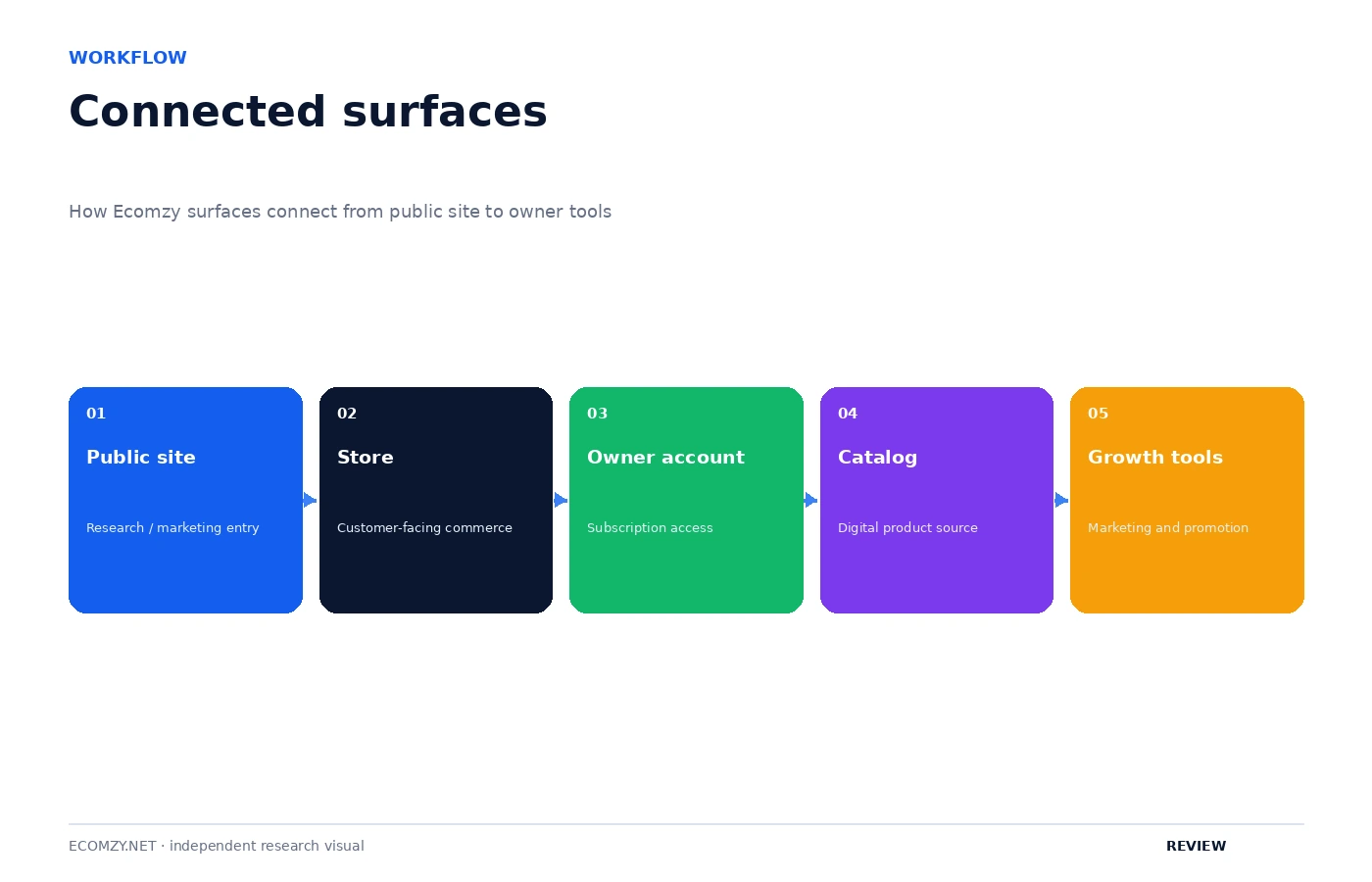
The public Ecomzy website explains and sells the service. The online store is the customer-facing commerce surface. The Ecomzy account and dashboard are the owner-facing operating surface. The product ecosystem supplies items that can be presented through the store. Marketing tools form another layer intended to support promotion and customer acquisition.
Seeing these as separate surfaces makes later research easier because each one can be tested against the right question:
- Storefront: What does the customer see and how is checkout handled?
- Products: What is available to sell and what rights or restrictions apply?
- Dashboard: What can the operator control and monitor?
- Marketing: Which promotional tools exist and how are they activated?
- Account: How are services, billing and other platform relationships managed?
Those questions belong to the same ecosystem, but they do not need to be answered in the same article.
Why Ecomzy’s documentation needs context
As of September 28, 2026, Ecomzy’s consumer-facing pages and its Terms do not always emphasize the same parts of the service.
The current public offer strongly emphasizes digital products, ready-made store infrastructure and a no-conventional-inventory positioning. The Terms are broader and describe additional service structures and contractual concepts that are not necessarily foregrounded on the marketing pages.
That does not need to be resolved inside a basic platform overview. It does mean readers should distinguish between the current marketing presentation and the broader contractual documentation.
For platform research, the consumer-facing pages tell us how Ecomzy is presently positioning the service. The Terms help identify contractual structure and boundaries that simplified marketing copy may not fully explain.
A dedicated Terms & Policies article should examine those differences in detail. Doing that here would turn a platform overview into a terms analysis and create unnecessary overlap with the rest of the Ecomzy.net library.
Who the platform is built around
Ecomzy repeatedly positions the service around the solopreneur: an individual operator who wants to launch or run an online business without assembling every technical component independently.
The architecture reflects that positioning. The store is prepared rather than started as an empty project. Product access is supplied. Core infrastructure is bundled. The dashboard centralizes owner-facing activity. Marketing tools are presented as part of the same broader environment.
That tells us who the product is designed around, but it does not tell us whether the product is a good fit for every solopreneur.
A user who values a supplied stack may see the integration as useful. A user who wants maximum control over infrastructure, product ownership, software selection and portability may evaluate the same architecture differently. That is a pros-and-cons question and should remain a separate article rather than a verdict hidden inside a definition page.
What this overview intentionally does not answer
A useful content library needs clear boundaries between pages. This article answers one question: What is Ecomzy as a platform?
It intentionally does not try to settle the following questions:
- How much does Ecomzy cost in total?
- How do Performance Tiers work?
- What happens after the free trial?
- How good is Ecomzy support?
- What are the platform’s strongest and weakest points?
- How easy is the dashboard to use?
- What do real Ecomzy users report?
- How does Ecomzy compare with other platforms?
Those are separate search intents and should remain separate pages. For pricing, continue to the Ecomzy Pricing section. For operational workflow, see How Ecomzy Works. First-hand submissions belong in Ecomzy User Reviews.
So, what is Ecomzy?
The most useful short description is that Ecomzy is a managed ecommerce platform that combines a prepared storefront, digital-product access, owner-facing account tools and a marketing layer inside one connected service.
The storefront is the visible piece, but it is not the whole product. The larger proposition is the environment around that store: infrastructure, product access, payments, analytics, account controls and promotional tools that would otherwise often be sourced from multiple systems.
That architecture is the foundation for every other Ecomzy question. Once the platform map is clear, pricing, usability, support, policies, marketing tools and user experiences can each be evaluated separately without turning one generic “review” into an article that tries to rank for everything at once.
FAQ
Is Ecomzy just a website builder?
No. A ready-made online store is one part of the current Ecomzy offer, but the platform also includes owner-facing account tools, product access, built-in payment infrastructure, analytics and marketing-related services.
Does Ecomzy currently focus on digital products?
Its current consumer-facing pages strongly emphasize digital products and a no-conventional-inventory model. Ecomzy’s broader Terms contain additional service language, which is why the marketing pages and contractual documentation should be read in context.
What is the difference between an Ecomzy store and the Ecomzy Dashboard?
The store is customer-facing: visitors browse products and complete checkout there. The account and Dashboard are owner-facing: they are used for operational and account-related activity exposed by the platform.
Does a ready-made Ecomzy store mean the business is passive?
No. “Ready-made” describes the amount of setup supplied by the platform. The operator still has to manage the account, understand the tools and costs, make business decisions and evaluate performance.
Sources
Public materials checked September 28, 2026. Features, positioning and terms can change.
Join the discussion
Share a question, correction or useful experience related to this article. First-time comments may be held for moderation.