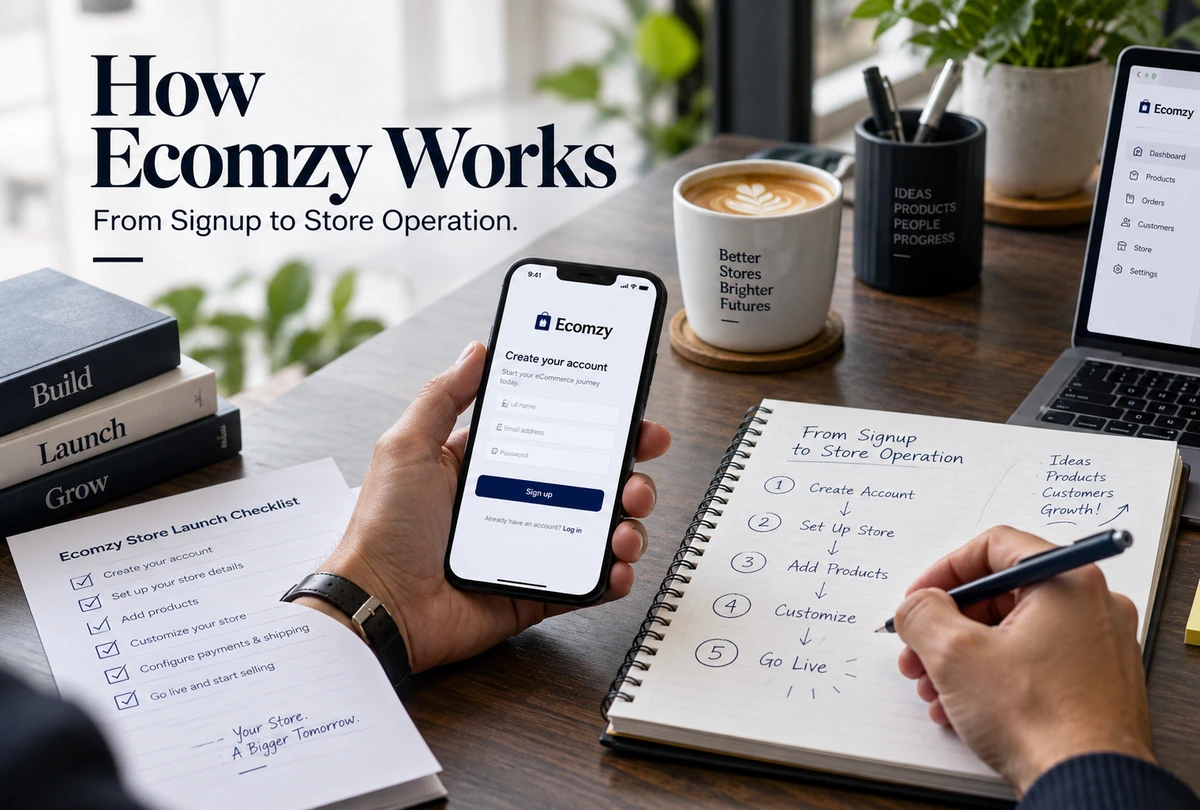
Ecomzy is easier to understand when it is treated as a sequence of operating layers rather than as one all-in-one promise. The public site describes a ready-made ecommerce setup with digital products, account access, a turnkey store, marketing support and an Ecomzy Dashboard. The Terms add the mechanics that matter after signup: what the subscription actually provides, what the catalog is, how an order moves into processing, how Commission changes status, when a redemption request can be made, and which tools sit behind separate Performance Tiers or paid services. This guide maps those pieces in the order a user encounters them. It is deliberately not a pricing article and it is not a verdict on whether Ecomzy is a good fit. The goal is narrower: to show what happens, which layer controls each action, and where a user should look when something in the workflow does not match expectations.
1. Start with the account, not the storefront
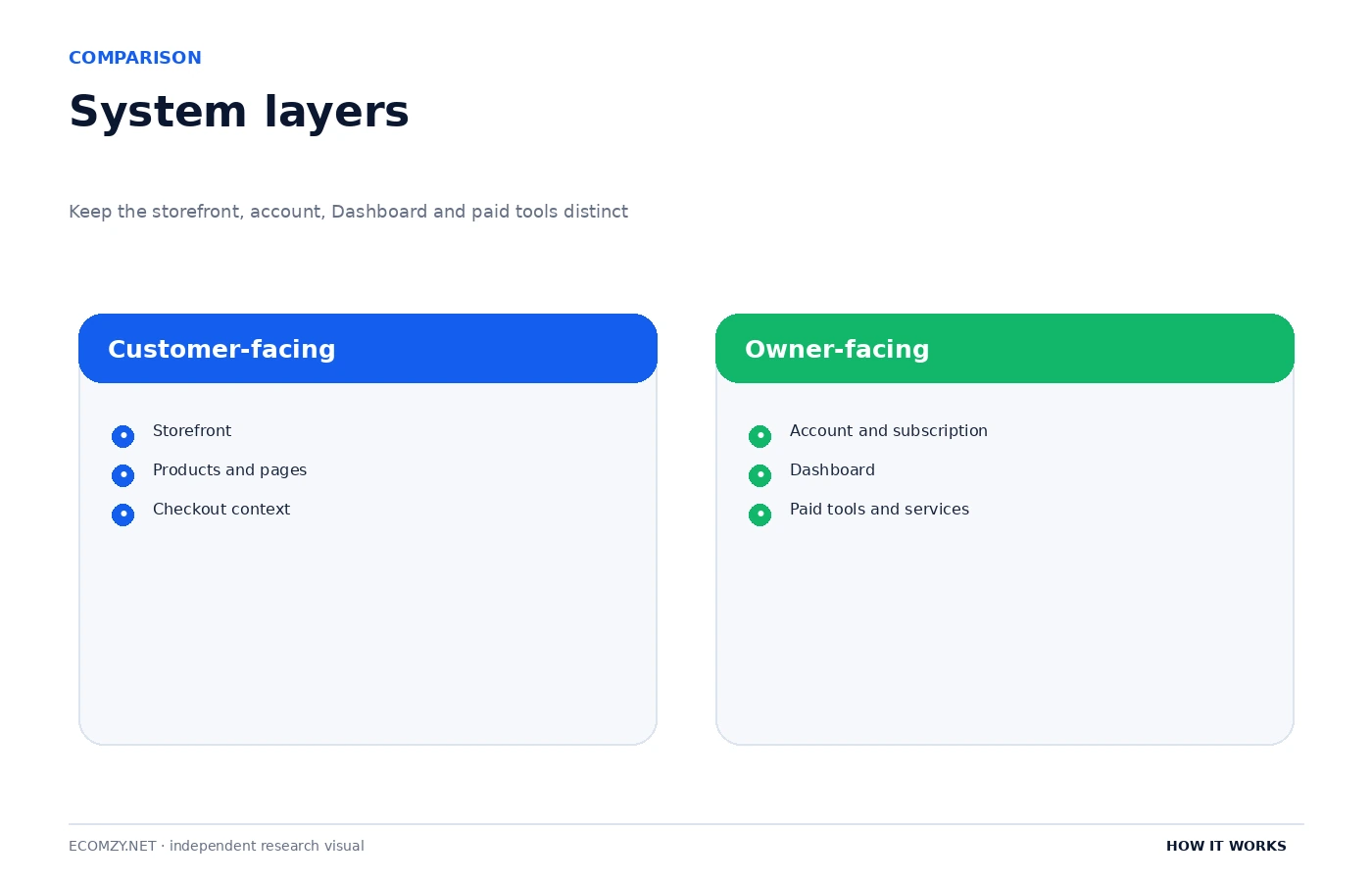
The first distinction is between the Ecomzy account and the customer-facing store. Ecomzy’s Terms describe the subscription as access to an Ecomzy account where a customer can manage the subscription and monitor orders, plus a free turnkey store built on WordPress with the Ecomzy platform plugin and hosting. That means there are at least two interfaces in play from the beginning. One is the account relationship with Ecomzy; the other is the storefront that shoppers see. Treating them as one screen leads to confusion later, especially when subscription status affects Dashboard access while the store has its own content, domain and product presentation.
The current public pricing material emphasizes a 14-day free trial and automatic billing after the trial. The Terms list PRO Basic, Advanced and Ultimate subscriptions and explain that the trial begins from the date the store access details are provided. For workflow purposes, the important point is that account status is not just billing metadata. It controls access to the Dashboard and, according to the Terms, Performance Tier features are suspended if the underlying PRO subscription is canceled, suspended or expired. A user evaluating how Ecomzy works should therefore think of the PRO subscription as the base access layer on which several other operating layers depend.
There is also a practical timing issue. Ecomzy marketing pages use very fast launch language, including a “live in 60 seconds” message, while the Fulfillment Policy says turnkey-store access credentials are delivered within one to two business days after successful payment and completion of the store setup survey. Those statements answer different kinds of questions, but they should not be blended into one promise. For planning, the policy wording is the safer operational expectation; the marketing language is better read as a description of reduced setup complexity rather than a guaranteed credential-delivery timer.
2. The turnkey store is a provisioned environment
The free turnkey store is not described as an empty website that the customer must build from scratch. The Terms say store creation includes a domain unless a premium or existing domain is selected in the survey, hosting, one branded email address, access to the Ecomzy Catalog, 50 random Ecomzy products uploaded by default, mailing-service setup and basic SEO metadata. The public Pricing page likewise says users do not need to install software or set up a payment gateway before they can start. Those details are important because “store setup” in Ecomzy is closer to provisioning and configuration than to a blank-site build.
That does not mean every launch decision disappears. A preconfigured storefront still has choices around the domain, product selection, presentation, policies, content and any paid services selected during setup. The Terms specifically warn that some additional services can be added while completing the survey and that those services are not part of the free trial; they can be charged immediately. From an operational perspective, the setup survey is therefore more than a cosmetic questionnaire. It can affect what is provisioned and what is billed.
The most useful mental model is to separate “platform work already done” from “store decisions still owned by the user.” Hosting and the base technical environment can be provisioned by Ecomzy. The user still needs to understand what was selected, what products are visible, what domain is attached, which payment model is active, and what optional services have been purchased. That distinction is why a turnkey store can be technically ready while still requiring business-level review before promotion begins.
3. Catalog access turns the store into an assortment, not a promise of demand
The Terms give the subscription access to thousands of products in the Ecomzy Catalog that are available for import, and the current public site positions the catalog around digital products. The starter store includes a default set of products, but the catalog layer is where the assortment can be changed or expanded. This matters because the catalog is an input into the store, not a guarantee that every available product should be published or that any particular item will perform.
A clean workflow is to treat catalog work as a sequence: inspect the available product, decide whether it fits the store, import it, review how the listing appears, and then decide whether the product should remain part of the live assortment. That is different from simply importing as many products as the subscription limit allows. The PRO plans use product-cap limits, but a capacity ceiling is not a merchandising strategy. Product relevance, presentation and store coherence still matter even when the technical import process is easy.
This is also the point where an independent review should avoid claiming ownership rights that the public documents do not establish. Catalog access is a subscription capability. It should not be described as a permanent transfer of the entire catalog or as a guarantee that any item will remain available indefinitely. The safest description is the one Ecomzy itself uses: the subscription provides access to the catalog and products are available for import.
4. Orders create the first operational handoff
Once a customer order appears, the workflow becomes more procedural. Ecomzy’s Terms connect order processing with internal fulfillment and with the Commission lifecycle. Pending Commission includes Commission associated with unprocessed orders. When the associated order is processed, the Commission moves into the Incoming state for verification. That makes processing a meaningful state transition rather than a purely administrative click.
The Terms also describe an optional Order Processing Service. It is intended to accelerate internal fulfillment and can include priority queue handling, faster verification and accelerated workflow execution. The service is initiated through Order Processing Credits, which the Terms explicitly define as prepaid non-cash service units. They are not a wallet, are not withdrawable and are non-refundable. This distinction is critical because a screen showing “credits” can look financial even when the contract defines those units as prepaid access to a service.
Timing can also affect cost. The current Terms list a Late Processing Charge when fulfillment is delayed because order processing was not confirmed within three days, and they state that additional operational steps can include using account Commission to cover processing fees if an order remains unprocessed within seven days. A user does not need to memorize every percentage to understand the workflow, but they do need to know that processing is time-sensitive and that ignoring an order is not operationally neutral. The detailed fee schedule belongs in the Pricing Hub; the process rule belongs here.
5. Commission is a status system before it is a redemption request
Ecomzy’s current Terms are unusually explicit about the nature of Commission. They define it as an internal non-cash promotional incentive funded by Ecomzy rather than customer money, sales revenue, stored value, escrow or a deposit account. That definition changes how the Dashboard should be read. A Commission number is not the same thing as cash sitting in a customer wallet waiting to be withdrawn.
The Terms divide Commission into Pending, Incoming and Available states. Pending is associated with unprocessed orders. After processing, Commission moves to Incoming and remains there for up to 72 hours while Ecomzy verifies activity, completion, attribution and policy compliance. After that verification period, qualifying Commission can be reclassified as Available. Even Available Commission is still subject to eligibility and approval before a payout becomes payable.
For redemption, the subscription must be active and fully paid at the standard plan rate, all orders associated with the Partner Storefront must be fully processed, and the minimum request threshold must be reached. The current Terms state a $100 minimum for U.S. residents and $300 for residents of other countries. Requests are initiated through the Dashboard using the Redeem Commission option. The exact transfer fees and methods are best handled separately in a pricing or payout-cost article because those numbers can change independently of the state logic.
6. The Dashboard is the operating control plane
The Terms describe the Ecomzy Dashboard as the personal account area where business information, purchased services, product packages and tools are surfaced. It is also where the user can access premium services such as promotional services, product packages, marketing tools, paid domains, themes and the Order Processing Service. This makes the Dashboard the control plane for the relationship with Ecomzy rather than simply a reporting screen.
Several important actions converge there. Plan upgrades can be initiated from the account’s Plans tab. Commission redemption begins in the Dashboard. Paid services can be purchased through one-click payments, with fees disclosed at checkout. Performance Tier changes and applicable pricing can also be displayed there. If the PRO subscription is canceled, the Terms say Dashboard access is disabled. In other words, the Dashboard is both an operational interface and an access-controlled service environment.
That structure is why screenshots of a Dashboard should not be interpreted without context. A card might represent a status, a prepaid service unit, a promotional incentive, a paid service or a subscription feature. The label and the governing Terms determine which one it is. A useful workflow article always asks what kind of object the screen is showing before explaining what the user can do with it.
7. Performance Tiers and promotion sit above the core workflow
Ecomzy Performance Tiers are supplementary subscriptions that sit on top of the active PRO plan. The current Terms list Basic, Plus, Advanced, Pro and Elite tiers with different order capacities and expanding tool access. Depending on tier, tools can include email marketing, Google backlinks, social media marketing, SEO blog posts, design customization, YouTube marketing, promotional videos, Instagram and TikTok ad tools, store tools and theme access. Tier access can therefore change what a user can do around the core store without changing the underlying PRO subscription itself.
The Terms also state that Performance Tiers have a separate billing cycle and that an upgrade can occur automatically based on usage, including enabled tools or order volume thresholds. A downgrade request is subject to review if current activity or enabled tools would be incompatible with the lower tier. This is a workflow rule because tool activation can affect the operating tier even when the user has not changed the base PRO plan.
The Promotion Service is another layer and should not be collapsed into Performance Tiers. Ads Credits are described as prepaid service credits used to activate Ecomzy’s Promotion Service, and the Terms set separate financial rules for that service. The public paid-ads page describes automated promotion across major platforms, while the Terms emphasize that results are not guaranteed. A user tracing “how Ecomzy works” should therefore separate access to marketing tools from paying Ecomzy to deliver a promotional service.
8. The simplest end-to-end model
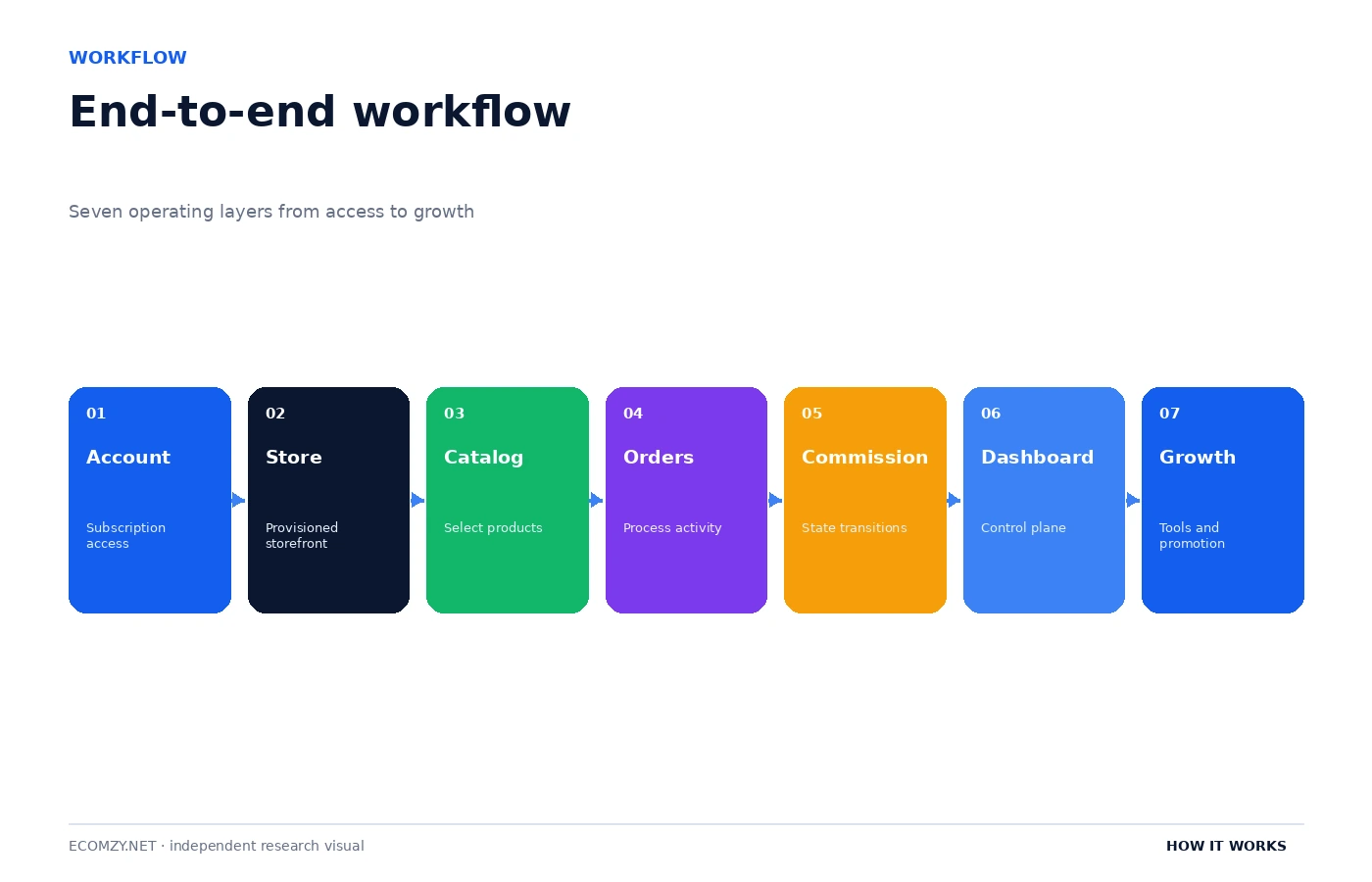
If all the terminology is reduced to one operating sequence, the platform can be read as follows: obtain account and store access; review the provisioned storefront; select or adjust the product assortment; monitor incoming orders; process orders under the applicable workflow; watch Commission move through its documented states; use the Dashboard to manage services and requests; and add marketing or Performance Tier tools only when they are needed. Each step has different rules, and moving a concept into the wrong layer is where most misunderstandings begin.
The practical advantage of this model is diagnostic. If a product is missing, look at the catalog or store layer. If an order is waiting, look at processing status and the relevant service. If Commission has not become Available, inspect the order state and verification window. If a payout cannot be requested, check subscription status, processing completion, threshold and verification requirements. If a marketing tool is inaccessible, check the active Performance Tier and the underlying PRO subscription. The workflow becomes easier to troubleshoot when the user knows which system owns the next action.
That is also the reason this research hub is split into separate articles. The complete map is useful for orientation, but each operating layer has enough detail to deserve its own analysis. The linked guides below go deeper into setup, catalog use, order processing, Commission, Dashboard controls and marketing tools without turning the overview into a 10,000-word catch-all page.
9. How to read Ecomzy documentation without mixing layers
Ecomzy’s public materials serve different purposes. The homepage and service pages explain the product in marketing language. The Terms define contractual relationships, state machines and fees. The Fulfillment Policy explains service delivery. The Dashboard shows account-specific configuration. When those sources appear to conflict, the right response is not to erase one of them. Identify the question each source is answering. A marketing page can truthfully describe a fast start while a policy page gives a longer credential-delivery window; the user needs both facts to understand what “launch” means.
The same method applies to performance claims. A marketing page can show example metrics or describe intended benefits. The Terms separately state that Ecomzy does not guarantee revenue, profitability, advertising performance or customer acquisition. A workflow guide should record both layers: what a service is designed to do and what the contract does not promise. This keeps the article useful without turning it into either marketing copy or reflexive criticism.
10. Why this model matters for troubleshooting
Most support problems can be mapped to a dependency. A store issue depends on provisioning or storefront configuration. An order issue depends on processing. A Commission issue depends on the order and verification state. A redemption issue depends on Commission plus subscription and compliance. A marketing-tool issue depends on Performance Tier plus PRO status. Thinking in dependencies turns a vague platform complaint into a specific state question that support can answer.
For every paid action, capture the final checkout disclosure. For every state-based action, capture the timestamp. For every account-level change, note the prior plan or tier. These records make later support conversations more precise because they show which stage changed and when. Finally, re-check the current Terms before acting on an old tutorial. Ecomzy’s documents allow plans, features and service scope to change, while the dependency model remains useful even when individual labels move.
Frequently asked questions
Is Ecomzy a store builder or a managed ecommerce platform?
The public documents describe a managed setup rather than a blank-site builder. The subscription includes an Ecomzy account plus a turnkey WordPress store with the Ecomzy plugin, hosting and catalog access. Users still make store-level decisions, but much of the base technical environment is provisioned.
Does the 14-day trial mean every Ecomzy service is free for 14 days?
No. The trial applies to the base subscription described by Ecomzy. The Terms say optional paid services selected during the setup survey are not part of the trial and can be charged immediately.
Does an Available Commission amount equal cash in an account?
Not under Ecomzy’s current Terms. Available Commission is still defined as an Ecomzy-funded promotional incentive and becomes payable only after a valid payout request is approved and eligibility conditions are satisfied.
Are Performance Tiers the same as PRO plans?
No. Performance Tiers are described as supplementary service-access subscriptions that require an active PRO subscription. They have their own billing cycle, order limits and tool access.
Where should I verify a rule before acting on it?
Use the current Ecomzy Terms, the relevant policy page and the Ecomzy Dashboard. Marketing pages are useful for understanding how the company presents the product, but operational decisions should be checked against the current governing terms and on-screen disclosures.
Where to go next
- How Ecomzy Store Setup Works
- How the Ecomzy Product Catalog Works
- How Ecomzy Orders and Order Processing Work
- How Ecomzy Commission, Redemption and Payout Requests Work
- How the Ecomzy Dashboard Works
- How Ecomzy Marketing Tools and Performance Tiers Work
- Ecomzy Pricing Hub
- Ecomzy Review Hub
Official sources reviewed
This article was checked against Ecomzy’s public documentation on September 30, 2026. Where marketing copy and policy language describe the same topic differently, the distinction is stated instead of silently choosing one version.
Join the discussion
Share a question, correction or useful experience related to this article. First-time comments may be held for moderation.